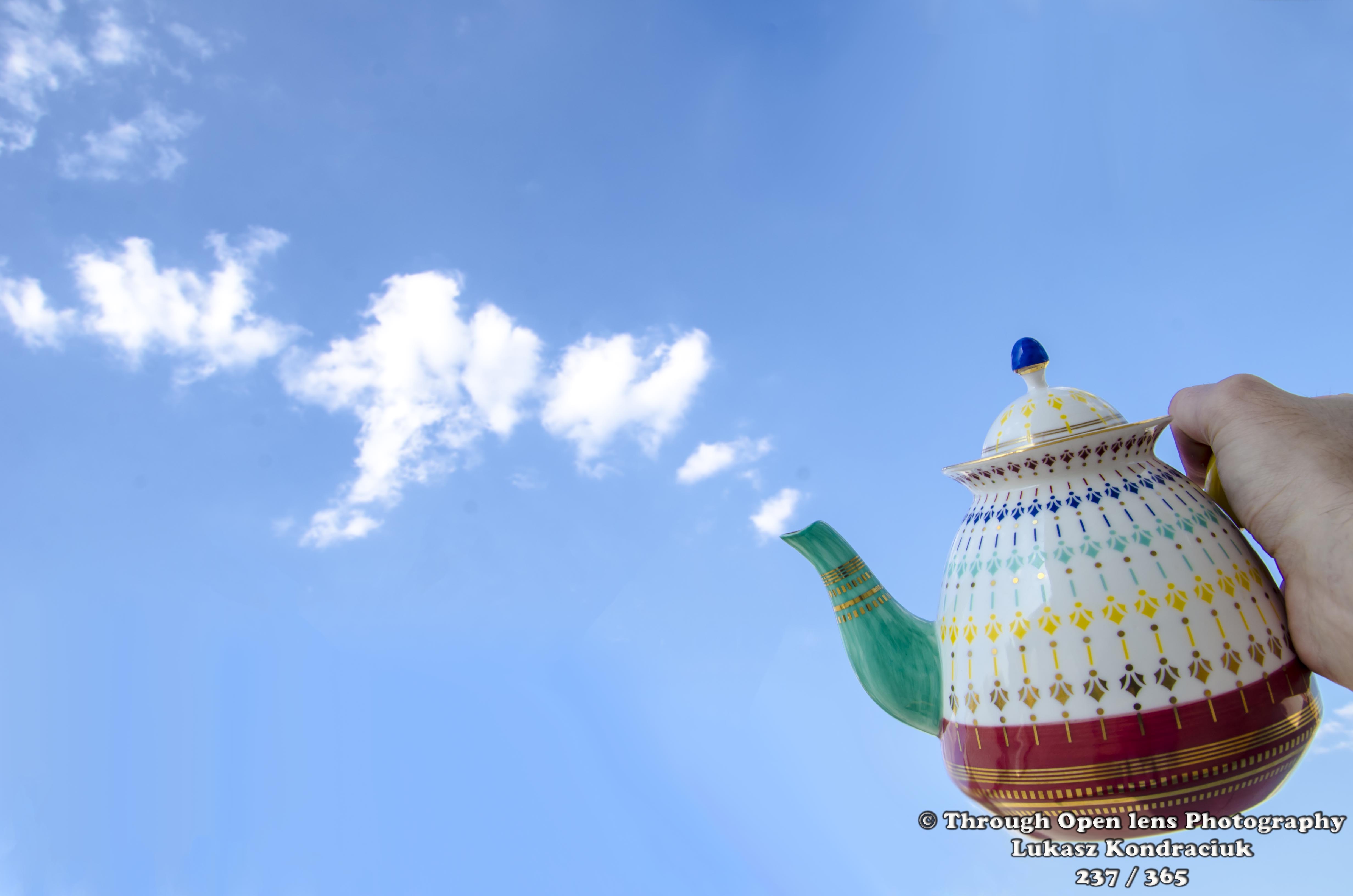
Tea Is Ready!

tea time

F/16.0, 1/50, ISO 100.

Day 237 / 365

What Starts With “T” What Ends With “T” & It Is Full Of “T”?

Teapot.

Interesting Fact: From the end of the 17th century tea was shipped from China to Europe as part of the export of exotic spices and luxury goods. The ships that brought the tea also carried porcelain teapots. The majority of these teapots were painted in blue and white underglaze. Porcelain being completely vitrified will withstand sea water without damage, so the teapots were packed below deck whilst the tea stayed on top in the dry. ( https://en.wikipedia.org/wiki/Teapot )

You Are The Mint To My Mojito!

Mojito

F/4.8, 1/60, ISO 100.

Mojito

Day 234 / 365

When life hands you lemons, find someone with tequila and salt!

Interesting Fact: Havana is the birthplace of the Mojito, although the exact origin of this classic cocktail is the subject of debate. One story traces the Mojito to a similar 16th century drink known as “El Draque”, after Francis Drake.[4] In 1586, after his successful raid at Cartagena de Indias Drake’s ships sailed towards Havana but there was an epidemic of dysentery and scurvy on board. It was known that the local South American Indians had remedies for various tropical illnesses; so a small boarding party went ashore on Cuba and came back with ingredients for a medicine which was effective. The ingredients were aguardiente de caña (a crude form of rum, translates as fire water from sugar cane) added with local tropical ingredients; lime, sugarcane juice and mint.[8] Drinking lime juice in itself would have been a great help in staving off scurvy and dysentery.[9] Tafia/Rum was used as soon as it became widely available to the British (ca. 1650). Mint, lime and sugar were also helpful in hiding the harsh taste of this spirit. While this drink was not called a Mojito at this time, it was still the original combination of these ingredients. ( https://en.wikipedia.org/wiki/Mojito )

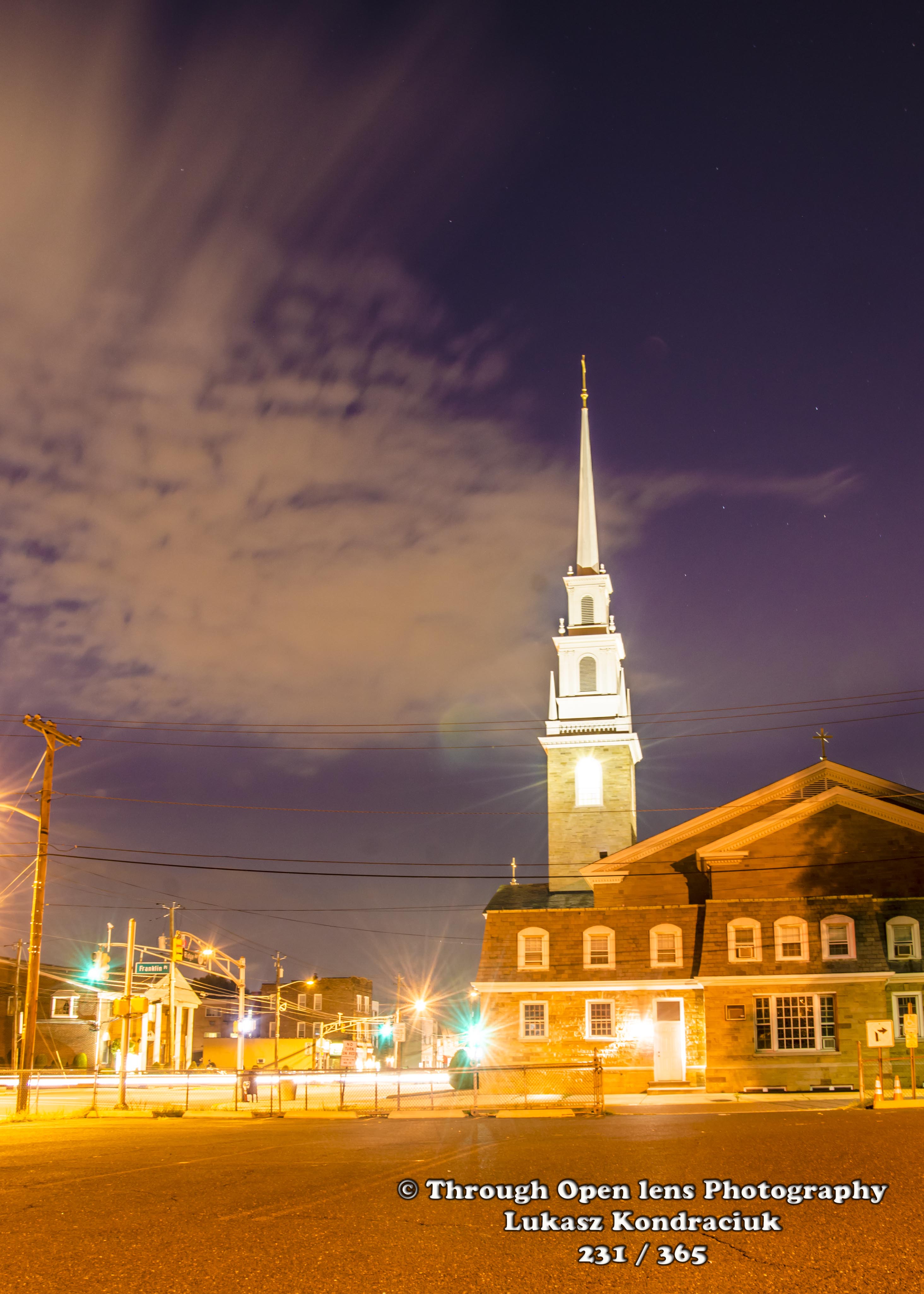
At Night I Can’t Sleep, In The Morning I Can’t Wake Up.

north arlington

F/ 14.0, 30.0, ISO 100.

Day 231 / 365

How can you go without sleep for seven days and not be tired?

Sleep at night.

Interesting Fact: In the early 1900s, a few notable photographers, Alfred Stieglitz and William Fraser, began working at night. The first known female night photographer is Jessie Tarbox Beals. The first photographers known to have produced large bodies of work at night were Brassai and Bill Brandt. In 1932, Brassai published Paris de Nuit, a book of black-and-white photographs of the streets of Paris at night. During World War II, British photographer Brandt took advantage of the black-out conditions to photograph the streets of London by moonlight. ( https://en.wikipedia.org/wiki/Night_photography )

I Want To Go Fast!

camshaft

F/5.3, 1/60, ISO 800.

Day 229 / 365

Tom meets up with Bob while he is picking up his car from the mechanic.

Tom asks, “Everything ok with your car now?”

Bob replies, “Yes, thank goodness. I was worried that my mechanic might try to rip me off, so I was relieved when he told me all I needed was $25 worth of blinker fluid.”

Interesting Fact: An early cam was built into Hellenistic water-driven automata from the 3rd century BC.[2] The camshaft was later described in Iraq (Mesopotamia) by Al-Jazari in 1206. He employed it as part of his automata, water-raising machines, and water clocks such as the castle clock.[3] The cam and camshaft later appeared in European mechanisms from at least the 14th century,[4] or possibly earlier. ( https://en.wikipedia.org/wiki/Camshaft )

Flame On!

Zippo

F/5.6, 1/20, ISO 1600.

Day 228 / 365

It’s really difficult to find what you want on eBay. I was searching for cigarette Lighters and found over 15,000 matches.

Interesting Fact: George G. Blaisdell founded Zippo Manufacturing Company in 1932, and produced the first Zippo lighter in early 1933, being inspired by an Austrian cigarette lighter of similar design made by IMCO.[2] It got its name because Blaisdell liked the sound of the word “zipper” and “zippo” sounded more modern.[citation needed] On March 3, 1936, a patent was granted for the Zippo lighter. ( https://en.wikipedia.org/wiki/Zippo )


Like Walking On Water Only Better! 

Paddleboarding

F/6.3, 1/800, ISO 200.

Day 227 / 365

How do paddle boarders say “hello” to each other?

They wave!

Interesting Fact: Historically, Africans and indeed many other river based and coastal cultures, have stood up within their canoes and upon rafts and paddled standing for thousands of years. Conceptually therefore, the idea of standing and paddling using an extended canoe paddle is far from being a new concept. ( https://en.m.wikipedia.org/wiki/Standup_paddleboarding )

Yeah We Lift!

cranes

F/9.0, 1/320, ISO 100.

Day 225 / 365

Crane party, they can get down and they can really raise the roof!

Interesting Fact: The crane for lifting heavy loads was invented by the Ancient Greeks in the late 6th century BC.[1] The archaeological record shows that no later than c.515 BC distinctive cuttings for both lifting tongs and lewis irons begin to appear on stone blocks of Greek temples. Since these holes point at the use of a lifting device, and since they are to be found either above the center of gravity of the block, or in pairs equidistant from a point over the center of gravity, they are regarded by archaeologists as the positive evidence required for the existence of the crane. ( https://en.wikipedia.org/wiki/Crane_(machine)#History )

And I Ran I Ran So Far Away

street art

F/4.2, 1/30, ISO 1100.

Day 224 / 365

What did the artist say to the rival?

I Challenge you a doodle!

Interesting Fact:  Artists have challenged art by situating it in non-art contexts. Street artists do not aspire to change the definition of an artwork, but rather to question the existing environment with its own language.[3] The motivations and objectives that drive street artists are as varied as the artists themselves. ‘Street’ artists attempt to have their work communicate with everyday people about socially relevant themes in ways that are informed by esthetic values without being imprisoned by them. There is a strong current of activism and subversion in urban art. Street art can be a powerful platform for reaching the public and a potent form of political expression for the oppressed, or people with little resources to create change.[5] Common variants include adbusting, subvertising and other culture jamming, the abolishment of private property and reclaiming the streets. ( https://en.wikipedia.org/wiki/Street_art )

Money Hungry!

Piggy Bank

F/4.8, 1/60, ISO 160.

Day 222 / 365

I was thinking about making piggy banks for a living.

I hear there’s good money in them.

I’ve rejected a new job making piggy banks.

I didn’t want change.

Interesting Fact: In English, the word “pig” can refer to two things: the animal and earthenware, which is used to make crockery. People often saved money in kitchen pots and jars made of pig, called “pig jars”. By the 18th century, the term “pig jar” had evolved to “pig bank”. [3] As earthenware was supplanted by other materials, such as glass, plaster, and plastic, the name gradually began to refer specifically to the shape of the bank, instead of what was used to make it. ( https://en.wikipedia.org/wiki/Piggy_bank )

Every Flower Must Grow Through Dirt.

Light Pink Gladiolas

F/14.0, 1/60, ISO 160.

Light Pink Gladiolus

Day 211 / 365

What did the old flower say to the younger flower?

What’s up, bud?

Interesting Fact: The British and Mediterranean gladiolus plants were often used for medicinal purposes. For example, the English used the plant’s corms (stem base) as a bandage and to extract thorns or splinters. The corms were also powdered and mixed with goat’s milk to soothe symptoms of colic. Parts of the gladiolus, however, are poisonous if eaten, and certain species cause irritation or allergic reaction when handled. Today we primarily use the gladiolus as a decorative flower in gardens and bouquets. ( http://www.nanzandkraft.com/blog/5-fun-facts-gladiolus-augusts-official-flower/ )