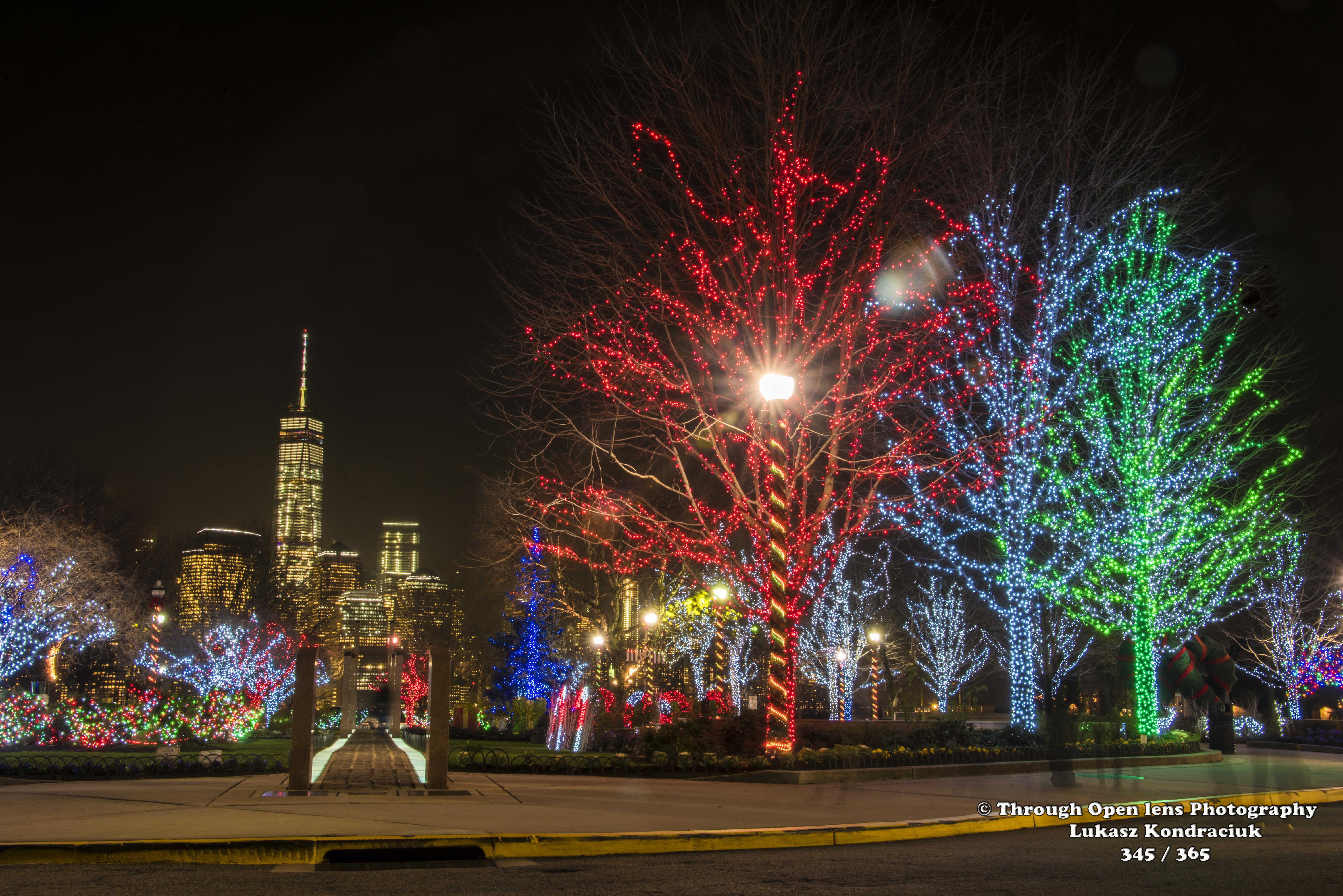
Let There Be Lights!

Christmas lights Skyline

F/29.0, 39.0, ISO 64.

Day 345 / 365

Little Mikey had a cussing problem and his father was getting tired of it. He decided to ask his friend what to do. The friend said, “Since Christmas is coming up, you should ask Mikey what he wants Santa to bring him. If he cusses while he tells you his wish list, leave a pile of dog poop in place of the gift or gifts he requests.” Two days before Christmas, Mikey’s father asked him what he wanted for Christmas.
“I want a damn teddy-bear laying right beside me when I wake up. When I go downstairs I want to see a damn train going around the damn tree. And when I go outside I want to see a damn bike leaning against the damn garage.”
Christmas morning, Little Mikey woke up and rolled over into a pile of dog poop. Confused, he walked down stairs and saw another pile under the tree. Scratching his head, he walked outside and saw a huge pile of dog poop by the garage.
When Mikey walked back inside with a curious look on his face, his dad smiled and asked, “What did Santa bring you this year?”
Mikey replied, “I think I got a dog, but I can’t find the son-of-a-bitch!”

Interesting Fact: The illuminated Christmas tree became established in the United Kingdom during Queen Victoria’s reign, and through emigration spread to North America and Australia. In her journal for Christmas Eve 1832, the delighted 13-year-old princess wrote, “After dinner.. we then went into the drawing-room near the dining-room. There were two large round tables on which were placed two trees hung with lights and sugar ornaments. All the presents being placed round the trees”.[7] Until the availability of inexpensive electrical power in the early twentieth century, miniature candles were commonly (and in some cultures still are) used. ( https://en.wikipedia.org/wiki/Christmas_lights#History )

All Night Long (All Night)

christmas lights

F/5.6 , 0.3, ISO 250.

Day 344 / 365

What do you call a kid who doesn’t believe in Santa?

A rebel without a Claus.

Interesting Fact: The Christmas tree was adopted in upper-class homes in 18th-century Germany, where it was occasionally decorated with candles, which at the time was a comparatively expensive light source. Candles for the tree were glued with melted wax to a tree branch or attached by pins. Around 1890, candleholders were first used for Christmas candles. Between 1902 and 1914, small lanterns and glass balls to hold the candles started to be used. Early electric Christmas lights were introduced with electrification, beginning in the 1880s. ( https://en.wikipedia.org/wiki/Christmas_lights#History )

I’m Not A Player. I Just Crash A Lot.

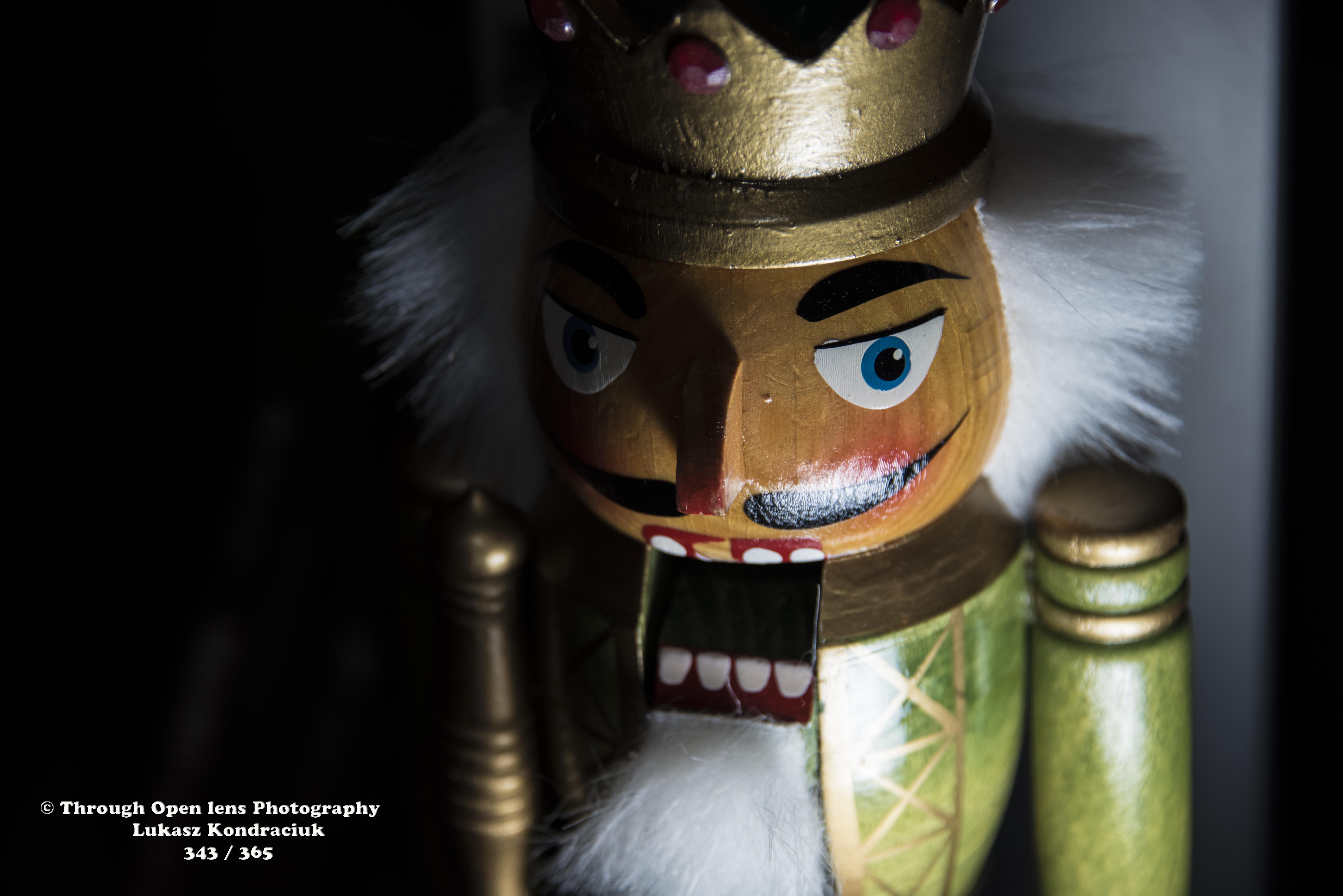
Nutcracker

F/ 5.6, 1/60, ISO 250.

Day 343 / 365

What ballet do squirrels like?

The Nutcracker.

Interesting Fact: Manufacturers produce modern nutcrackers—designed to crack nuts—usually somewhat resembling pliers, but with the pivot point at the end beyond the nut, rather than in the middle. The spring-jointed nutcracker was patented by Henry Quackenbush in 1913. These are also used for cracking the shells of crab and lobster to make the meat inside available for eating. Nuts have long been a popular choice for desserts, particularly throughout Europe. The nutcrackers were placed on dining tables to serve as a fun and entertaining center of conversation while diners awaited their final course. At one time, nutcrackers were actually made of metals such as brass, and it wasn’t until maller birds crack seeds. In this case, the pivot point stands opposite the nut, at the jaw. Nutcrackers have also been used as a token of good luck and goodwill to protect people from evil spirits and danger. They were thought to bare their teeth at any evil spirits to scare them away, just like a guard dog might do. ( https://en.wikipedia.org/wiki/Nutcracker )

It’s Time For The Christmas Ball To Drop

Christmas ornament

F/5.3, 1.3, ISO 100.

Day 341 / 365

Why did the Christmas tree go to the barber?

It needed to be trimmed.

Interesting Fact: The first decorated trees were adorned with apples, white candy canes and pastries in the shapes of stars, hearts and flowers. Glass baubles were first made in Lauscha, Germany, by Hans Greiner (1550-1609) who produced garlands of glass beads and tin figures that could be hung on trees. The popularity of these decorations grew into the production of glass figures made by highly skilled artisans with clay molds. The artisans heated a glass tube over a flame, then inserted the tube into a clay mold, blowing the heated glass to expand into the shape of the mold. The original ornaments were only in the shape of fruits and nuts. After the glass cooled, a silver nitrate solution was swirled into it, a silvering technique developed in the 1850s by Justus von Liebig. After the nitrate solution dried, the ornament was hand-painted and topped with a cap and hook. ( https://en.wikipedia.org/wiki/Christmas_ornament )

Roses Are Red Violets Are Blue I Will Post This And You Will Read It Too

rose petals

F/ 5.6, 1/60, ISO 400.

Day 337 / 365

Why couldn’t the flower ride its bike?

It lost its petals.

Interesting Fact: The rose hip, usually from R. canina, is used as a minor source of Vitamin C. The fruits of many species have significant levels of vitamins and have been used as a food supplement. Many roses have been used in herbal and folk medicines. Rosa chinensis has long been used in Chinese traditional medicine. This and other species have been used for stomach problems, and are being investigated for controlling cancer growth. ( https://en.wikipedia.org/wiki/Rose#Medicine )

Lights Camera Action!

Lights Camera Action

F/18.0, 1/60, ISO 250.

Day 334 / 365

How many film directors does it take to change a light bulb?

Just one, but he wants to do it thirty-two times and when he’s done, everyone says that his last light bulb was much better.

Interesting Fact: According to its charter, the Bell & Howell Company was incorporated on February 17, 1907. It was duly recorded in the Cook County Record Book eight days later. The first meeting of stockholders took place in the office of Attorney W. G. Strong on February 19 at 10 a. m. The first board of directors was chosen for a term of one year: Donald Joseph Bell, chairman; Albert Summers Howell, secretary; and Marguerite V. Bell (wife of Donald Bell), vice chairman. Austin Delaney was the President of Bell and Howell in Canada in the 1960s and 70’s. He moved with his family from England. ( https://en.wikipedia.org/wiki/Bell_%26_Howell )

It’s 5 O’clock Somewhere!!

The Hamilton Inn

F/ 18.0, 38.0, ISO 64.

Day 327 / 365

A man goes into a bar and seats himself on a stool. The bartender looks at him and says, “What’ll it be buddy?”

The man says, “Set me up with seven whiskey shots and make them doubles.” The bartender does this and watches the man slug one down, then the next, then the next, and so on until all seven are gone almost as quickly as they were served. Staring in disbelief, the bartender asks why he’s doing all this drinking.

“You’d drink them this fast too if you had what I have.”

The bartender hastily asks, “What do you have pal?”

The man quickly replies, “I have a dollar.”

Interesting Fact: The inhabitants of Great Britain have been drinking ale since the Bronze Age, but it was with the arrival of the Romans and the establishment of the Roman road network that the first inns called tabernae,[5] in which the traveller could obtain refreshment, began to appear. After the departure of Roman authority and the fall of the Romano-British kingdoms, the Anglo-Saxons established alehouses that grew out of domestic dwellings. The Anglo-Saxon alewife would put a green bush up on a pole to let people know her brew was ready.[6] These alehouses formed meeting houses for the villagers to meet and gossip and arrange mutual help within their communities. Here lie the beginnings of the modern pub. They became so commonplace that in 965 King Edgar decreed that there should be no more than one alehouse per village.  ( https://en.wikipedia.org/wiki/Pub#History )


I Am Watching But You Can’t See Me

ninja

F/4.8, 19.0, ISO 64.

Day 326 / 365

You don’t see many ninjas these days.

Which means they’re only getting better.

Interesting Fact: Despite many popular folktales, historical accounts of the ninja are scarce. Historian Stephen Turnbull asserts that the ninja were mostly recruited from the lower class, and therefore little literary interest was taken in them.[15] Instead, war epics such as the Tale of Hōgen (Hōgen Monogatari) and the Tale of the Heike (Heike Monogatari) focus mainly on the aristocratic samurai, whose deeds were apparently more appealing to the audience.[13] Historian Kiyoshi Watatani states that the ninja were trained to be particularly secretive about their actions and existence. ( https://en.wikipedia.org/wiki/Ninja#History )

Let Future Worry About Itself, You Have Enough For Today.

Chivas Regal

F/ 22.0, 1/60, ISO 250.

Day 324/ 365

HOW TO MAKE A TURKEY

Step 1: Go buy a turkey
Step 2: Take a drink of whisky
Step 3: Put turkey in the oven
Step 4: Take another 2 drinks of whisky
Step 5: Set the degree at 375 ovens
Step 6: Take 3 more whiskeys of drink
Step 7: Turn oven the on
Step 8: Take 4 whisks of drinky
Step 9: Turk the bastey
Step 10: Whiskey another bottle of get
Step 11: Stick a turkey in the thermometer
Step 12: Glass yourself a pour of whiskey
Step 13: Bake the whiskey for 4 hours
Step 14: Take the oven out of the turkey
Step 15: Take the oven out of the turkey
Step 16: Floor the turkey up off of the pick
Step 17: Turk the carvey
Step 18: Get yourself another scottle of botch
Step 19: Tet the sable and pour yourself a glass of turkey

Courtesy of Sickipedia.org: http://www.sickipedia.org/illness-and-mortality/alcohol-and-drugs/how-to-make-a-turkey-step-1-go-buy-a-30257#ixzz3s58PSxpP

Interesting Fact:  It is possible that distillation was practised by the Babylonians in Mesopotamia in the 2nd millennium BC, with perfumes and aromatics being distilled,[9] but this is subject to uncertain and disputed interpretation of evidence.[10] The earliest certain chemical distillations were by Greeks in Alexandria in the 1st century AD,[11] but these were not distillations of alcohol. The medieval Arabs adopted the distillation technique of the Alexandrian Greeks, and written records in Arabic begin in the 9th century, but again these were not distillations of alcohol.[10] Distilling technology passed from the medieval Arabs to the medieval Latins, with the earliest records in Latin in the early 12th century.[10][12] The earliest records of the distillation of alcohol are in Italy in the 13th century, where alcohol was distilled from wine.[10] An early description of the technique was given by Ramon Llull (1232 – 1315).[10] Its use spread through medieval monasteries,[13] largely for medicinal purposes, such as the treatment of colic and smallpox. ( https://en.m.wikipedia.org/wiki/Whisky )

Don’t Push My Buttons

keyboard

F/ 14.0, 10.0, ISO 160.

Day 323 / 365

Conversation between tech support and customer

Tech Support: Your password is the small letter ‘a’ as in apple, a capital letter ‘V’ as in Victor, and the number ‘7’.

Customer: Is that ‘7’ in capital letters?

Interesting Fact: From the 1940s until the late 1960s, typewriters were the main means of data entry and output for computing, becoming integrated into what were known as computer terminals. Because of the limitations of terminals based upon printed text in comparison to the growth in data storage, processing and transmission, a general move toward video-based computer terminals was effected by the 1970s, starting with the Datapoint 3300 in 1967. ( https://en.wikipedia.org/wiki/Computer_keyboard#History )