
F/5.6, 1/500, ISO 900.
Day 69 / 365
Cause you had a foggy day
You sing a sad song just to turn it around and the road is gone. 🙂

F/5.6, 1/500, ISO 900.
Day 69 / 365
Cause you had a foggy day
You sing a sad song just to turn it around and the road is gone. 🙂

F/22.0, 1/60, ISO 100, Photoshop CS6.
Day 68 / 365
Let’s bring happiness back! 🙂
Interesting Fact: Paint colors can affect your mood. Cool tones invoke feelings of calm, peace and happiness. Warmer tones can provoke feelings of anger or energy. ( http://www.futurecitygroup.com/10-interesting-facts-about-paint/ )

F/4.8, 1/60, ISO 100.
Gerbera
Day 67 / 365
All women deserve flowers on this day.
Interesting Fact: International Women’s Day (8 March) is a global day celebrating the economic, political and social achievements of women past, present and future. In some places like China, Russia, Vietnam and Bulgaria, International Women’s Day is a national holiday. ( http://www.internationalwomensday.com/ )
It has been one year since my first post. What a great year! Thank You everyone for your support.
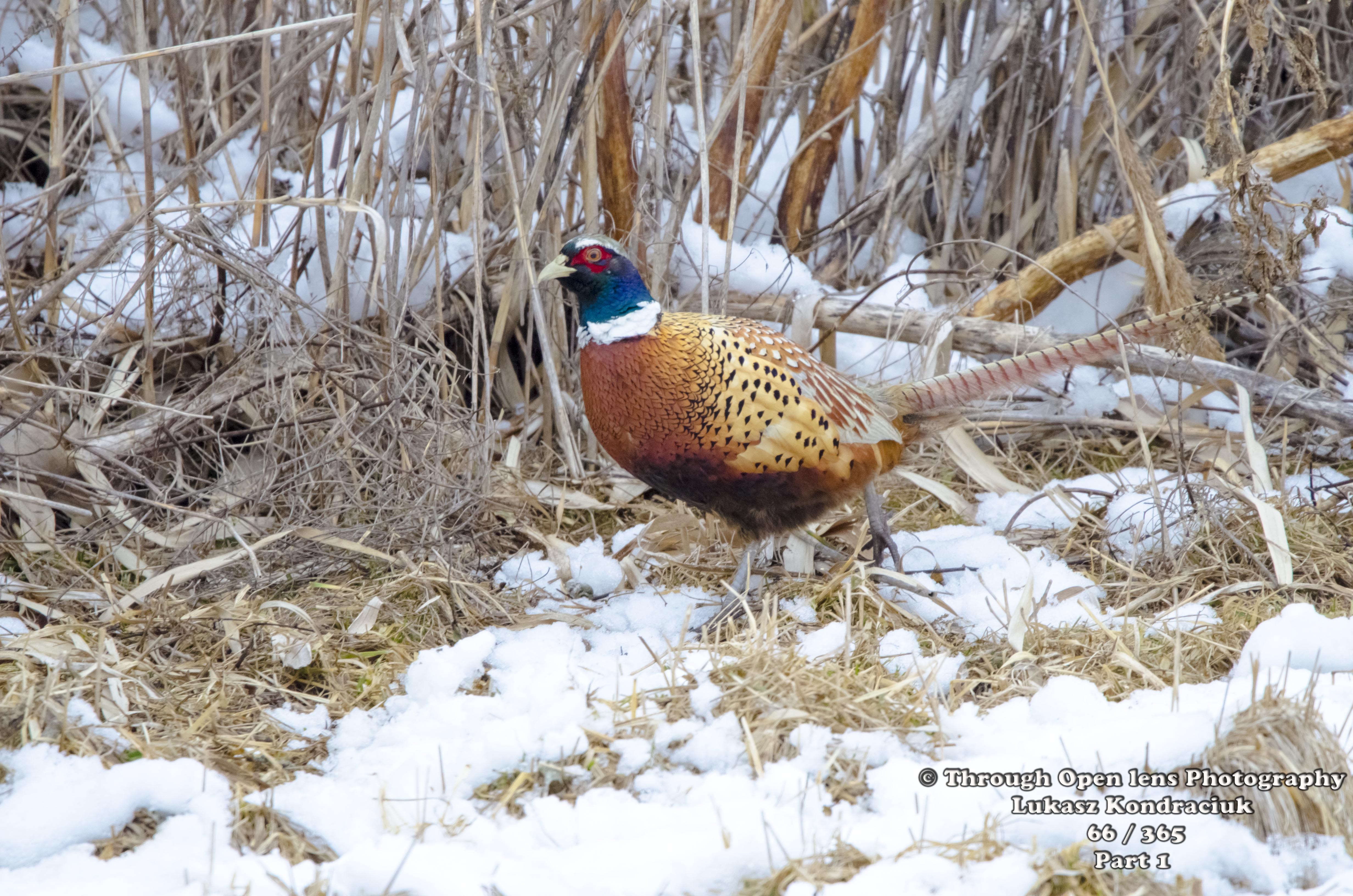
F/6.3, 1/320, ISO 1600.
Ring-Necked Pheasant
Day 66 / 365 Part 1
“Oh sh*t people, time to run”.
Interesting Fact: Ring-necked Pheasants sometimes cope with extreme cold by simply remaining dormant for days at a time. ( http://www.allaboutbirds.org/guide/ring-necked_pheasant/lifehistory )

F/6.3, 1/125, ISO 800.
Short Eared Owl
Day 66 / 365 Part 2
“I can see clearly now the snow has stopped”!
Interesting Fact: The Short-eared Owl may compete with the Barn Owl in some areas. Some successful nest box programs to attract Barn Owls have coincided with the decline of the Short-eared Owl in the same area. ( http://www.allaboutbirds.org/guide/short-eared_owl/lifehistory )

F/16.0, 1/60, ISO 200.
Day 65 / 365
I work all night, I work all day, to pay the bills I have to pay. ( Money, Money, Money. ) Song by ABBA
Interesting Fact: Florence, Italy was the first city to mint its own gold coins in 1252. The fiorino became known as the florence, then the florin. ( http://www.fleur-de-coin.com/trivials/world-coins )

F/6.3, 1/500, ISO 1600.
European Starlings
Day 64 / 365
“My family immigrated from Europe”.
Interesting Fact: All of the 200 million European Starlings found in North America today are descendants of approximately 100 birds released in New York City’s Central Park in the early 1890s by an industrialist who wanted to establish, in the U.S., all birds mentioned in the works of Shakespeare. ( http://identify.whatbird.com/obj/160/_/European_Starling.aspx )

F/ 5.6, 1/250, ISO 320.
Day 63 /365
Yummy. And now they’re gone.
Interesting Fact: A crêpe (pronounced /kreɪp/, French IPA: [kʀɛp]) is a type of very thin, cooked pancake usually made from wheat flour. The word, like the pancake itself, is of French origin, deriving from the Latin crispa, meaning “curled.” While crêpes originate from Brittany, a region in the northwest of France, their consumption is nowadays widespread in France and is considered the national dish. Crêpes can be compared to the African injera, the tortilla, the Indian dosa and the Mexican sope. Crêpes often have a fruit filling of syrup, mixed berries, fresh fruit or lemon cream. ( http://www.excusemyfrench.co.nz/a-little-crepe-history/ )

F/11.0, 1/60, ISO 100.
Day 62 / 365
What if you were able to freeze time? Well I did, with a photo. 🙂
Interesting Fact: Many years ago, devices for telling the time were created by the Egyptians around 1500BC. Known as sundials time was measured by a shadow falling in sections across a marked area. Water clocks were used later with more accuracy. ( http://www.westcoastwatch.com/blog/8-fun-facts-about-watches/ )

F/5.6, 1/60, ISO 100.
Day 61 / 365
We are energetic and really positive, but we have a negative side.
Interesting Fact: In 1800 Alessandro Volta invented the first voltaic cell battery. This battery did not look like modern batteries, but still worked the same. ( http://sciencewithkids.com/science-facts/facts-about-batteries.html )

F/6.3, 1/800, ISO 800.
Common Merganser
Day 60 / 365
You quack me up!
Interesting Fact: These large fish-eaters have serrated edges to their bills to help them grip their prey. Along with the Smew and the other Mergansers, they are often known as “sawbills.” ( http://identify.whatbird.com/obj/416/_/Common_Merganser.aspx )
 Through Open Lens