Best Thing About Sunsets Is Watching Them With You

marina sunset

F/ 14.0, 1/800, ISO 500.

Living on Earth might be expensive but at least you get a free trip around the Sun every year.


Interesting Fact:  The time of sunset varies throughout the year, and is determined by the viewer’s position on Earth, specified by longitude and latitude, and elevation. Small daily changes and noticeable semi-annual changes in the timing of sunsets are driven by the axial tilt of Earth, daily rotation of the Earth, the planet’s movement in its annual elliptical orbit around the Sun, and the Earth and Moon’s paired revolutions around each other. During winter and spring, the days get longer and sunsets occur later every day until the day of the latest sunset, which occurs after the summer solstice. In the Northern Hemisphere, the latest sunset occurs late in June or in early July, but not on the summer solstice of June 21. This date depends on the viewer’s latitude (connected with the Earth’s slower movement around the aphelion around July 4). Likewise, the earliest sunset does not occur on the winter solstice, but rather about two weeks earlier, again depending on the viewer’s latitude. In the Northern Hemisphere, it occurs in early December or late November (influenced by the Earth’s faster movement near its perihelion, which occurs around January 3). ( https://en.wikipedia.org/wiki/Sunset )

Happy International Women’s Day! All Women Deserve Flowers On This Day!

flowers

Happy International Women’s Day

F/3.5, 1/60, ISO 250.

Why couldn’t the flower ride its bike?

It lost its petals.

Interesting Fact:  The earliest Women’s Day observance was held on February 28, 1909, in New York; it was organized by the Socialist Party of America in remembrance of the 1908 strike of the International Ladies’ Garment Workers’ Union.[4] There was no specific strike happening on March 8, despite later claims. ( https://en.wikipedia.org/wiki/International_Women%27s_Day )

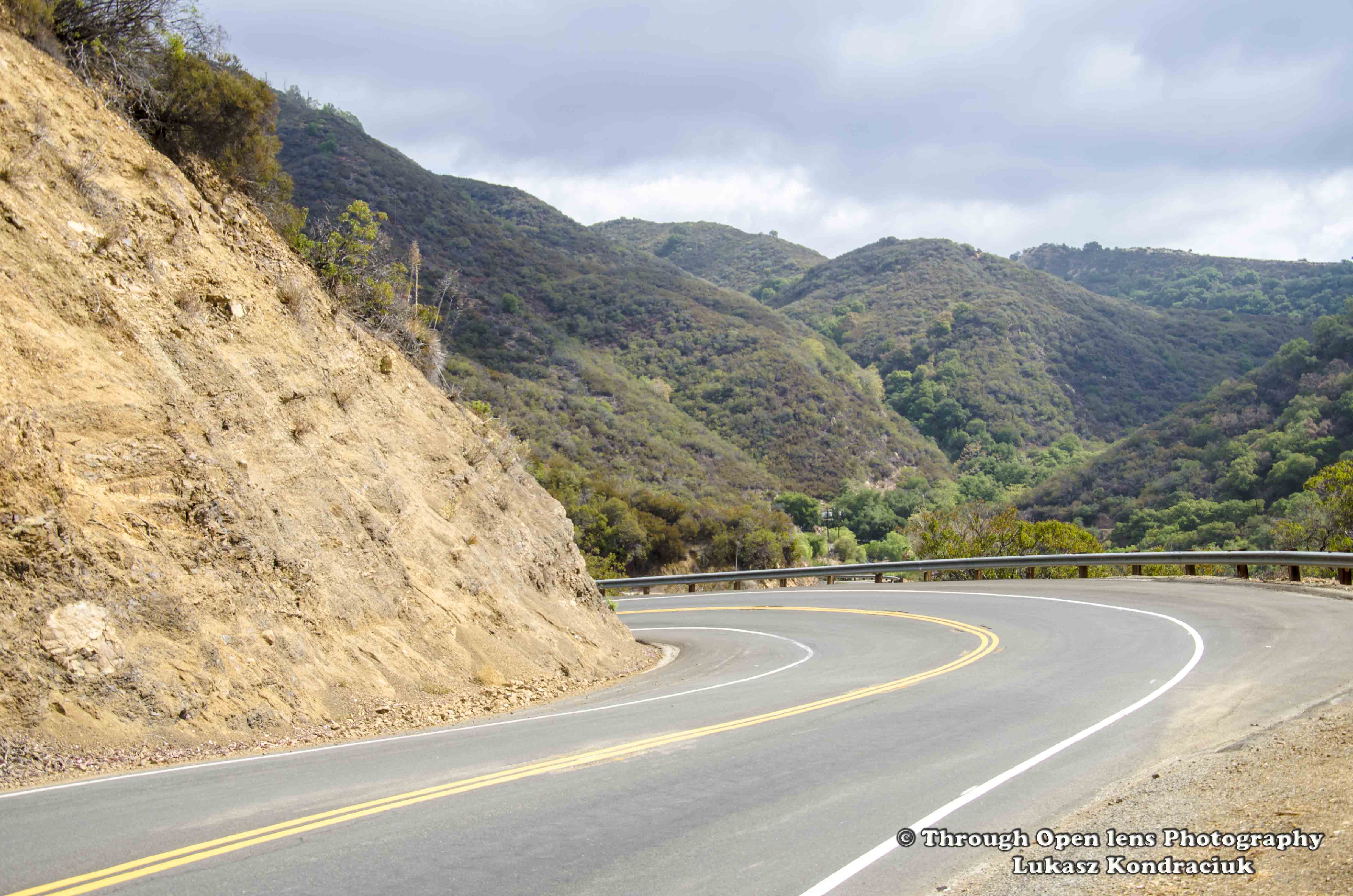
A Change May Be Just Around The Corner!

canyon road malibu

F/ 8.0 , 1/250, ISO 100.

California Week Two

Why didn’t the bicycle cross the road?

Because it was two tired

Interesting Fact: Explorer Juan Rodríguez Cabrillo is believed to have moored at Malibu Lagoon, at the mouth of Malibu Creek, to obtain fresh water in 1542. The Spanish presence returned with the California mission system, and the area was part of Rancho Topanga Malibu Sequit—a 13,000-acre (53 km2) land grant—in 1802. That ranch passed intact to Frederick Hastings Rindge in 1891. He and his widow, May K. Rindge, guarded their privacy zealously by hiring guards to evict all trespassers and fighting a lengthy court battle to prevent the building of a Southern Pacific railroad line through the ranch. Interstate Commerce Commission regulations would not support a railroad condemning property in order to build tracks that paralleled an existing line, so Frederick H. Rindge decided to build his own railroad through his property first. He died, and May K. Rindge followed through with the plans, building a line starting just inside the ranch’s property eastern boundary at Las Flores Canyon, and running 15 miles westward, past Pt. Dume. ( https://en.wikipedia.org/wiki/Malibu,_California#History )

It’s Magical!

Getty Center

F/ 8.0, 1/250, ISO 100.

Getty Center

California Week Two

It had been anything but an easy afternoon for the teacher who took six of her pupils through the Museum of Natural History, but their enthusiastic interest in the stuffed animals and their open-eyed wonder at the prehistoric fossils amply repaid her.

“Well, boys, where have you been all afternoon?” asked the father of two of the party that evening.

The answer came back with joyous promptness: “Oh, pop! Teacher took us to a dead circus.”

Interesting Fact: In 1984, Richard Meier was chosen to be the architect of the Center.[8] After an extensive conditional-use permit process,[4] construction by the Hathaway Dinwiddie Construction Company[9] began in August 1989.[10] The construction was significantly delayed, with the planned completion date moved from 1988 to 1995 (as of 1990).[11] By 1995, however, the campus was described as only “more than halfway complete”. ( https://en.wikipedia.org/wiki/Getty_Center#Location_and_history )


Life Is A Garden, Dig It!

Getty Museum

F/ 8.0, 1/250, ISO 100.

Getty Center

California Week

Two elderly women are walking through a museum and get separated.
As soon as they meet up with each other again, one of them appears quite flustered and says, “Goodness, gracious! Did you see the statue of the naked man back there? I’ve never been so shocked. How can they possibly display such a thing. My gosh, the penis on it was so large!”
Whereupon, the other old lady accidentally blurts out, “Yes, and cold, too!”

Interesting Fact:  Originally, the Getty Museum started in J. Paul Getty‘s house located in Pacific Palisades in 1954. He expanded the house with a museum wing. In the 1970s, Getty built a replica of an Italian villa on his home’s property to better house his collection, which opened in 1974. After Getty’s death in 1976, the entire property was turned over to the Getty Trust for museum purposes. However, the collection outgrew the site, which has since been renamed the Getty Villa, and management sought a location more accessible to Los Angeles. The purchase of the land upon which the Center is located, a campus of 24 acres (9.7 ha) on a 110-acre (45 ha) site in the Santa Monica Mountains above Interstate 405, surrounded by 600 acres (240 ha) kept in a natural state, was announced in 1983.[4] The site cost $25 million.[5] The top of the hill is 900 feet (270 m) above I-405, high enough that on a clear day it is possible to see not only the Los Angeles skyline but also the San Bernardino Mountains, and San Gabriel Mountains to the east as well as the Pacific Ocean to the west. ( https://en.wikipedia.org/wiki/Getty_Center#Location_and_history )


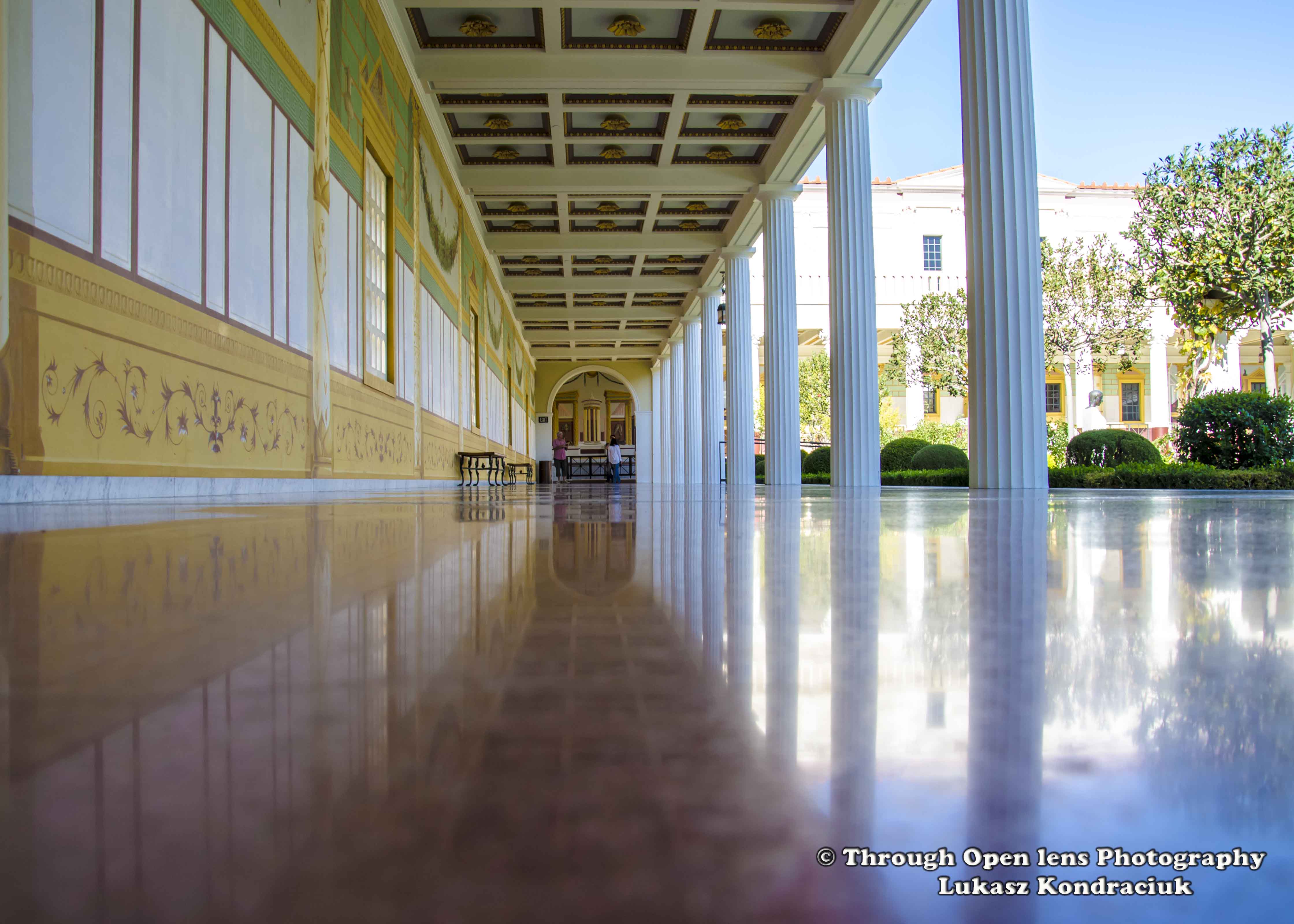
Show Me, Wax The Floor

Getty Villa

F/8.0, 1/250, ISO 200.

Getty Villa

California Week

Visiting the modern art museum, a lady turned to an attendant standing nearby.” This,” she said, “I suppose, is one of those hideous representations you call modern art? ” “No, madam,” replied the attendant. “That one’s called a mirror.”

Interesting Fact: In 1954, oil tycoon J. Paul Getty opened a gallery adjacent to his home in Pacific Palisades.[3][4][5] Quickly running out of room, he built a second museum, the Getty Villa, on the property down the hill from the original gallery.[4][6] The villa design was inspired by the Villa of the Papyri at Herculaneum[6] and incorporated additional details from several other ancient sites. It was designed by architects Robert E. Langdon, Jr. and Ernest C. Wilson, Jr..[7][8] It opened in 1974,[9] but was never visited by Getty, who died in 1976.[5] Following his death, the museum inherited $661 million[10] and began planning a much larger campus, the Getty Center, in nearby Brentwood. The museum overcame neighborhood opposition to its new campus plan by agreeing to limit the total size of the development on the Getty Center site.[11] To meet the museum’s total space needs, the museum decided to split between the two locations with the Getty Villa housing the Greek, Roman, and Etruscan antiquities.[11] In 1993, the Getty Trust selected Rodolpho Machado and Jorge Silvetti to design the renovation of the Getty Villa and its campus.[11] In 1997, portions of the museum’s collection of Greek, Roman and Etruscan antiquities were moved to the Getty Center for display, and the Getty Villa was closed for renovation.[12] The collection was restored during the renovation. ( https://en.wikipedia.org/wiki/Getty_Villa#History )

Day Is Behind Us, Watch Out Night, Here We Go!

cali sunset

F/ 10.0, 1/500, ISO 100.

California Week

Three men were in a NASA conference room to decide how to spend $10 billion.
“I think we should put our men on Mars!” said the first man.
“Ooh, good idea,” said the other two.
“I think we should put our men on Venus!” said the second man.
“Ooh, good idea,” said the other two.
“I think we should put our men on the Sun!”
“How are you going to do that?”
“Easy. We go at night.”

Interesting Fact: The 16th-century astronomer Nicolaus Copernicus was the first to present to the world a detailed and eventually widely accepted mathematical model supporting the premise that the Earth is moving and the Sun actually stays still, despite the impression from our point of view of a moving Sun. ( https://en.wikipedia.org/wiki/Sunset#Historically )

My Pillow Just Slapped Me Upside The Head And Said What Are You Still Doing Up!

Griffith Observatory

F/10.0, 30.0, ISO 100.

Griffith Observatory

California Week

How can you go without sleep for seven days and not be tired?

Sleep at night.

Interesting Fact: 3,015 acres (12.20 km2) of land surrounding the observatory was donated to the City of Los Angeles by Colonel Griffith J. Griffith on December 16, 1896.[1] In his will Griffith donated funds to build an observatory, exhibit hall, and planetarium on the donated land. Griffith’s objective was to make astronomy accessible by the public, as opposed to the prevailing idea that observatories should be located on remote mountaintops and restricted to scientists. ( https://en.wikipedia.org/wiki/Griffith_Observatory#History )

California Dreaming

Santa Monica Pier

F/ 16.0, 10.0, ISO 100.

Santa Monica Pier  

California Week

What did the boat say to the pier?

What’s up, dock?

Interesting Fact: Santa Monica has had several piers over the years; however, the current Santa Monica Pier is actually two adjoining piers that long had separate owners. The long, narrow Municipal Pier opened September 9, 1909,[4] primarily to carry sewer pipes beyond the breakers,[5] and had no amenities. The short, wide adjoining Pleasure Pier to the south, a.k.a. Newcomb Pier, was built in 1916 by Charles I. D. Looff and his son Arthur, amusement park pioneers.[6] Attractions on the Pleasure Pier eventually included the Santa Monica Looff Hippodrome building (which now houses the current carousel and is listed on the National Register of Historic Places), the Blue Streak Racer wooden roller coaster (which was purchased from the defunct Wonderland amusement park in San Diego), the Whip, merry-go-rounds, Wurlitzer organs, and a funhouse. ( https://en.wikipedia.org/wiki/Santa_Monica_Pier#History )

Monkey Say Monkey Do!

Snow monkey

Happy Chinese New Year!!  The Year Of The MONKEY.

F/5.6, 1/200, ISO 800.

Snow Monkey

A policeman in the big city stops a man in a car with a monkey in the front seat.
“What are you doing with that monkey?” He exclaimed, “You should take it to the zoo.”
The following week, the same policeman sees the same man with the monkey again in the front seat, with both of them wearing sunglasses. The policeman pulls him over.
“I thought you were going to take that monkey to the zoo!”
The man replied, “I did. We had such a good time we are going to the beach this weekend!”


Interesting Fact: Snow monkeys are known as the one of the cleverest species of monkeys. They learn easily and share new skills and hunting (or eating) techniques with other members of the troop and with their offspring.  ( http://www.softschools.com/facts/animals/snow_monkey_facts/106/ )


Interesting Fact: Chinese New Year is an important Chinese festival celebrated at the turn of the traditional lunisolar Chinese calendar. It is also known as the Spring Festival, the literal translation of the modern Chinese name. Celebrations traditionally run from the evening preceding the first day, to the Lantern Festival on the 15th day of the first calendar month. The first day of the New Year falls on the new moon between 21 January and 20 February.[2] In 2016, the first day of Chinese New Year falls on Monday, February 8th. ( https://en.wikipedia.org/wiki/Chinese_New_Year#History )