It’s Time For The Christmas Ball To Drop

Christmas ornament

F/5.3, 1.3, ISO 100.

Day 341 / 365

Why did the Christmas tree go to the barber?

It needed to be trimmed.

Interesting Fact: The first decorated trees were adorned with apples, white candy canes and pastries in the shapes of stars, hearts and flowers. Glass baubles were first made in Lauscha, Germany, by Hans Greiner (1550-1609) who produced garlands of glass beads and tin figures that could be hung on trees. The popularity of these decorations grew into the production of glass figures made by highly skilled artisans with clay molds. The artisans heated a glass tube over a flame, then inserted the tube into a clay mold, blowing the heated glass to expand into the shape of the mold. The original ornaments were only in the shape of fruits and nuts. After the glass cooled, a silver nitrate solution was swirled into it, a silvering technique developed in the 1850s by Justus von Liebig. After the nitrate solution dried, the ornament was hand-painted and topped with a cap and hook. ( https://en.wikipedia.org/wiki/Christmas_ornament )

Times Sure Have Changed

video recording

F/ 11.0, 1/60, ISO 200.

Day 328 / 365

Just when I discovered the meaning of life, they changed it.

Interesting Fact: After several attempts by other companies, the first commercially successful VTR, the Ampex VRX-1000, was introduced in 1956 by Ampex Corporation.[17] At a price of US$50,000 in 1956, and US$300 for a 90-minute reel of tape, it was intended only for the professional market.  ( https://en.wikipedia.org/wiki/VHS#History )

It’s 5 O’clock Somewhere!!

The Hamilton Inn

F/ 18.0, 38.0, ISO 64.

Day 327 / 365

A man goes into a bar and seats himself on a stool. The bartender looks at him and says, “What’ll it be buddy?”

The man says, “Set me up with seven whiskey shots and make them doubles.” The bartender does this and watches the man slug one down, then the next, then the next, and so on until all seven are gone almost as quickly as they were served. Staring in disbelief, the bartender asks why he’s doing all this drinking.

“You’d drink them this fast too if you had what I have.”

The bartender hastily asks, “What do you have pal?”

The man quickly replies, “I have a dollar.”

Interesting Fact: The inhabitants of Great Britain have been drinking ale since the Bronze Age, but it was with the arrival of the Romans and the establishment of the Roman road network that the first inns called tabernae,[5] in which the traveller could obtain refreshment, began to appear. After the departure of Roman authority and the fall of the Romano-British kingdoms, the Anglo-Saxons established alehouses that grew out of domestic dwellings. The Anglo-Saxon alewife would put a green bush up on a pole to let people know her brew was ready.[6] These alehouses formed meeting houses for the villagers to meet and gossip and arrange mutual help within their communities. Here lie the beginnings of the modern pub. They became so commonplace that in 965 King Edgar decreed that there should be no more than one alehouse per village.  ( https://en.wikipedia.org/wiki/Pub#History )


I Am Watching But You Can’t See Me

ninja

F/4.8, 19.0, ISO 64.

Day 326 / 365

You don’t see many ninjas these days.

Which means they’re only getting better.

Interesting Fact: Despite many popular folktales, historical accounts of the ninja are scarce. Historian Stephen Turnbull asserts that the ninja were mostly recruited from the lower class, and therefore little literary interest was taken in them.[15] Instead, war epics such as the Tale of Hōgen (Hōgen Monogatari) and the Tale of the Heike (Heike Monogatari) focus mainly on the aristocratic samurai, whose deeds were apparently more appealing to the audience.[13] Historian Kiyoshi Watatani states that the ninja were trained to be particularly secretive about their actions and existence. ( https://en.wikipedia.org/wiki/Ninja#History )

Let Future Worry About Itself, You Have Enough For Today.

Chivas Regal

F/ 22.0, 1/60, ISO 250.

Day 324/ 365

HOW TO MAKE A TURKEY

Step 1: Go buy a turkey
Step 2: Take a drink of whisky
Step 3: Put turkey in the oven
Step 4: Take another 2 drinks of whisky
Step 5: Set the degree at 375 ovens
Step 6: Take 3 more whiskeys of drink
Step 7: Turn oven the on
Step 8: Take 4 whisks of drinky
Step 9: Turk the bastey
Step 10: Whiskey another bottle of get
Step 11: Stick a turkey in the thermometer
Step 12: Glass yourself a pour of whiskey
Step 13: Bake the whiskey for 4 hours
Step 14: Take the oven out of the turkey
Step 15: Take the oven out of the turkey
Step 16: Floor the turkey up off of the pick
Step 17: Turk the carvey
Step 18: Get yourself another scottle of botch
Step 19: Tet the sable and pour yourself a glass of turkey

Courtesy of Sickipedia.org: http://www.sickipedia.org/illness-and-mortality/alcohol-and-drugs/how-to-make-a-turkey-step-1-go-buy-a-30257#ixzz3s58PSxpP

Interesting Fact:  It is possible that distillation was practised by the Babylonians in Mesopotamia in the 2nd millennium BC, with perfumes and aromatics being distilled,[9] but this is subject to uncertain and disputed interpretation of evidence.[10] The earliest certain chemical distillations were by Greeks in Alexandria in the 1st century AD,[11] but these were not distillations of alcohol. The medieval Arabs adopted the distillation technique of the Alexandrian Greeks, and written records in Arabic begin in the 9th century, but again these were not distillations of alcohol.[10] Distilling technology passed from the medieval Arabs to the medieval Latins, with the earliest records in Latin in the early 12th century.[10][12] The earliest records of the distillation of alcohol are in Italy in the 13th century, where alcohol was distilled from wine.[10] An early description of the technique was given by Ramon Llull (1232 – 1315).[10] Its use spread through medieval monasteries,[13] largely for medicinal purposes, such as the treatment of colic and smallpox. ( https://en.m.wikipedia.org/wiki/Whisky )

Don’t Push My Buttons

keyboard

F/ 14.0, 10.0, ISO 160.

Day 323 / 365

Conversation between tech support and customer

Tech Support: Your password is the small letter ‘a’ as in apple, a capital letter ‘V’ as in Victor, and the number ‘7’.

Customer: Is that ‘7’ in capital letters?

Interesting Fact: From the 1940s until the late 1960s, typewriters were the main means of data entry and output for computing, becoming integrated into what were known as computer terminals. Because of the limitations of terminals based upon printed text in comparison to the growth in data storage, processing and transmission, a general move toward video-based computer terminals was effected by the 1970s, starting with the Datapoint 3300 in 1967. ( https://en.wikipedia.org/wiki/Computer_keyboard#History )

Are You Egging Me On?!

egg

F/5.6, 1/60, ISO 200.

Day 321 / 365

How do you make an egg roll?

You push it!

Interesting Fact: The dried egg industry developed in the 19th century, before the rise of the frozen egg industry.[9] In 1878, a company in St. Louis, Missouri started to transform egg yolk and white into a light-brown, meal-like substance by using a drying process.[9] The production of dried eggs significantly expanded during World War II, for use by the United States Armed Forces and its allies. ( https://en.wikipedia.org/wiki/Egg_(food)#History )

I Think I’m On The Right Track

Light Rail

F/ 14.0 , 25.0, ISO 200.

Day 320 / 365

What do you call a train that eats toffee?

A chew, chew train.

Interesting Fact: The system began operating its first segment in April 2000, expanded in phases during the next decade, and was completed with the opening of its southern terminus on January 31, 2011. The line generally runs parallel to the Hudson River and Upper New York Bay, while its northern end and its western branch travel through the lower Hudson Palisades. HBLR has twenty-four stations along a total track length of just over 34 miles (55 km) and serves over 54,000 weekday passengers.[1] There are plans for expansion through extensions and additional stations. ( https://en.wikipedia.org/wiki/Hudson%E2%80%93Bergen_Light_Rail#Historical_overview )

Let Me Lift Up Your Smile

crane

F/14.0, 259.0, ISO 64.

Day 217 / 365

There were three workers; one crane operator, one pole climber, one guide.
The guide tied the crane to the end of a pole. The crane operator would then pick the pole up on end. The climber climbed to the top and dropped a tape measure which the guide promptly read and noted the measurement. The crane operator then lowered the pole to the ground and repsitioned to pick up another pole.
This went on several times when the foreman came over and asked why they couldn’t measure the poles while they were laying on the ground?
The worker replied, “we need to know how tall the poles are, not how long”.

source: http://www.jokebuddha.com/Crane#ixzz3rRDzfNPL

Interesting Fact: It is assumed that Roman engineers lifted these extraordinary weights by two measures. First, as suggested by Heron, a lifting tower was set up, whose four masts were arranged in the shape of a quadrangle with parallel sides, not unlike a siege tower, but with the column in the middle of the structure (Mechanica 3.5).[6] Second, a multitude of capstans were placed on the ground around the tower, for, although having a lower leverage ratio than treadwheels, capstans could be set up in higher numbers and run by more men (and, moreover, by draught animals).[7] This use of multiple capstans is also described by Ammianus Marcellinus (17.4.15) in connection with the lifting of the Lateranense obelisk in the Circus Maximus (ca. 357 AD). The maximum lifting capability of a single capstan can be established by the number of lewis iron holes bored into the monolith. In case of the Baalbek architrave blocks, which weigh between 55 and 60 tons, eight extant holes suggest an allowance of 7.5 ton per lewis iron, that is per capstan.[8] Lifting such heavy weights in a concerted action required a great amount of coordination between the work groups applying the force to the capstans. ( https://en.wikipedia.org/wiki/Crane_(machine)#History )

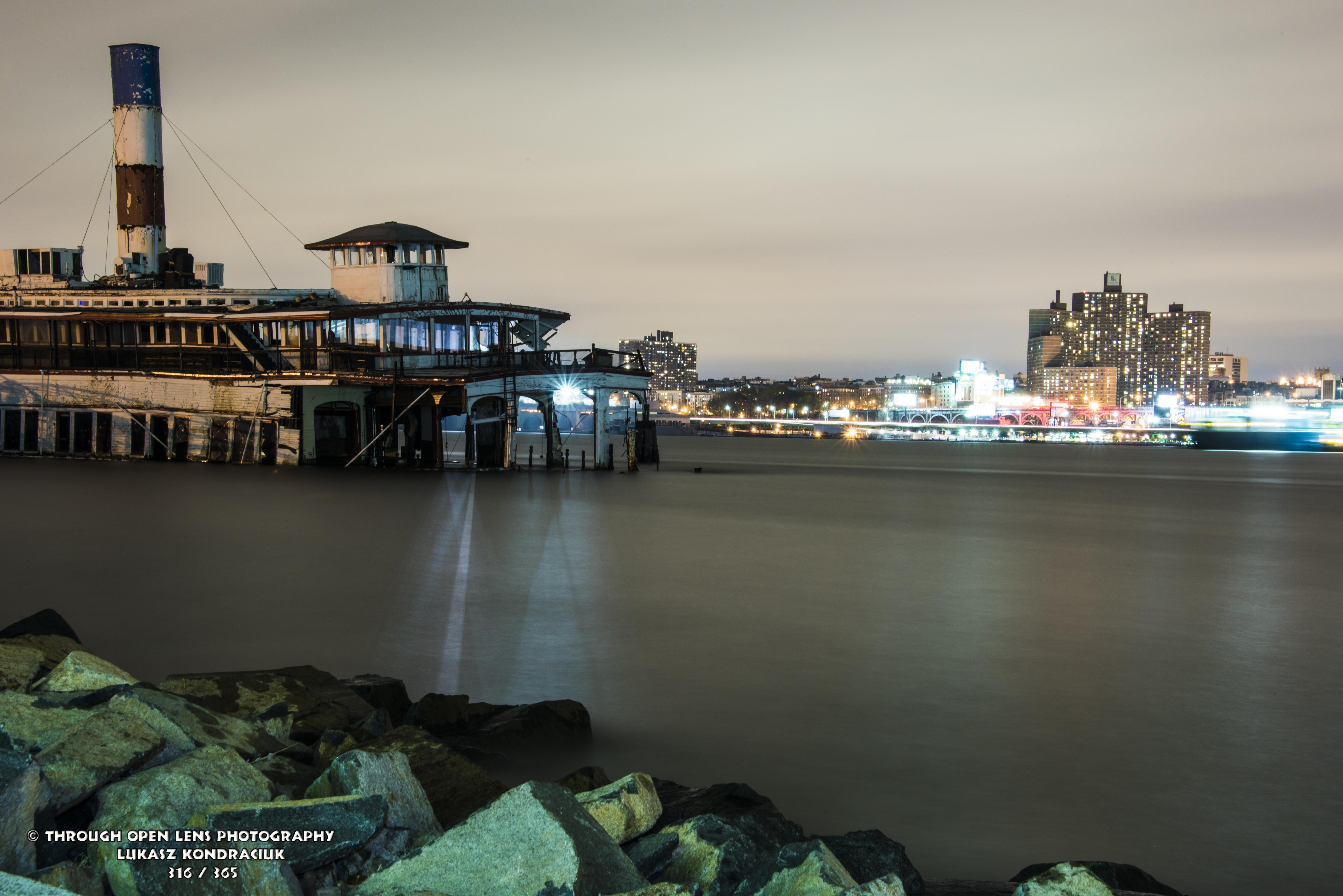
I Don’t Think Anyone Will Row Row Row That Boat Gently Down The Stream

Binghamton ferry

F/22.0, 159.0, ISO 64.

Day 316 / 365

What do you do with a sick boat?

Take it to the DOC!

Interesting Fact:

Binghamton was one of six identical screw-propelled double-ended ferryboats built by the Newport News Shipbuilding and Dry-dock Company at Newport News, Virginia in 1904-05 to designs by Gardner & Cox, naval architects. She was launched on February 20, 1905, with Miss Charlotte Emery, daughter of John M. Emery, the newly promoted superintendent of the Hoboken Ferry Company and Ferry Department of the DL&W, serving as her sponsor. Binghamton was completed a month later and left the Newport News yard on March 25 for the trip to Hoboken, New Jersey. She was placed in commission on April 3. Her Captain for the first crossing was Oren D. Relyea.

Her normal run was from the Hoboken Terminal to Barclay Street, a twelve-minute journey of approximately 1 and 3/4 miles, a trip made continuously nearly every day for more than sixty years (on occasion she substituted on the Hoboken – 23rd Street run). ( https://en.wikipedia.org/wiki/Binghamton_(ferryboat) )