I Don’t Think Anyone Will Row Row Row That Boat Gently Down The Stream

Binghamton ferry

F/22.0, 159.0, ISO 64.

Day 316 / 365

What do you do with a sick boat?

Take it to the DOC!

Interesting Fact:

Binghamton was one of six identical screw-propelled double-ended ferryboats built by the Newport News Shipbuilding and Dry-dock Company at Newport News, Virginia in 1904-05 to designs by Gardner & Cox, naval architects. She was launched on February 20, 1905, with Miss Charlotte Emery, daughter of John M. Emery, the newly promoted superintendent of the Hoboken Ferry Company and Ferry Department of the DL&W, serving as her sponsor. Binghamton was completed a month later and left the Newport News yard on March 25 for the trip to Hoboken, New Jersey. She was placed in commission on April 3. Her Captain for the first crossing was Oren D. Relyea.

Her normal run was from the Hoboken Terminal to Barclay Street, a twelve-minute journey of approximately 1 and 3/4 miles, a trip made continuously nearly every day for more than sixty years (on occasion she substituted on the Hoboken – 23rd Street run). ( https://en.wikipedia.org/wiki/Binghamton_(ferryboat) )


It’s Not A 3D Print Of The Save Icon

Floppy disk

F/5.3, 1/60, ISO250.

Day 315 / 365

What does a baby computer call his father?

Data!

Interesting Fact: The earliest floppy disks, developed in the late 1960s, are 8 inches (200 mm) in diameter;[1] they became commercially available in 1971.[2] These disks and associated drives were produced and improved upon by IBM and other companies such as Memorex, Shugart Associates, and Burroughs Corporation.[3] The term “floppy disk” appeared in print as early as 1970,[4] and although in 1973 IBM announced its first media as “Type 1 Diskette” the industry continued to use the terms “floppy disk” or “floppy”. ( https://en.wikipedia.org/wiki/Floppy_disk )

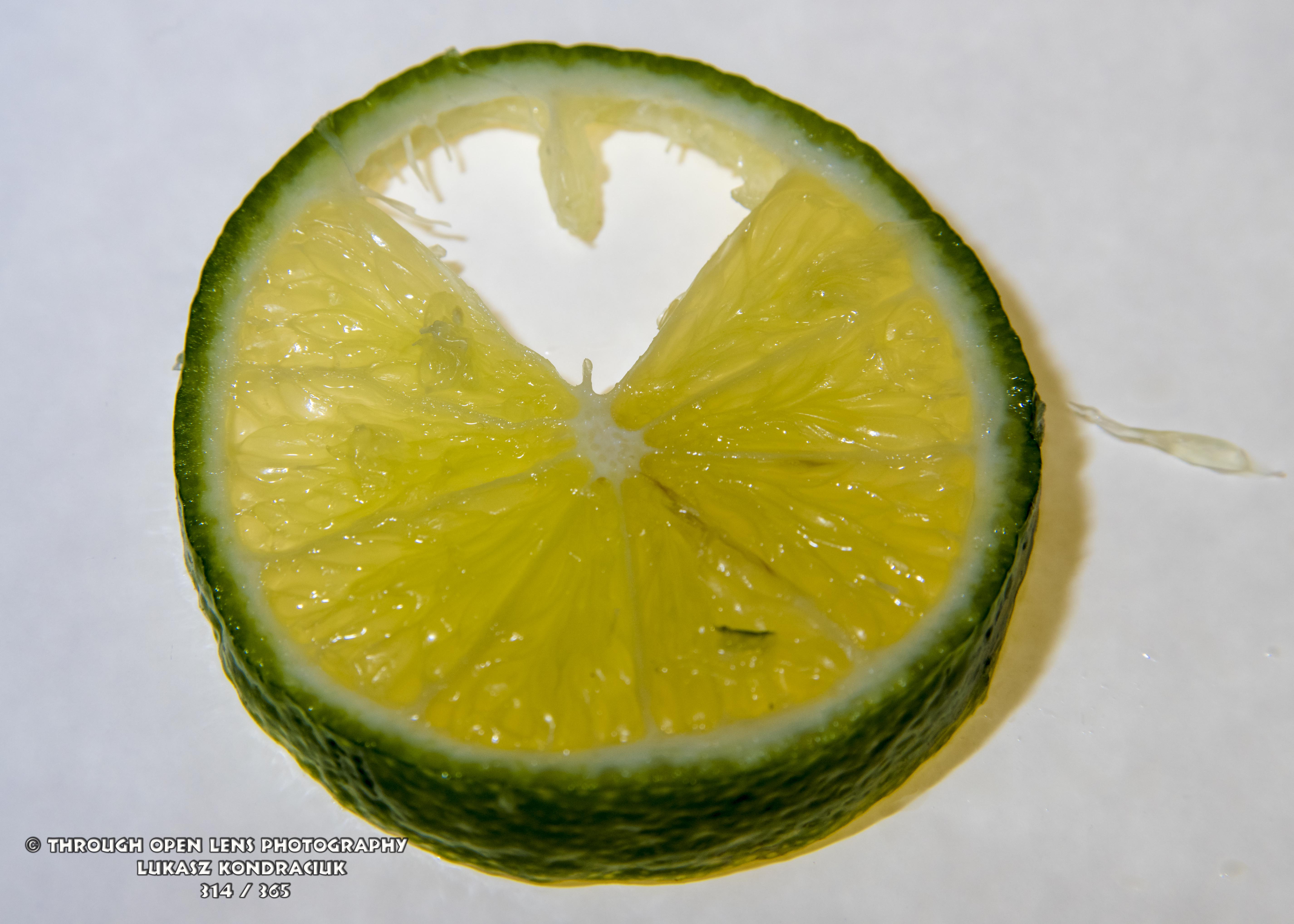
First They Are Sour Then They Are Sweet

lime

F/ 13.0, 1/60, ISO 320.

Day 314 / 365

There was a scientist who wanted to see how smart kids were before they went to kindergarten.
He blind-folded them and gave them a lime lifesaver to eat. He asked them if they knew what kind it was.
“Lime” they all replied
“Very good!” the scientist said “What about this one?” He gave them a honey flavored one and asked them if they knew what it was but no one knew.
“C’mon!” he said “It’s what your mommy calls your daddy”
All of the sudden one kid spits it out and yells out “EVERYBODY SPIT IT OUT – THEY’RE A$$HOLES!”

Interesting Fact: To prevent scurvy during the 19th century, British sailors were issued a daily allowance of citrus, such as lemon, and later switched to lime.[8] The use of citrus was initially a closely guarded military secret, as scurvy was a common scourge of various national navies, and the ability to remain at sea for lengthy periods without contracting the disorder was a huge benefit for the military. The British sailor thus acquired the nickname, “Limey” because of their usage of limes. ( https://en.m.wikipedia.org/wiki/Lime_(fruit) )

Blow The Speakers

Loudspeaker

F/4.5, 1/ 60, ISO 320.

Day 213 / 365

A guy is sitting in the restaurant when suddenly he realize that he needed to pass gas. The music was really, really loud, so he timed his
gas with the beat of the music. After a couple of songs, he started to feel better. He finished his coffee, and noticed that everybody was staring at him….
Then he suddenly remembered that he was listening to his iPod.

Interesting Fact: Johann Philipp Reis installed an electric loudspeaker in his telephone in 1861; it was capable of reproducing clear tones, but also could reproduce muffled speech after a few revisions.[3] Alexander Graham Bell patented his first electric loudspeaker (capable of reproducing intelligible speech) as part of his telephone in 1876, which was followed in 1877 by an improved version from Ernst Siemens. During this time, Thomas Edison was issued a British patent for a system using compressed air as an amplifying mechanism for his early cylinder phonographs, but he ultimately settled for the familiar metal horn driven by a membrane attached to the stylus. In 1898, Horace Short patented a design for a loudspeaker driven by compressed air; he then sold the rights to Charles Parsons, who was issued several additional British patents before 1910. A few companies, including the Victor Talking Machine Company and Pathé, produced record players using compressed-air loudspeakers. However, these designs were significantly limited by their poor sound quality and their inability to reproduce sound at low volume. Variants of the system were used for public address applications, and more recently, other variations have been used to test space-equipment resistance to the very loud sound and vibration levels that the launching of rockets produces. ( https://en.wikipedia.org/wiki/Loudspeaker#History )


The Duck Says Quack!

Ruddy Duck

F/ 10.0, 1/400, ISO 250.

Ruddy Duck

Day 312 / 365

What did the duck say when he dropped the dishes?

I hope I didn’t quack any!”
Interesting Fact: Though Ruddy Ducks are native to the Americas, one population became established in England after captive ducks escaped in 1952. This population grew to about 3,500 individuals by 1992, and now appears to be expanding into the Netherlands, France, Belgium, and Spain. ( https://www.allaboutbirds.org/guide/Ruddy_Duck/lifehistory ).

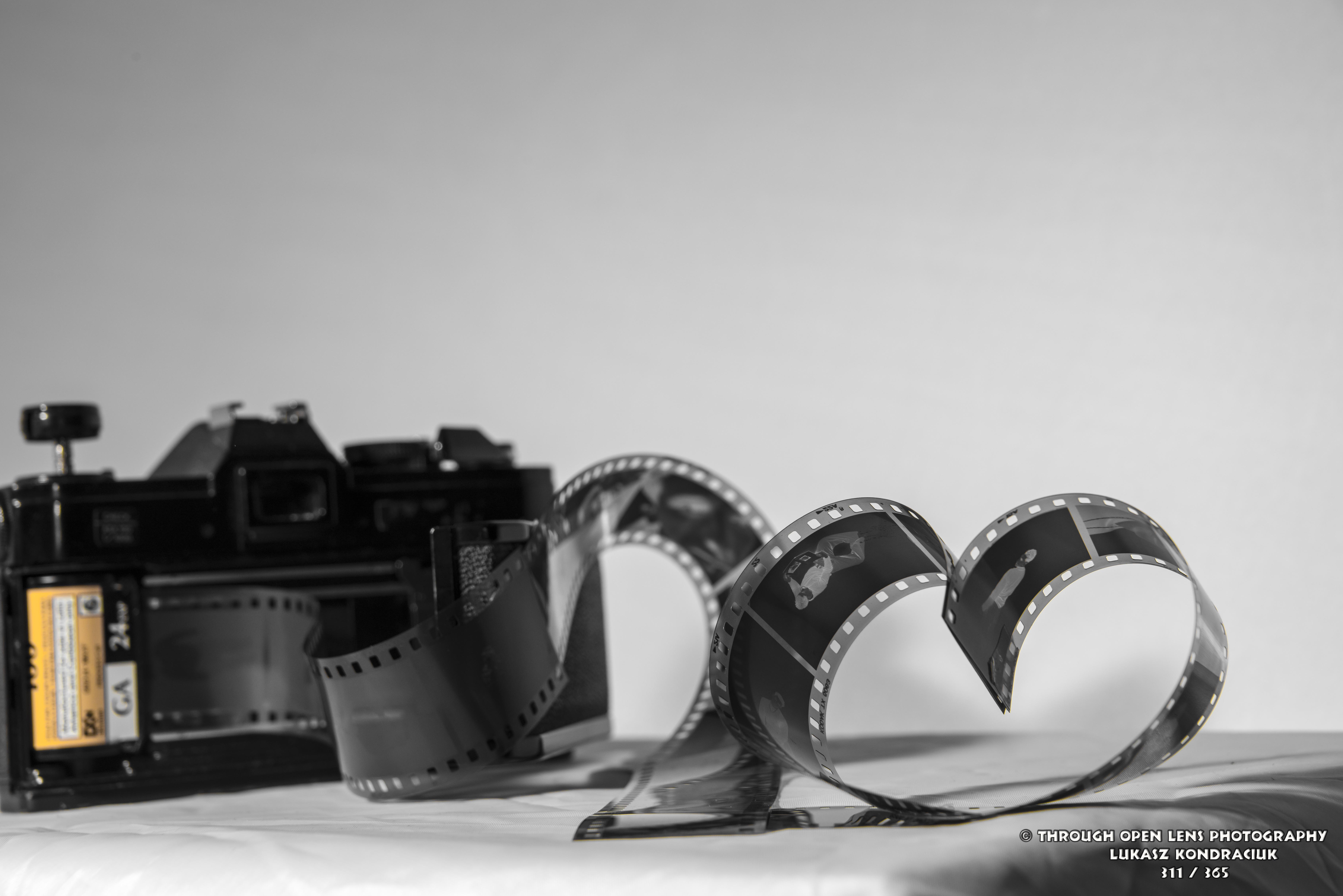
Love The Past With The Future  

love film negative

F/9.0, 1/60, ISO 125.

Day 311 / 365

Ever since buying a digital camera, I can only think of it’s positive points. There aren’t any negatives.

Interesting Fact: Around the year 1800, Thomas Wedgwood made the first known attempt to capture the image in a camera obscura by means of a light-sensitive substance. He used paper or white leather treated with silver nitrate. Although he succeeded in capturing the shadows of objects placed on the surface in direct sunlight, and even made shadow-copies of paintings on glass, it was reported in 1802 that “[t]he images formed by means of a camera obscura have been found too faint to produce, in any moderate time, an effect upon the nitrate of silver.” The shadow images eventually darkened all over because “[n]o attempts that have been made to prevent the uncoloured part of the copy or profile from being acted upon by light have as yet been successful.”[8] Wedgwood may have prematurely abandoned his experiments due to frail and failing health; he died aged 34 in 1805. ( https://en.m.wikipedia.org/wiki/History_of_photography )

New York, Concrete Jungle Where Dreams Are Made Of There’s Nothin’ You Can’t Do Now You’re In New York

Empire State Building

F/16.0, 57.0, ISO 64.

Day 310 / 365

Two men are sitting drinking at a bar at the top of the Empire State
Building when the first man turns to the other and says, “You know,
last week I discovered that if you jump from the top of this building,
by the time you fall to the 10th floor, the winds around the building
are so intense that they carry you around the building and back into
the window.”

The bartender just shakes his head in disapproval while wiping the
bar.

The second guy says, “What are you a nut? There is no way that could
happen.” “No, it’s true,” said the first man, let me prove it to you.”
He gets up from the bar, jumps over the balcony, and plummets to the
street below. When he passes the 10th floor, the high wind whips him
around the building and back into the 10th floor window and he takes
the elevator back up to the bar. He met the second man, who looked
quite astonished. “You know, I saw that with my own eyes, but that
must have been a one time fluke.”

“No, I’ll prove it again,” says the first man as he jumps. Again just
as he is hurling toward the street, the 10th floor wind gently carries
him around the building and into the window.

Once upstairs he urges his fellow drinker to try it. “Well, what the
hey,” the second guy says, “it works, I’ll try it!” He jumps over the
balcony plunges downward, passes the 11th, 10th, 9th, 8th floors
…and hits the sidewalk with a ‘splat.’ Back upstairs the Bartender
turns to the other drinker, saying “You know, Superman, sometimes you
can be a real jerk.”

Interesting Fact: On July 28, 1945, a B-25 bomber that was lost in fog slammed into Empire State Building north wall of the 78th and 79th floors. Fourteen people were killed (it was a Saturday, so many offices were empty). Elevator operator Betty Lou Oliver survived a plunge of 75 stories inside an elevator, the Guinness World Record for the longest survived elevator fall recorded. There was no important structural damage to the building, which opened for business on the following Monday. ( https://www.walksofnewyork.com/blog/empire-state-building-facts )

I’m A Little Teapot Short And Stout

teapot

F/ 4.5, 1/60, ISO 250.

Day 309 / 365

What does the teapot say to its bag?

I don’t want another seep out of you!

Interesting Fact:  Tea drinking in Europe was initially the preserve of the upper classes since it was very expensive. Porcelain teapots were particularly desirable because porcelain could not be made in Europe at that time. It wasn’t until 1708 that Ehrenfried Walther von Tschirnhaus devised a way of making porcelain in Dresden, Germany, and started the Meissen factory in 1710.[5] When European potteries began to make their own tea wares they were naturally inspired by the Chinese designs. ( https://en.wikipedia.org/wiki/Teapot )

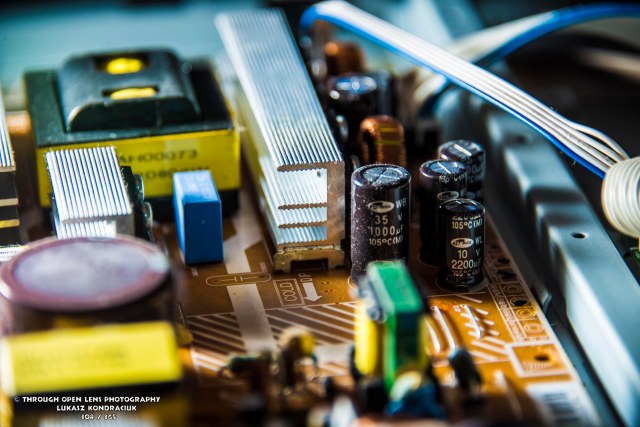
It’s Electrifying!

power supply board

F/5.6, 1/60, ISO 200.

Day 308 / 365

Experiencing problems with his computer, an incognizant user called technical support for assistance …

Technician: Good morning. How may I help you?

Customer: There’s smoke coming from my computer’s power supply.

Technician: Sounds like you need a new power supply.

Customer: No, I don’t! I just need to change the startup files.

Technician: Sir, what you described is a faulty power supply. It needs to be replaced.

Customer: No way! Someone told me that I just have to change the system startup files to fix the problem! All I need is for you to tell me the right command.

For the next several minutes, despite the technician’s efforts to explain the problem and its solution, the customer adamantly insisted that he was right. So, in frustration, the technician responded …

Technician: I’m sorry. Normally we don’t tell our customers this, but there is an undocumented DOS command that will fix the problem.

Customer: Aha! I knew it!

Technician: Add the line ‘LOAD NOSMOKE.COM’ at the end of the CONFIG.SYS file and everything should work fine. Let me know how it goes.

A few minutes later, the technician received a call back from the customer …

Customer: It didn’t work. The power supply is still smoking.

Technician: What version of DOS are you using?

Customer: MS-DOS 6.22.

Technician: Well, that’s your problem. That version of DOS doesn’t include NOSMOKE. You’ll need to contact Microsoft and ask them for a patch. Let me know how it all works out.

An hour passed and the technician received another call from the customer …

Customer: I need a new power supply.

Technician: Really? How did you reach that conclusion?

Customer: Well, I called Microsoft and told the technician what you said, and he started asking me questions about the make of the power supply.

Technician: I see. What did he tell you?

Customer: He said my power supply isn’t compatible with NOSMOKE!

Interesting Fact: 1910 An inductive discharge ignition system invented by Charles F. Kettering and his company (Delco) goes into production for Cadillac. This is a mechanically-switched version of a flyback boost converter with an autotransformer (the ignition coil). Variations of this ignition system are in all non-diesel internal combustion engines. 1926 “Electrical Condensors” by Coursey[1] mentions high frequency welding[2] and furnaces.[1] 1936 Car radios used electromechanical vibrators to transform the 6 V battery supply to a suitable B+ voltage for the vacuum tubes.[3] 1959 Transistor oscillation and rectifying converter power supply system U.S. Patent 3,040,271 is filed.[4] 1970 High-Efficiency Power Supply produced from about 1970 to 1995.[5][6][7][8] 1972 HP-35, Hewlett-Packard’s first pocket calculator, is introduced with transistor switching power supply for light-emitting diodes, clocks, timing, ROM, and registers.[9] 1977 Apple II is designed with a switching mode power supply. “Rod Holt was brought in as product engineer and there were several flaws in Apple II that were never publicized. One thing Holt has to his credit is that he created the switching power supply that allowed us to do a very lightweight computer“.[10] 1980 The HP8662A 10 kHz – 1.28 GHz synthesized signal generator went with a switched power supply. ( https://en.wikipedia.org/wiki/Switched-mode_power_supply#History )

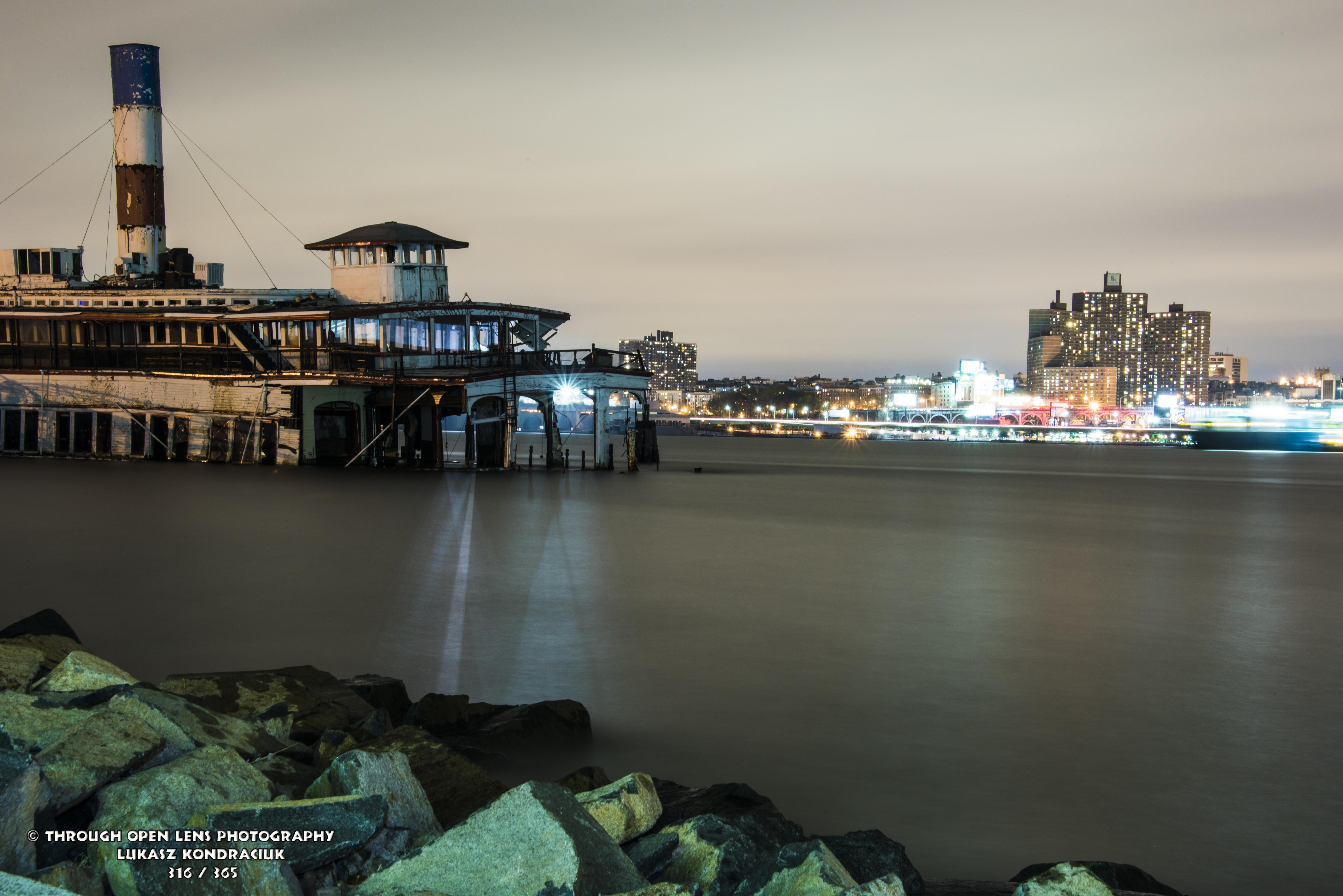
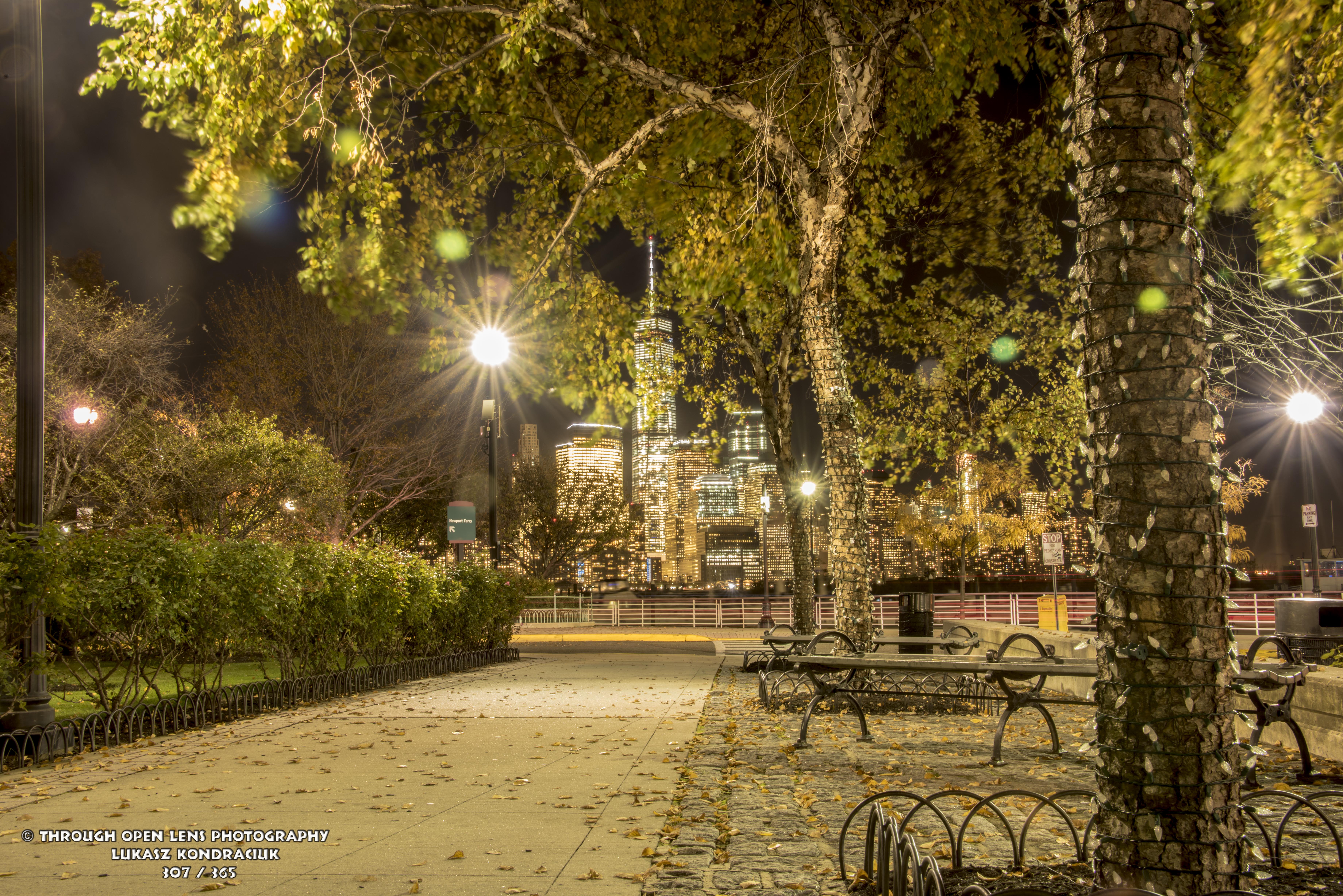
Dear Autumn, I Am Not Ready For What Comes Next

autumn night

F/ 25.0, 393.0, ISO 64.

Day 307 / 365

A couple goes to an art gallery. They find a picture of a naked women with only her privates covered with leaves.
The wife doesn’t like it and moves on but the husband keeps looking.
The wife asks: “What are you waiting for?”
The husband replies: “Autumn.”

Interesting Fact: As winter approaches, leaves make a coating for themselves which blocks their water source; in the absence of water, the leaves no longer produce chlorophyll (chlorophyll is what makes leaves green). ( http://www.metoffice.gov.uk/learning/learn-about-the-weather/how-weather-works/autumn-facts )