Time Is Precious, Waste It Wisely!

paint

F/ 13.0, 1/60, ISO 200, Photoshop CS6.

Day 351 / 365

A man was given the job of painting the white lines down the middle of a highway. On his first day he painted six miles; the next day three miles; the following day less than a mile. When the foreman asked the man why he kept painting less each day.

He replied “I just can’t do any better. Each day I keep getting further away from the paint can”.

Interesting Fact:  Ancient colored walls at Dendera, Egypt, which were exposed for years to the elements, still possess their brilliant color, as vivid as when they were painted about 2,000 years ago. The Egyptians mixed their colors with a gummy substance, and applied them separately from each other without any blending or mixture. They appear to have used six colors: white, black, blue, red, yellow, and green. They first covered the area entirely with white, then traced the design in black, leaving out the lights of the ground color. They used minium for red, and generally of a dark tinge. ( https://en.wikipedia.org/wiki/Paint#History )

Click! Click! Snap!

cartoon photography

F/16.0, 1/60, ISO 160.

Day 350 / 365

Top ten reasons to date a photographer:

  1. They work well in the dark
  2. They’re used to funny smells
  3. They make things develop
  4. They work well on many settings
  5. They know how to focus
  6. They can make big things look small and small things look big
  7. They work well from many different angles
  8. They zoom in and out. And in and out and in and out and in and out…
  9. They shoot in many different locations
  10. They can find the beauty in anything

Interesting Fact: Color photography is almost as old as black-and-white, with early experiments including John Herschel‘s Anthotype prints in 1842, the pioneering work of Louis Ducos du Hauron in the 1860s, and the Lippmann process unveiled in 1891, but for many years color photography remained little more than a laboratory curiosity. It first became a widespread commercial reality with the introduction of Autochrome plates in 1907, but the plates were very expensive and not suitable for casual snapshot-taking with hand-held cameras. The mid-1930s saw the introduction of Kodachrome and Agfacolor Neu, the first easy-to-use color films of the modern multi-layer chromogenic type. These early processes produced transparencies for use in slide projectors and viewing devices, but color prints became increasingly popular after the introduction of chromogenic color print paper in the 1940s. The needs of the motion picture industry generated a number of special processes and systems, perhaps the best-known being the now-obsolete three-strip Technicolor process. ( https://en.wikipedia.org/wiki/Photograph#History )


Don’t Get Erased

don't be erased

F/9.0, 1/60, ISO 320, Photoshop CS6.

Day 349 / 365

Mother: “why are you home from school so early?” son: “i was the only one who could answer a question.” mother: “oh, really?
What was the question?” son: “who threw the eraser at the principal?”

source: http://www.jokebuddha.com/Eraser#ixzz3uRglUMj4

Interesting Fact: Before rubber erasers, tablets of rubber or wax were used to erase lead or charcoal marks from paper. Bits of rough stone such as sandstone or pumice were used to remove small errors from parchment or papyrus documents written in ink. Crustless bread was used as an eraser in the past; a Meiji-era (1868-1912) Tokyo student said: “Bread erasers were used in place of rubber erasers, and so they would give them to us with no restriction on amount. So we thought nothing of taking these and eating a firm part to at least slightly satisfy our hunger.” ( https://en.wikipedia.org/wiki/Eraser#History )

I Never Thought It Was Such A Bad Little Tree. It’s Not Bad At All, Really. Maybe It Just Needs A Little Love.

Charlie Brown christmas tree

F/ 8.0, 1/60, ISO 250.

Day 348 / 365

Teacher: Who answers my next question, can go home.
One boy throws his bag out the window.
Teacher: Who just threw that?
Boy: Me and I’m going home now.

Interesting Fact: He first appeared in 1948, two years before Peanuts started, in a comic strip by Charles M. Schulz called Li’l Folks. He later appears in the first Peanuts comic strip, on October 2, 1950. The strip features Charlie Brown walking by, as the characters Shermy and Patty look at him. Shermy kept on praising him, but then suddenly insults him on the last panel. During the strip’s early years, Charlie Brown was much more playful than he is known, as he often played pranks and jokes on the other characters. On December 21 of the same year, his signature zig-zag T-shirt appeared; previously, he only wore a plain one. On the March 6, 1951 strip, Charlie Brown first appears to play baseball, as he was warming up before telling Shermy that they can start the game; however, he was the catcher, not yet the pitcher. ( https://en.wikipedia.org/wiki/Charlie_Brown#1940s-1950s )

Don’t Chirp With Your Mouth Full!

House Finch

F/ 10.0, 1/400, ISO 320.

House Finch

Day 347 / 365

Three birds were walking down the street. Two walked into a bar, the other one ducked!

Interesting Fact: The red of a male House Finch comes from pigments contained in its food during molt (birds can’t make bright red or yellow colors directly). So the more pigment in the food, the redder the male. This is why people sometimes see orange or yellowish male House Finches. Females prefer to mate with the reddest male they can find, perhaps raising the chances they get a capable mate who can do his part in feeding the nestlings. ( https://www.allaboutbirds.org/guide/House_Finch/lifehistory )

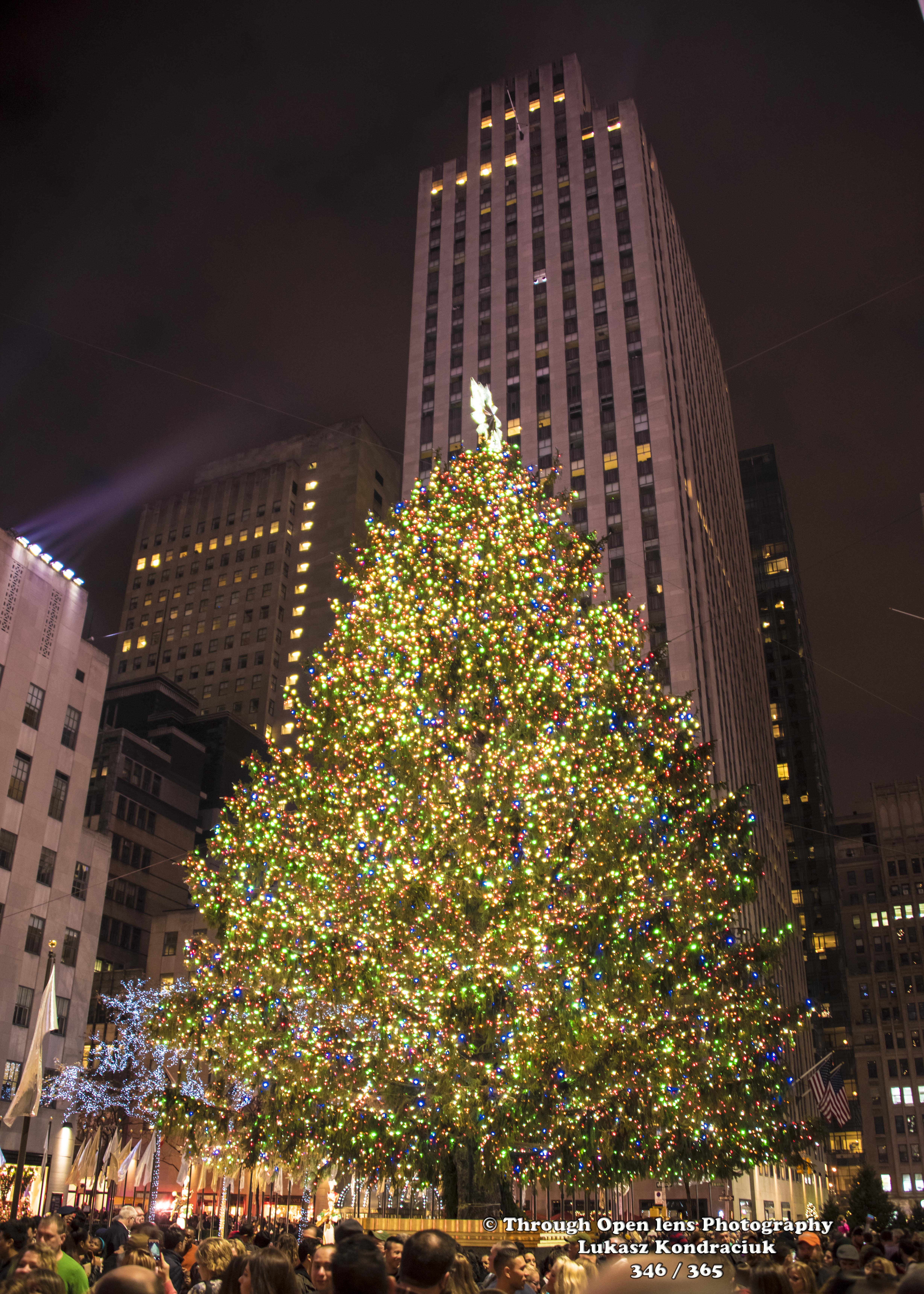
O Christmas Tree! O Christmas Tree!

nyc christmas tree

F/3.5, 1/15, ISO 500.

Day 346 / 365

A guy bought his wife a beautiful diamond ring for Christmas.
After hearing about this extravagant gift, a friend of his said, “I thought she wanted one of those sporty four-wheel-drive vehicles.”
“She did,” he replied. “But where was I going to find a fake Jeep?”

Interesting Fact: Although the official Christmas tree tradition at Rockefeller Center began in 1933 (the year 30 Rockefeller Plaza opened), the unofficial tradition began during the Depression-era construction of Rockefeller Center, when workers decorated a smaller 20 feet (6.1 m) balsam fir tree with “strings of cranberries, garlands of paper, and even a few tin cans” on Christmas Eve (December 24, 1931), as recounted by Daniel Okrent in his history of Rockefeller Center.[10] One claim is the tree had some gum wrappers and detonator blasting caps as decorations. There was no Rockefeller Center Christmas tree in 1932. ( https://en.wikipedia.org/wiki/Rockefeller_Center_Christmas_Tree#History )


Let There Be Lights!

Christmas lights Skyline

F/29.0, 39.0, ISO 64.

Day 345 / 365

Little Mikey had a cussing problem and his father was getting tired of it. He decided to ask his friend what to do. The friend said, “Since Christmas is coming up, you should ask Mikey what he wants Santa to bring him. If he cusses while he tells you his wish list, leave a pile of dog poop in place of the gift or gifts he requests.” Two days before Christmas, Mikey’s father asked him what he wanted for Christmas.
“I want a damn teddy-bear laying right beside me when I wake up. When I go downstairs I want to see a damn train going around the damn tree. And when I go outside I want to see a damn bike leaning against the damn garage.”
Christmas morning, Little Mikey woke up and rolled over into a pile of dog poop. Confused, he walked down stairs and saw another pile under the tree. Scratching his head, he walked outside and saw a huge pile of dog poop by the garage.
When Mikey walked back inside with a curious look on his face, his dad smiled and asked, “What did Santa bring you this year?”
Mikey replied, “I think I got a dog, but I can’t find the son-of-a-bitch!”

Interesting Fact: The illuminated Christmas tree became established in the United Kingdom during Queen Victoria’s reign, and through emigration spread to North America and Australia. In her journal for Christmas Eve 1832, the delighted 13-year-old princess wrote, “After dinner.. we then went into the drawing-room near the dining-room. There were two large round tables on which were placed two trees hung with lights and sugar ornaments. All the presents being placed round the trees”.[7] Until the availability of inexpensive electrical power in the early twentieth century, miniature candles were commonly (and in some cultures still are) used. ( https://en.wikipedia.org/wiki/Christmas_lights#History )

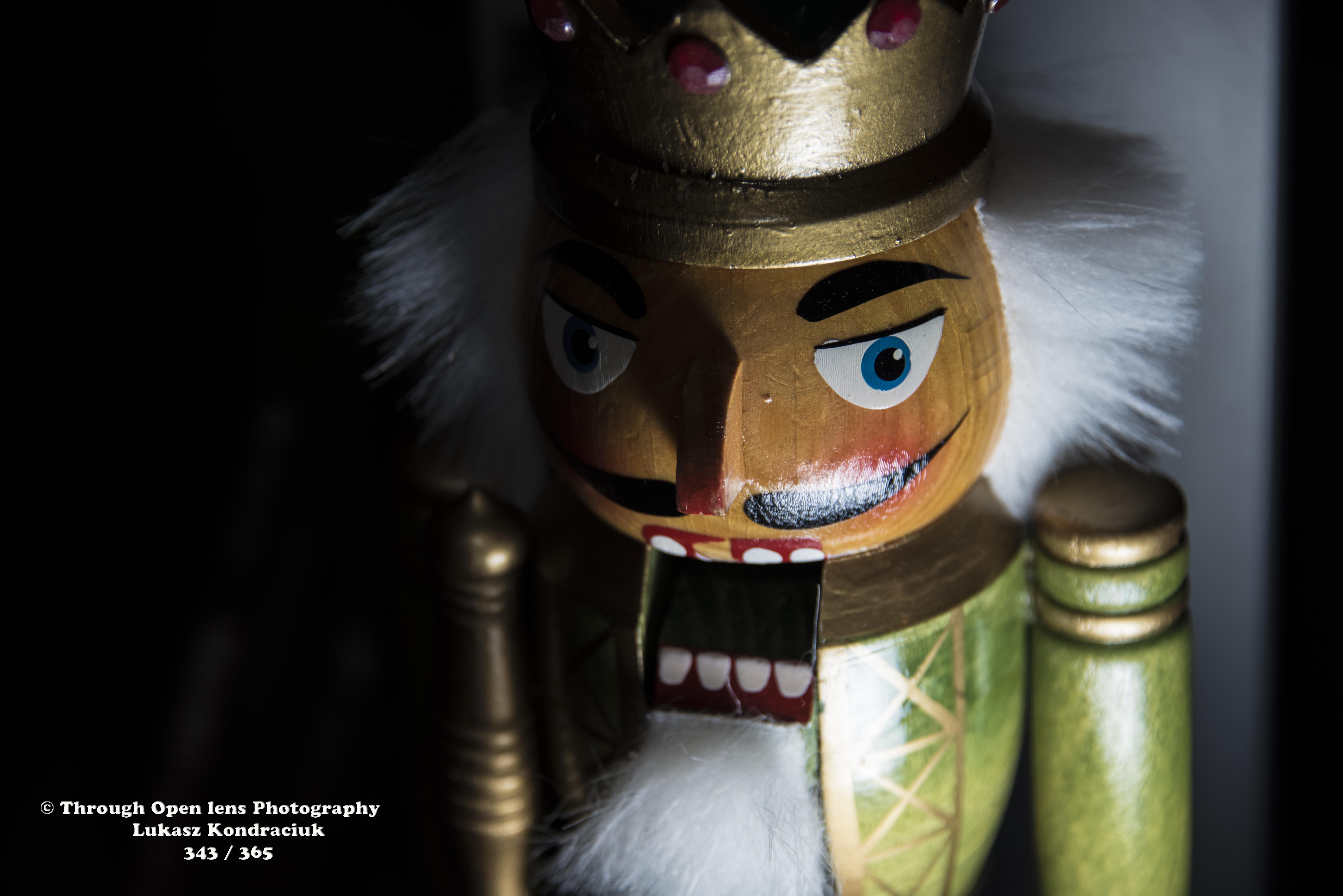
I’m Not A Player. I Just Crash A Lot.

Nutcracker

F/ 5.6, 1/60, ISO 250.

Day 343 / 365

What ballet do squirrels like?

The Nutcracker.

Interesting Fact: Manufacturers produce modern nutcrackers—designed to crack nuts—usually somewhat resembling pliers, but with the pivot point at the end beyond the nut, rather than in the middle. The spring-jointed nutcracker was patented by Henry Quackenbush in 1913. These are also used for cracking the shells of crab and lobster to make the meat inside available for eating. Nuts have long been a popular choice for desserts, particularly throughout Europe. The nutcrackers were placed on dining tables to serve as a fun and entertaining center of conversation while diners awaited their final course. At one time, nutcrackers were actually made of metals such as brass, and it wasn’t until maller birds crack seeds. In this case, the pivot point stands opposite the nut, at the jaw. Nutcrackers have also been used as a token of good luck and goodwill to protect people from evil spirits and danger. They were thought to bare their teeth at any evil spirits to scare them away, just like a guard dog might do. ( https://en.wikipedia.org/wiki/Nutcracker )

I Came In Like A Wrecking Ball!

The Elf on the Shelf

F/ 13.0, 15.0, ISO 100.

Day 342 / 365

What kind of money do elves use?

Jingle bills!

Interesting Fact: The Elf on the Shelf: A Christmas Tradition is a 2005 children’s picture book, written and self-published by American author Carol Aebersold and daughter Chanda Bell and illustrated by Coë Steinwart. The book tells a Christmas-themed story, written in rhyme, that explains how Santa Claus knows who is naughty and who is nice and describes elves visiting children between Thanksgiving and Christmas Eve, after which they return to the North Pole until the next holiday season. ( https://en.wikipedia.org/wiki/The_Elf_on_the_Shelf )

It’s Time For The Christmas Ball To Drop

Christmas ornament

F/5.3, 1.3, ISO 100.

Day 341 / 365

Why did the Christmas tree go to the barber?

It needed to be trimmed.

Interesting Fact: The first decorated trees were adorned with apples, white candy canes and pastries in the shapes of stars, hearts and flowers. Glass baubles were first made in Lauscha, Germany, by Hans Greiner (1550-1609) who produced garlands of glass beads and tin figures that could be hung on trees. The popularity of these decorations grew into the production of glass figures made by highly skilled artisans with clay molds. The artisans heated a glass tube over a flame, then inserted the tube into a clay mold, blowing the heated glass to expand into the shape of the mold. The original ornaments were only in the shape of fruits and nuts. After the glass cooled, a silver nitrate solution was swirled into it, a silvering technique developed in the 1850s by Justus von Liebig. After the nitrate solution dried, the ornament was hand-painted and topped with a cap and hook. ( https://en.wikipedia.org/wiki/Christmas_ornament )