Hot Chocolate Is Like A Hug From The Inside

Hot chocolate

F/ 4.8, 8.0, ISO 64.

Day 356 / 365

A man found a bottle on the beach. He opened it and out popped a genie, who gave the man three wishes. The man wished for a million dollars, and poof! There was a million dollars. Then he wished for a convertible, and poof! There was a convertible. And then, he wished he could be irresistible to all women… Poof! He turned into a box of chocolates.

Interesting Fact: What the Spaniards then called “chocolatl” was said to be a beverage consisting of a chocolate base flavored with vanilla and other spices that was served cold.[6][7] Because sugar was yet to come to the Americas,[4] xocolatl was said to be an acquired taste. The drink tasted spicy and bitter as opposed to sweetened modern hot chocolate.[4] As to when xocolatl was first served hot, sources conflict on when and by whom.[4][7] However, Jose de Acosta, a Spanish Jesuit missionary who lived in Peru and then Mexico in the later 16th century, described xocolatl as: Loathsome to such as are not acquainted with it, having a scum or froth that is very unpleasant taste. Yet it is a drink very much esteemed among the Indians, where with they feast noble men who pass through their country. The Spaniards, both men and women, that are accustomed to the country, are very greedy of this Chocolate. They say they make diverse sorts of it, some hot, some cold, and some temperate, and put therein much of that “chili”; yea, they make paste thereof, the which they say is good for the stomach and against the catarrh. ( https://en.wikipedia.org/wiki/Hot_chocolate )
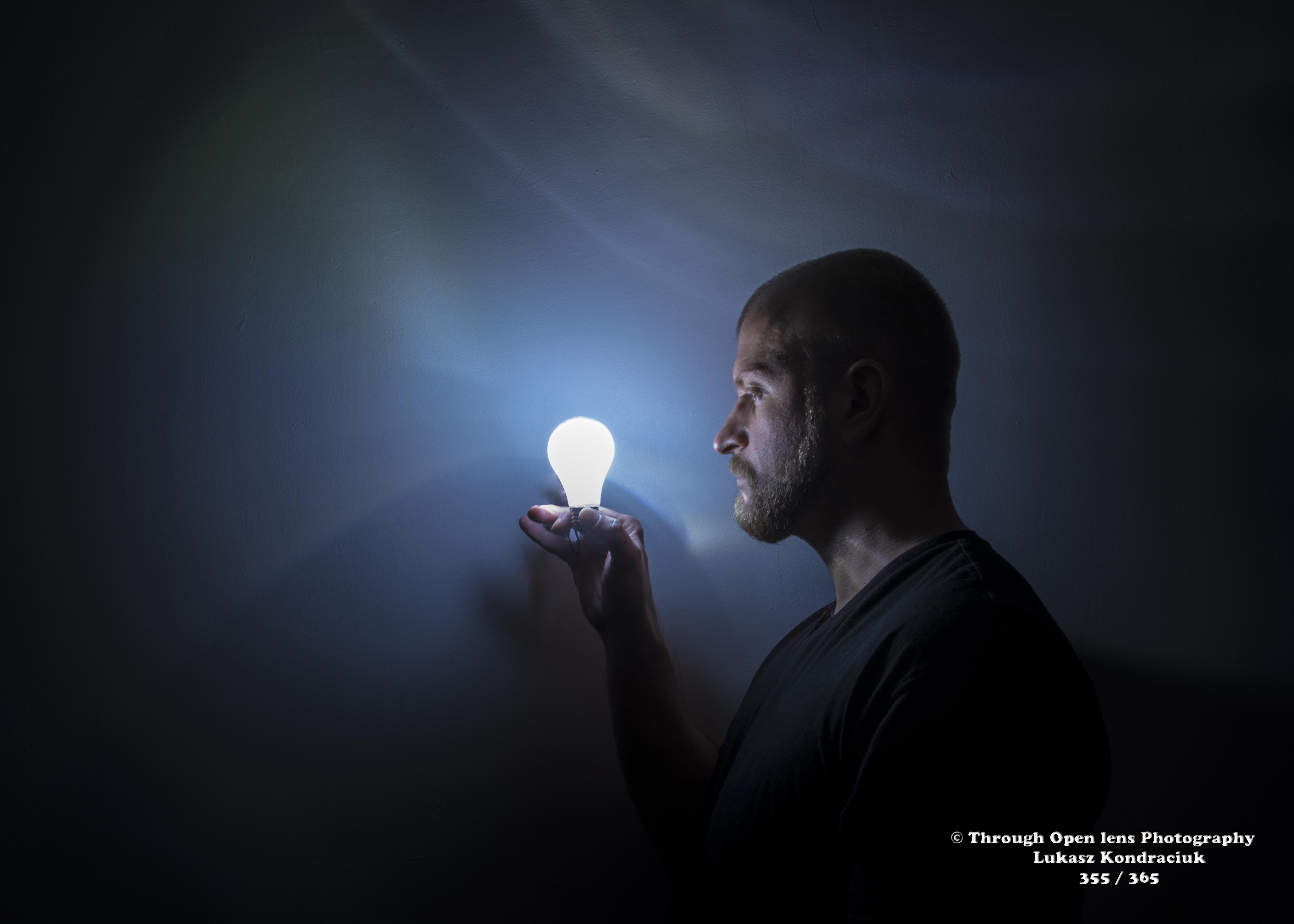
Ideas Just Come To Me

idea

F/ 10.0, 4.0, ISO 320.

Day 355 / 365

When the inventor of the drawing board messed things up, what did he go back to?

Interesting Fact: In addressing the question of who invented the incandescent lamp, historians Robert Friedel and Paul Israel[9] list 22 inventors of incandescent lamps prior to Joseph Swan and Thomas Edison. They conclude that Edison’s version was able to outstrip the others because of a combination of three factors: an effective incandescent material, a higher vacuum than others were able to achieve (by use of the Sprengel pump) and a high resistance that made power distribution from a centralized source economically viable. ( https://en.wikipedia.org/wiki/Incandescent_light_bulb#Early_pre-commercial_research )

Staring Contest!

Northern Pintail Ducks

F/ 9.0, 1/320, ISO 250.

Northern Pintail Ducks

Day 354 / 365

What’s another name for a clever duck?

A wise quacker!

Interesting Fact: Like the Mallard, the Northern Pintail breeds in a variety of habitats all across northern North America and Eurasia. Also like the Mallard, island populations have splintered off and evolved into separate species. Two closely related forms can be found on Crozet and Kerguelen islands in the very southern Indian Ocean, known as Eaton’s Pintail (Anas eatoni) ( https://www.allaboutbirds.org/guide/Northern_Pintail/lifehistory )

Eat So You Will Be Big And Strong!

White-throated Sparrow

F/ 6.3, 1/60, ISO 320.

White-throated Sparrow

Day 353 / 365

A couple of birds made a date to meet on the ledge outside the tenth floor of a skyscraper. The female was there on time, but the male arrived an hour late. “Where were you? I was worried sick.” “It was such nice day, I decided to walk.”
Interesting Fact: Although they look nothing alike and aren’t particularly closely related, the White-throated Sparrow and the Dark-eyed Junco occasionally mate and produce hybrids. The resulting offspring look like grayish, dully marked White-throated Sparrows with white outer tail feathers. ( https://www.allaboutbirds.org/guide/White-throated_Sparrow/lifehistory )

Lights Are On And The Dark Is Gone!

Jersey City Downtown

F/22.0, 42.0, ISO160.

Day 352 / 365

How do we really know that Santa is a man?

Because no woman would ever wear the same outfit year after year.

Interesting Fact: The first known electrically illuminated Christmas tree was the creation of Edward H. Johnson, an associate of inventor Thomas Edison. While he was vice president of the Edison Electric Light Company, a predecessor of today’s Con Edison electric utility, he had Christmas tree light bulbs especially made for him. He proudly displayed his Christmas tree, which was hand-wired with 80 red, white and blue electric incandescent light bulbs the size of walnuts, on December 22, 1882 at his home on Fifth Avenue in New York City. Local newspapers ignored the story, seeing it as a publicity stunt. However, it was published by a Detroit newspaper reporter, and Johnson has become widely regarded as the Father of Electric Christmas Tree Lights. By 1900, businesses started stringing up Christmas lights behind their windows.[12] Christmas lights were too expensive for the average person; as such, electric Christmas lights did not become the majority replacement for candles until 1930. ( https://en.wikipedia.org/wiki/Christmas_lights#History )

Time Is Precious, Waste It Wisely!

paint

F/ 13.0, 1/60, ISO 200, Photoshop CS6.

Day 351 / 365

A man was given the job of painting the white lines down the middle of a highway. On his first day he painted six miles; the next day three miles; the following day less than a mile. When the foreman asked the man why he kept painting less each day.

He replied “I just can’t do any better. Each day I keep getting further away from the paint can”.

Interesting Fact:  Ancient colored walls at Dendera, Egypt, which were exposed for years to the elements, still possess their brilliant color, as vivid as when they were painted about 2,000 years ago. The Egyptians mixed their colors with a gummy substance, and applied them separately from each other without any blending or mixture. They appear to have used six colors: white, black, blue, red, yellow, and green. They first covered the area entirely with white, then traced the design in black, leaving out the lights of the ground color. They used minium for red, and generally of a dark tinge. ( https://en.wikipedia.org/wiki/Paint#History )

Click! Click! Snap!

cartoon photography

F/16.0, 1/60, ISO 160.

Day 350 / 365

Top ten reasons to date a photographer:

  1. They work well in the dark
  2. They’re used to funny smells
  3. They make things develop
  4. They work well on many settings
  5. They know how to focus
  6. They can make big things look small and small things look big
  7. They work well from many different angles
  8. They zoom in and out. And in and out and in and out and in and out…
  9. They shoot in many different locations
  10. They can find the beauty in anything

Interesting Fact: Color photography is almost as old as black-and-white, with early experiments including John Herschel‘s Anthotype prints in 1842, the pioneering work of Louis Ducos du Hauron in the 1860s, and the Lippmann process unveiled in 1891, but for many years color photography remained little more than a laboratory curiosity. It first became a widespread commercial reality with the introduction of Autochrome plates in 1907, but the plates were very expensive and not suitable for casual snapshot-taking with hand-held cameras. The mid-1930s saw the introduction of Kodachrome and Agfacolor Neu, the first easy-to-use color films of the modern multi-layer chromogenic type. These early processes produced transparencies for use in slide projectors and viewing devices, but color prints became increasingly popular after the introduction of chromogenic color print paper in the 1940s. The needs of the motion picture industry generated a number of special processes and systems, perhaps the best-known being the now-obsolete three-strip Technicolor process. ( https://en.wikipedia.org/wiki/Photograph#History )


Don’t Get Erased

don't be erased

F/9.0, 1/60, ISO 320, Photoshop CS6.

Day 349 / 365

Mother: “why are you home from school so early?” son: “i was the only one who could answer a question.” mother: “oh, really?
What was the question?” son: “who threw the eraser at the principal?”

source: http://www.jokebuddha.com/Eraser#ixzz3uRglUMj4

Interesting Fact: Before rubber erasers, tablets of rubber or wax were used to erase lead or charcoal marks from paper. Bits of rough stone such as sandstone or pumice were used to remove small errors from parchment or papyrus documents written in ink. Crustless bread was used as an eraser in the past; a Meiji-era (1868-1912) Tokyo student said: “Bread erasers were used in place of rubber erasers, and so they would give them to us with no restriction on amount. So we thought nothing of taking these and eating a firm part to at least slightly satisfy our hunger.” ( https://en.wikipedia.org/wiki/Eraser#History )

I Never Thought It Was Such A Bad Little Tree. It’s Not Bad At All, Really. Maybe It Just Needs A Little Love.

Charlie Brown christmas tree

F/ 8.0, 1/60, ISO 250.

Day 348 / 365

Teacher: Who answers my next question, can go home.
One boy throws his bag out the window.
Teacher: Who just threw that?
Boy: Me and I’m going home now.

Interesting Fact: He first appeared in 1948, two years before Peanuts started, in a comic strip by Charles M. Schulz called Li’l Folks. He later appears in the first Peanuts comic strip, on October 2, 1950. The strip features Charlie Brown walking by, as the characters Shermy and Patty look at him. Shermy kept on praising him, but then suddenly insults him on the last panel. During the strip’s early years, Charlie Brown was much more playful than he is known, as he often played pranks and jokes on the other characters. On December 21 of the same year, his signature zig-zag T-shirt appeared; previously, he only wore a plain one. On the March 6, 1951 strip, Charlie Brown first appears to play baseball, as he was warming up before telling Shermy that they can start the game; however, he was the catcher, not yet the pitcher. ( https://en.wikipedia.org/wiki/Charlie_Brown#1940s-1950s )

Don’t Chirp With Your Mouth Full!

House Finch

F/ 10.0, 1/400, ISO 320.

House Finch

Day 347 / 365

Three birds were walking down the street. Two walked into a bar, the other one ducked!

Interesting Fact: The red of a male House Finch comes from pigments contained in its food during molt (birds can’t make bright red or yellow colors directly). So the more pigment in the food, the redder the male. This is why people sometimes see orange or yellowish male House Finches. Females prefer to mate with the reddest male they can find, perhaps raising the chances they get a capable mate who can do his part in feeding the nestlings. ( https://www.allaboutbirds.org/guide/House_Finch/lifehistory )