Fly Me To The Moon

moon 2

F/6.3, 1/2500, ISO 500, Photoshop CS6.

Day 266 / 365

When is the moon not hungry?

When it is full!

Interesting Fact: When a month has two full moons, the second full moon is called a blue moon. Another definition of a blue moon is the third full moon in any season (quarter of year) containing 4 total full moons. ( http://www.moonconnection.com/moon_facts.phtml )

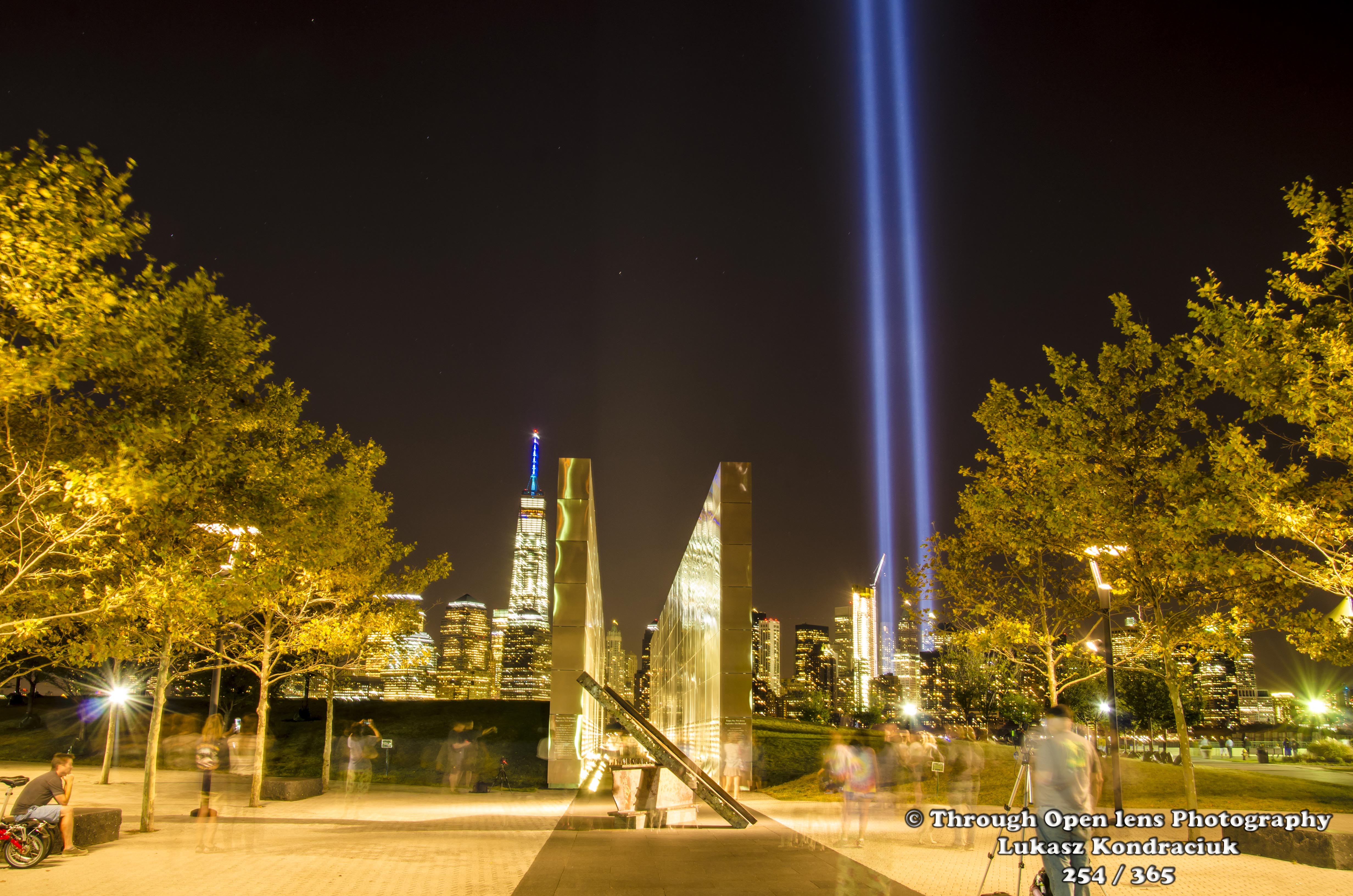
We Remember!

September 11

F/14.0, 30.0, ISO 100.

Day 254 / 365

God Bless all who lost their Lives. We Will Never Forget 9/11.

Interesting Fact:  September 11 is now remembered as Patriot Day in the US in memory of those killed. ( http://www.express.co.uk/life-style/top10facts/509590/Top-10-facts-about-9-11 )

Imagine What Else Is Out There.

Jersey City

F/ 14.0, 30.0, ISO 100.

Day 253 / 365

What did the painter say to the wall?

One more crack like that and I’ll plaster ya.

Interesting Fact: The land comprising what is now Jersey City was inhabited by the Lenape, a collection of tribes (later called Delaware Indian). In 1609, Henry Hudson, seeking an alternate route to East Asia, anchored his small vessel Halve Maen (English: Half Moon) at Sandy Hook, Harsimus Cove and Weehawken Cove, and elsewhere along what was later named the North River. After spending nine days surveying the area and meeting its inhabitants, he sailed as far north as Albany. By 1621, the Dutch West India Company was organized to manage this new territory and in June 1623, New Netherland became a Dutch province, with headquarters in New Amsterdam. Michael Reyniersz Pauw received a land grant as patroon on the condition that he would establish a settlement of not fewer than fifty persons within four years. He chose the west bank of the North River (Hudson River) and purchased the land from the Lenape. This grant is dated November 22, 1630 and is the earliest known conveyance for what are now Hoboken and Jersey City. Pauw, however, was an absentee landlord who neglected to populate the area and was obliged to sell his holdings back to the Company in 1633.[29] That year, a house was built at Communipaw for Jan Evertsen Bout, superintendent of the colony, which had been named Pavonia (the Latinized form of Pauw’s name, which means peacock).[30] Shortly after, another house was built at Harsimus Cove and became the home of Cornelius Van Vorst, who had succeeded Bout as superintendent, and whose family would become influential in the development of the city. Relations with the Lenape deteriorated, in part because of the colonialist’s mismanagement and misunderstanding of the indigenous people, and led to series of raids and reprisals and the virtual destruction of the settlement on the west bank. During Kieft’s War, approximately eighty Lenapes were killed by the Dutch in a massacre at Pavonia on the night of February 25, 1643. ( https://en.wikipedia.org/wiki/Jersey_City,_New_Jersey#Lenape_and_New_Netherland )

Tick Tock Goes The Clock!

Colgate Clock

F/18.0, 30.0, ISO 100.

Day 249 / 365

What does a wall clock do after it stops ticking?

It hangs around.

Interesting Fact: The current Colgate Clock was built in 1924 to replace an earlier clock designed by Colgate engineer Warren Davey, which was constructed by the Seth Thomas Clock Company for Colgate’s centennial in 1906. After the current clock’s construction, the earlier clock was relocated to a Colgate factory in Clarksville, Indiana.[1][2][3] The Jersey City clock was maintained by John A. Winters from the 1930s until his retirement in 1976. ( https://en.wikipedia.org/wiki/Colgate_Clock_(Jersey_City))

Let’s Go For A Little Ride

let's go for a ride

F/29.0, 30.0, ISO 100.

Day 236 /365

A guy walks into a bar and demands to know “Who’s the strongest in here?”
The toughest guy looks at him and says “I am the strongest around here!”
The other guy politely asks “Can you help me push my car to the gas station?”

Interesting Fact:  By 1932, the name fiasco between Horch the man, and Horch the company was water under the bridge. Horch (the company) and Audi entered an agreement along with two other German car manufacturers, DKW and Wanderer, to form Auto Union. The four rings, which Audi still uses today, originally represented the four companies of Auto Union. After the merger, Auto Union became the second biggest car company in Germany after Mercedes-Benz. Each of the companies were allocated a market segment: Horch would build high-end luxury cars, Audi focused on deluxe mid-size cars, Wanderer was put in charge of standard mid-size cars, and DKW was tasked with small cars and motorcycles. ( http://www.carcrushing.com/12-things-didnt-know-audi/)

Park Closes At Dusk!

park bench

F/10.0, 30.0, ISO 100.

Day 245 / 365

I woke up on a park bench and had no idea where I had been

And then I remembered, I’d been to the park

Interesting Fact: The first parks were English deer parks,[citation needed] land set aside for hunting by royalty and the aristocracy in medieval times. They had walls or thick hedges around them to keep game animals (e.g., stags) in and people out. It was strictly forbidden for commoners to hunt animals in these deer parks. ( https://en.wikipedia.org/wiki/Park#History )


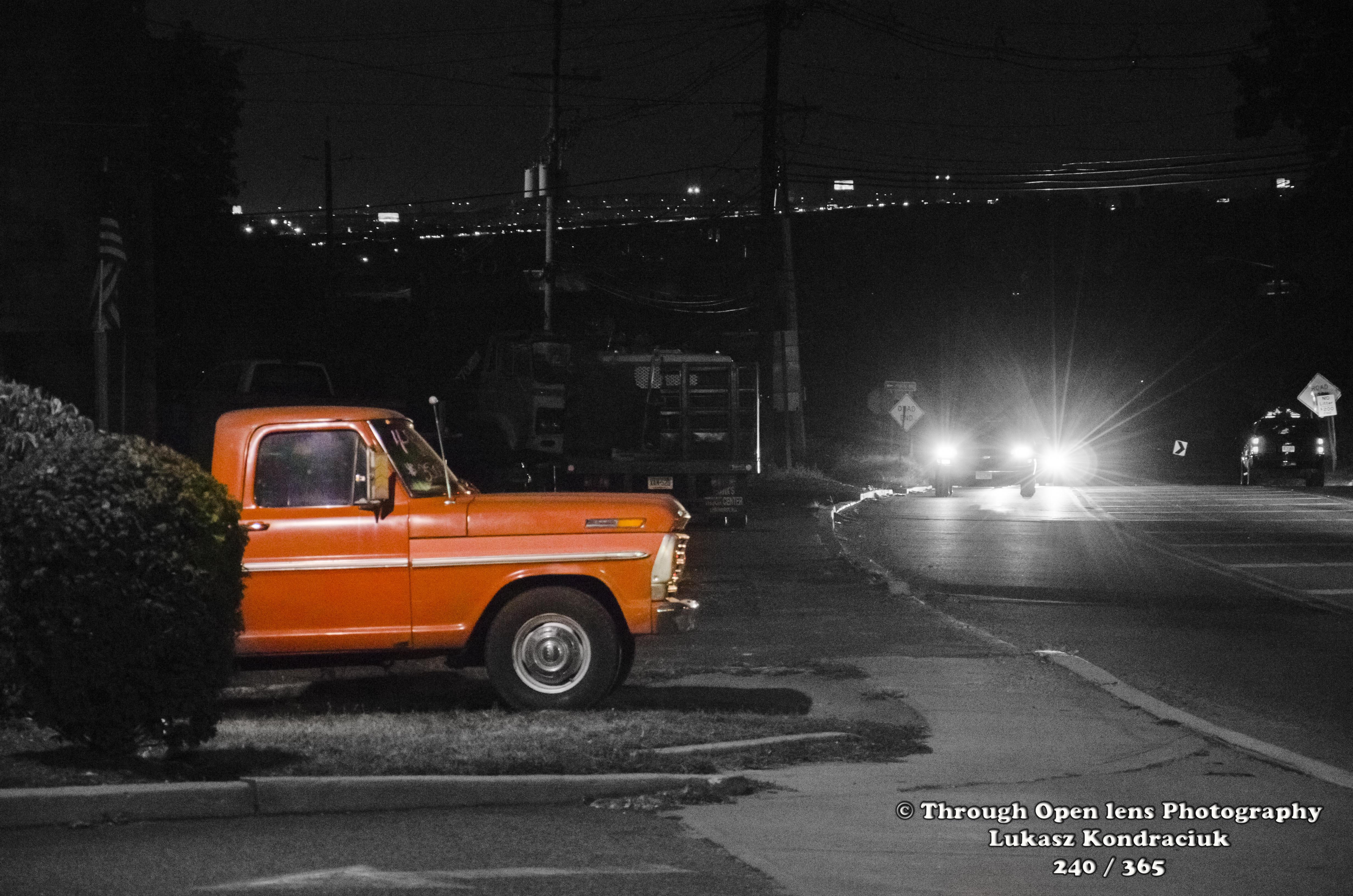
Out Of The Shadows Into The Light.

Orange Truck

F/5.6, 1/30, ISO 800.

Day 240 / 365

A police officer sees a man driving around with a pickup truck full of penguins. He pulls the guy over and says: “You can’t drive around with penguins in this town! Take them to the zoo immediately.” The guy says OK, and drives away.  The next day, the officer sees the guy still driving around with the truck full of penguins, and they’re all wearing sun glasses.  He pulls the guy over and demands: “I thought I told you to take these penguins to the zoo yesterday?”

The guy replies: “I did… today I’m taking them to the beach!”

Interesting Fact: In the early days of automobile manufacturing, vehicles were sold as a chassis only, and third parties added bodies on top.[5] In 1913 the Galion Allsteel Body Company, an early developer of the pickup and dump truck, built and installed hauling boxes on slightly modified Ford Model T chassis,[6] and from 1917 on the Model TT. Seeking part of this market share, Dodge introduced a 3/4-ton pickup with cab and body constructed entirely of wood in 1924.[7] In 1925 Ford followed up with a Model T-based steel-bodied, half-ton with an adjustable tailgate and heavy-duty rear springs.[8] Billed it as the “Ford Model T Runabout with Pickup Body,” it sold for US$281. 34,000 were built. In 1928 it was replaced by the Model A which had a closed-cab, safety glass windshield, roll-up side windows and three-speed transmission. In 1931 Chevrolet produced its first factory-assembled pickup.[9] Ford Australia produced the first Australian “ute” in 1932.[10] During the second world war, the United States government halted the product of privately-owned pickup trucks. ( https://en.wikipedia.org/wiki/Pickup_truck )

I’m Cute And Cuddly. But I Will Steal Your Stuff When You Are Not Looking!

Chinchilla

F/5.6, 1/60, ISO 800.

Chinchilla

Day 239 / 365

A man went to visit a friend and was amazed to find him playing chess with his Chinchilla. He watched the game in astonishment for a while. “I can hardly believe my eyes!” he exclaimed. “That’s the smartest chinchilla I’ve ever seen.”

“Nah, he’s not so smart,” the friend replied. “I’ve beaten him three games out of five.”

Interesting Fact: Chinchillas see with their whiskers. Even though they have big eyes, the eyes are under developed, making the Chinchilla not see well with it. They have long whiskers which can grow half the length of their body to help them ‘see’ or rather feel things around them. ( http://chinchilla.co/chinchilla-facts/ )

Orange You Glad To See Me?!

orange you glad

F/3.5, 1/60, ISO 100.

Day 232 / 365

Why did the orange fail his driving test?

He kept peeling out.

Interesting Fact: Because oranges do not spoil easily and are full of vitamin C during the years of world exploration sailors planted orange and other citrus trees along trade routes to prevent scurvy which is a disease that develops from a deficiency of vitamin C. ( http://snip.ly/LNaQ#http://www.sciencekids.co.nz/sciencefacts/food/oranges.html )

At Night I Can’t Sleep, In The Morning I Can’t Wake Up.

north arlington

F/ 14.0, 30.0, ISO 100.

Day 231 / 365

How can you go without sleep for seven days and not be tired?

Sleep at night.

Interesting Fact: In the early 1900s, a few notable photographers, Alfred Stieglitz and William Fraser, began working at night. The first known female night photographer is Jessie Tarbox Beals. The first photographers known to have produced large bodies of work at night were Brassai and Bill Brandt. In 1932, Brassai published Paris de Nuit, a book of black-and-white photographs of the streets of Paris at night. During World War II, British photographer Brandt took advantage of the black-out conditions to photograph the streets of London by moonlight. ( https://en.wikipedia.org/wiki/Night_photography )