You Make Me Blush!

House Finch

F/ 6.3, 1/640, ISO 800.

House Finch

Day 257 / 365

Why do birds lay eggs?

If they dropped them, they d break!

Interesting Fact: The House Finch was originally a bird of the western United States and Mexico. In 1940 a small number of finches were turned loose on Long Island, New York, after failed attempts to sell them as cage birds (“Hollywood finches”). They quickly started breeding and spread across almost all of the eastern United States and southern Canada within the next 50 years. ( http://www.allaboutbirds.org/guide/House_Finch/lifehistory )

I Don’t Think You Want To Pull His Finger

Skunk

F/6.3, 1/160, ISO 1600.

Skunk

Day 256 / 365

Have you heard the skunk joke?

You don’t want to; it really stinks!

Interesting Fact: Skunks are legendary for their powerful predator-deterrent—a hard-to-remove, horrible-smelling spray. A skunk’s spray is an oily liquid produced by glands under its large tail. To employ this scent bomb, a skunk turns around and blasts its foe with a foul mist that can travel as far as ten feet (three meters). ( http://animals.nationalgeographic.com/animals/mammals/skunk/ )

I Want To Fly Like An Eagle

American Kestrel 1

F/6.3, 1/800, ISO 800.

American Kestrel

Day 255 / 365

Why did the American Kestrel cross the road, roll in the mud, and cross back?

He was a dirty double-crosser!

Interesting Fact: When nature calls, nestling kestrels back up, raise their tails, and squirt feces onto the walls of the nest cavity. The feces dry on the cavity walls and stay off the nestlings. The nest gets to be a smelly place, with feces on the walls and uneaten parts of small animals on the floor. ( http://www.allaboutbirds.org/guide/American_Kestrel/lifehistory )


We Remember!

September 11

F/14.0, 30.0, ISO 100.

Day 254 / 365

God Bless all who lost their Lives. We Will Never Forget 9/11.

Interesting Fact:  September 11 is now remembered as Patriot Day in the US in memory of those killed. ( http://www.express.co.uk/life-style/top10facts/509590/Top-10-facts-about-9-11 )

Imagine What Else Is Out There.

Jersey City

F/ 14.0, 30.0, ISO 100.

Day 253 / 365

What did the painter say to the wall?

One more crack like that and I’ll plaster ya.

Interesting Fact: The land comprising what is now Jersey City was inhabited by the Lenape, a collection of tribes (later called Delaware Indian). In 1609, Henry Hudson, seeking an alternate route to East Asia, anchored his small vessel Halve Maen (English: Half Moon) at Sandy Hook, Harsimus Cove and Weehawken Cove, and elsewhere along what was later named the North River. After spending nine days surveying the area and meeting its inhabitants, he sailed as far north as Albany. By 1621, the Dutch West India Company was organized to manage this new territory and in June 1623, New Netherland became a Dutch province, with headquarters in New Amsterdam. Michael Reyniersz Pauw received a land grant as patroon on the condition that he would establish a settlement of not fewer than fifty persons within four years. He chose the west bank of the North River (Hudson River) and purchased the land from the Lenape. This grant is dated November 22, 1630 and is the earliest known conveyance for what are now Hoboken and Jersey City. Pauw, however, was an absentee landlord who neglected to populate the area and was obliged to sell his holdings back to the Company in 1633.[29] That year, a house was built at Communipaw for Jan Evertsen Bout, superintendent of the colony, which had been named Pavonia (the Latinized form of Pauw’s name, which means peacock).[30] Shortly after, another house was built at Harsimus Cove and became the home of Cornelius Van Vorst, who had succeeded Bout as superintendent, and whose family would become influential in the development of the city. Relations with the Lenape deteriorated, in part because of the colonialist’s mismanagement and misunderstanding of the indigenous people, and led to series of raids and reprisals and the virtual destruction of the settlement on the west bank. During Kieft’s War, approximately eighty Lenapes were killed by the Dutch in a massacre at Pavonia on the night of February 25, 1643. ( https://en.wikipedia.org/wiki/Jersey_City,_New_Jersey#Lenape_and_New_Netherland )

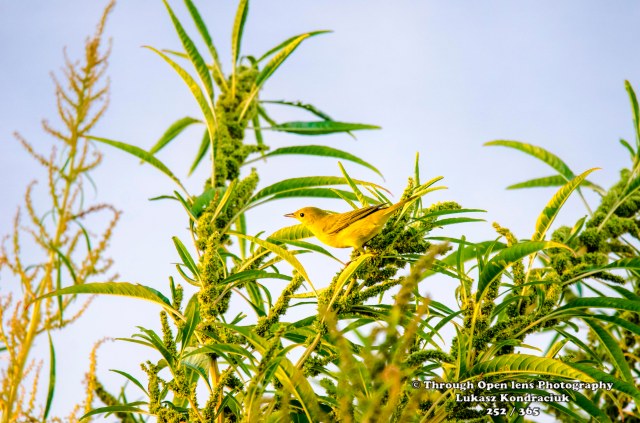
Yellow Is Back!

Yellow Warbler 2

F/6.3, 1/500, ISO 1600.

Yellow Warbler

Day 252 / 365

Daughter: Mom, can I have a yellow bird for Christmas?
Mom: NO! You’ll have turkey like everyone else.

Interesting Fact: Yellow Warblers forage along slender branches of shrubs and small trees, picking off insect prey as they go or briefly hovering to get at prey on leaves. Singing males perch near the tops of the bushes or trees in their territory. As male Yellow Warblers are setting up territories they may perform a “circle flight” in which they fly toward a neighboring male or female in a horizontal, semicircular path. A male may also fly slowly with fast, exaggerated wingbeats away from a female he is courting or a male he is competing with. As these territorial encounters proceed, males start by singing at each other; as the dispute goes on, the songs get quieter or switch to chip notes as the males begin to chase each other. Yellow Warblers typically form monogamous pairs that sometimes last more than one breeding season and reform the next. Yellow Warblers defend their nesting territories from many species, including other warbler species, chickadees, House Wrens, blackbirds, and Eastern Kingbirds. They may even chase off other warbler species while on their wintering grounds. Common predators of Yellow Warbler nests include garter snakes, red squirrels, jays, crows, raccoons, weasels, skunks, and domestic or feral cats. ( http://www.allaboutbirds.org/guide/Yellow_Warbler/lifehistory )

Ta-Da!!!

Clothespins

F/5.6, 1/60, ISO 100.

Day 251 / 365

What did the first sock say to the second sock in the dryer?

I’ll see you the next time around

Interesting Fact: The survival of the spring-hinged clothespin into the modern era is an unlikely story of Darwinian selection. From 1852 to 1887, the U.S. patent office issued 146 separate patents for clothespins. The first design that resembles the modern clothespin was patented in 1853 by David M. Smith, a prolific Vermont inventor. Smith also invented a combination lock, a “lathe dog” (a machine part for shaping metal) and a lifting spring for matchboxes. His “spring-clamp for clothes-lines” offered an elegant model of “two levers” hinged so that “the two longer legs may be moved toward each other and at the same time move the shorter ones apart.” Smith’s design was later improved by the 1887 patent of another Vermont inventor, Solon E. Moore, whose great contribution was the “coiled fulcrum,” made from a single wire, which joined the two grooved pieces of wood at the center of the clothespin. Moore’s version had the advantage of being both sturdy — it kept clothes securely on the line — and easy to manufacture. ( http://www.nytimes.com/2012/05/13/magazine/who-made-that-clothespin.html?_r=0 )

I Go Fast!

Flash

F/ 18.0, 6.0, ISO 100.

Day 250 / 365

What is the Flash’s favorite movie?
Fast & Furious!

Interesting Fact: The Flash first appeared in the Golden Age Flash Comics #1 (Jan. 1940), from All-American Publications, one of three companies that would eventually merge to form DC Comics. Created by writer Gardner Fox and artist Harry Lampert, this Flash was Jay Garrick, a college student who gained his speed through the inhalation of hard water vapors. When re-introduced in the 1960s Garrick’s origin was modified slightly, gaining his powers through exposure to heavy water. ( https://en.wikipedia.org/wiki/Flash_(comics)#Publication_history )

Tick Tock Goes The Clock!

Colgate Clock

F/18.0, 30.0, ISO 100.

Day 249 / 365

What does a wall clock do after it stops ticking?

It hangs around.

Interesting Fact: The current Colgate Clock was built in 1924 to replace an earlier clock designed by Colgate engineer Warren Davey, which was constructed by the Seth Thomas Clock Company for Colgate’s centennial in 1906. After the current clock’s construction, the earlier clock was relocated to a Colgate factory in Clarksville, Indiana.[1][2][3] The Jersey City clock was maintained by John A. Winters from the 1930s until his retirement in 1976. ( https://en.wikipedia.org/wiki/Colgate_Clock_(Jersey_City))

I Have To Stop Clowning Myself.

American Oystercatcher

F/6.3, 1/1600, ISO 400.

American Oystercatchers

Day 248 / 365

What did the egg say to the other egg?
You crack me up!

Interesting Fact: American Oystercatchers insert their long blade-like bills into mussels and other bivalves, severing the powerful adductor muscles before the shells can close. ( http://identify.whatbird.com/obj/1013/overview/American_Oystercatcher.aspx )