You Can Run, But You Can’t Hide

Peregrine Falcon

F/10.0, 1/400, ISO 250.

Peregrine Falcon

Day 291 / 365

What birds spend all their time on their knees?

Birds of prey!

Interesting Fact: The name “peregrine” means wanderer, and the Peregrine Falcon has one of the longest migrations of any North American bird. Tundra-nesting falcons winter in South America, and may move 25,000 km (15,500 mi) in a year. Maps of the migration of individual falcons determined by satellite telemetry can be seen at Environment Canada. ( http://www.allaboutbirds.org/guide/Peregrine_Falcon/lifehistory )

I’m Just Hanging Out

Golden-crowned Kinglet

F/6.3, 1/500, ISO 800.

Golden-crowned Kinglet

Day 289 / 365

When is the best time to buy birds?

When they’re going cheap!

Interesting Fact: The tiny Golden-crowned Kinglet is hardier than it looks, routinely wintering in areas where nighttime temperatures can fall below –40° Fahrenheit. ( https://www.allaboutbirds.org/guide/Golden-crowned_Kinglet/lifehistory )

Go Green!

Yellow-Rumped Warbler

F/6.3, 1/80, ISO 1000.

Yellow-Rumped Warbler

Day 288 / 365

I was in a park earlier and I saw a “keep off the grass” sign.

I couldn’t help but think… how did it get there?

Interesting Fact: Yellow-rumped Warblers are perhaps the most versatile foragers of all warblers. They’re the warbler you’re most likely to see fluttering out from a tree to catch a flying insect, and they’re also quick to switch over to eating berries in fall. Other places Yellow-rumped Warblers have been spotted foraging include picking at insects on washed-up seaweed at the beach, skimming insects from the surface of rivers and the ocean, picking them out of spiderwebs, and grabbing them off piles of manure.  ( http://www.allaboutbirds.org/guide/Yellow-rumped_Warbler/lifehistory )

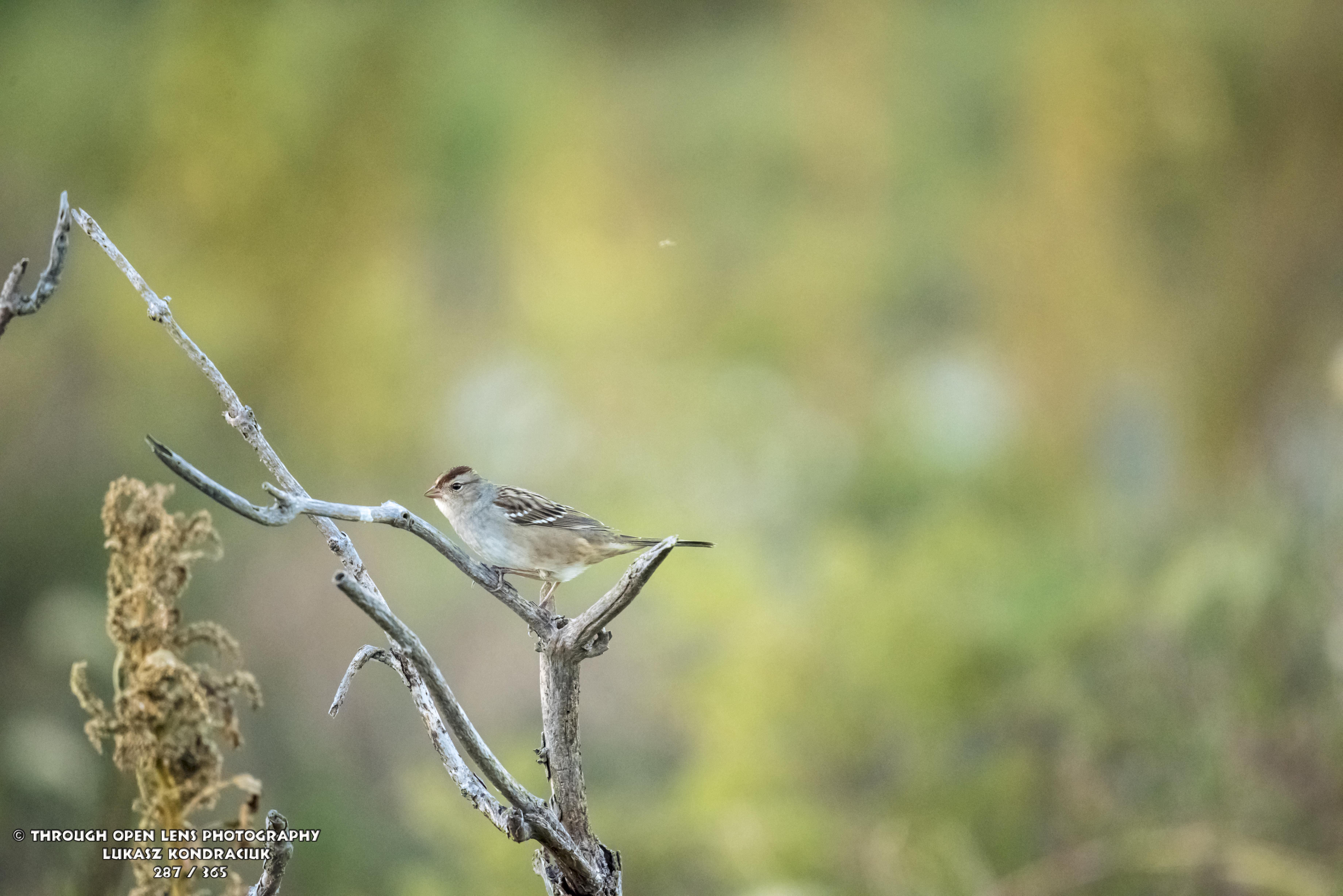
“I Am Training To Be A Spy”

American Tree Sparrow

F/6.3, 1/640, ISO 5600.

American Tree Sparrow

Day 287 / 365

Older couple were walking through the park when a sparrow flew overhead. The bird poop landed right on old man’s head.
Seeing the mess, old woman said, “I wish we had some toilet tissue.”
The Old man replied, “What good would it do. He’s probably a half a mile away by now.”

Interesting Fact: American Tree Sparrows need to take in about 30 percent of their body weight in food and a similar percentage in water each day. A full day’s fasting is usually a death sentence. Their body temperature drops and they lose nearly a fifth of their weight in that short time.  ( http://www.allaboutbirds.org/guide/American_Tree_Sparrow/lifehistory )

Swim At Your Own Risk!

Pied-Billed Grebe Juvenile

F/6.3, 1/640, ISO 6400.

Pied-Billed Grebe ( Juvenile )

Day 286 / 365

What robs you while you’re in the bathtub?

A robber ducky.

Interesting Fact: Pied-billed Grebes can trap water in their feathers, giving them great control over their buoyancy. They can sink deeply or stay just at or below the surface, exposing as much or as little of the body as they wish. The water-trapping ability may also aid in the pursuit of prey by reducing drag in turbulent water. ( http://www.allaboutbirds.org/guide/Pied-billed_Grebe/lifehistory )

Wiggle It Just A Little Bit

Palm Warbler

F/6.3, 1/80, ISO 500.

Palm Warbler

Day 281 / 365

A little boy comes in to a pet store.

Little boy : I’d like to buy some bird seed.
Clerk: How many birds do you have?
Little boy : None! I want to grow some!


Interesting Fact: The Palm Warbler can be most easily recognized by the tail-wagging habit that shows off its yellow undertail. ( http://identify.whatbird.com/obj/335/overview/Palm_Warbler.aspx )

Walking On Water Ain’t Easy!

Great Blue Heron 1

F/ 6.3, 1/160, ISO 320.

Great Blue Heron

Day 273 / 365

What holiday is observed by all birds?

Feather’s Day!

Interesting Fact: Great Blue Herons aren’t likely to visit a typical backyard. However, they are sometimes unwelcome visitors to yards that include fish ponds. A length of drain pipe placed in the pond can provide fish with a place to hide from feeding herons. Herons, like most of our birds, are legally protected by the Migratory Bird Treaty Act. ( http://www.allaboutbirds.org/guide/great_blue_heron/lifehistory )

Super Blood Moon

Blood Moon

F/6.3, 1/250, ISO 500, Photoshop CS6.

Day 270 / 365

How does a man on a moon get his haircut?

Eclipse it.

Interesting Fact: There is a total eclipse of the moon on the night of September 27-28, 2015. It happens to be the closest supermoon of 2015. It’s the Northern Hemisphere’s Harvest Moon, or full moon nearest the September equinox. It’s the Southern Hemisphere’s first full moon of spring. This September full moon is also called a Blood Moon, because it presents the fourth and final eclipse of a lunar tetrad: four straight total eclipses of the moon, spaced at six lunar months (full moons) apart. Phew! ( http://earthsky.org/tonight/total-lunar-eclipse-blood-moon-hunters-moon-september-27-28-2015 )


Fly Me To The Moon

moon 2

F/6.3, 1/2500, ISO 500, Photoshop CS6.

Day 266 / 365

When is the moon not hungry?

When it is full!

Interesting Fact: When a month has two full moons, the second full moon is called a blue moon. Another definition of a blue moon is the third full moon in any season (quarter of year) containing 4 total full moons. ( http://www.moonconnection.com/moon_facts.phtml )

Going Down Down Down

American Kestrel 2

F/6.3, 1/1250, ISO 400, Photoshop CS6.

American Kestrel

Day 260 / 365

Teacher: “What is the difference between a bird and fly?”
Student:  “Well…a bird can fly…..but a fly can’t bird.”

Interesting Fact: Unlike humans, birds can see ultraviolet light. This enables kestrels to make out the trails of urine that voles, a common prey mammal, leave as they run along the ground. Like neon diner signs, these bright paths may highlight the way to a meal—as has been observed in the Eurasian Kestrel, a close relative. ( http://www.allaboutbirds.org/guide/American_Kestrel/lifehistory )