Yellow Is Back!

Yellow Warbler 2

F/6.3, 1/500, ISO 1600.

Yellow Warbler

Day 252 / 365

Daughter: Mom, can I have a yellow bird for Christmas?
Mom: NO! You’ll have turkey like everyone else.

Interesting Fact: Yellow Warblers forage along slender branches of shrubs and small trees, picking off insect prey as they go or briefly hovering to get at prey on leaves. Singing males perch near the tops of the bushes or trees in their territory. As male Yellow Warblers are setting up territories they may perform a “circle flight” in which they fly toward a neighboring male or female in a horizontal, semicircular path. A male may also fly slowly with fast, exaggerated wingbeats away from a female he is courting or a male he is competing with. As these territorial encounters proceed, males start by singing at each other; as the dispute goes on, the songs get quieter or switch to chip notes as the males begin to chase each other. Yellow Warblers typically form monogamous pairs that sometimes last more than one breeding season and reform the next. Yellow Warblers defend their nesting territories from many species, including other warbler species, chickadees, House Wrens, blackbirds, and Eastern Kingbirds. They may even chase off other warbler species while on their wintering grounds. Common predators of Yellow Warbler nests include garter snakes, red squirrels, jays, crows, raccoons, weasels, skunks, and domestic or feral cats. ( http://www.allaboutbirds.org/guide/Yellow_Warbler/lifehistory )

Tick Tock Goes The Clock!

Colgate Clock

F/18.0, 30.0, ISO 100.

Day 249 / 365

What does a wall clock do after it stops ticking?

It hangs around.

Interesting Fact: The current Colgate Clock was built in 1924 to replace an earlier clock designed by Colgate engineer Warren Davey, which was constructed by the Seth Thomas Clock Company for Colgate’s centennial in 1906. After the current clock’s construction, the earlier clock was relocated to a Colgate factory in Clarksville, Indiana.[1][2][3] The Jersey City clock was maintained by John A. Winters from the 1930s until his retirement in 1976. ( https://en.wikipedia.org/wiki/Colgate_Clock_(Jersey_City))

I Have To Stop Clowning Myself.

American Oystercatcher

F/6.3, 1/1600, ISO 400.

American Oystercatchers

Day 248 / 365

What did the egg say to the other egg?
You crack me up!

Interesting Fact: American Oystercatchers insert their long blade-like bills into mussels and other bivalves, severing the powerful adductor muscles before the shells can close. ( http://identify.whatbird.com/obj/1013/overview/American_Oystercatcher.aspx )

This Fence Can’t Hold Me! I’m Breaking Out!

Yellow-breasted Chat

F/6.3, 1/640, ISO 800.

Yellow-breasted Chat

Day 247 / 365

Why did the Yellow-breasted Chat scale the chain-link fence?

To see what was on the other side.

Interesting Fact: Unlike most warblers, this species has been known to mimic the calls of other birds, and it’s the largest North American warbler.  ( http://identify.whatbird.com/obj/342/overview/Yellow-breasted_Chat.aspx )

Let’s Go For A Little Ride

let's go for a ride

F/29.0, 30.0, ISO 100.

Day 236 /365

A guy walks into a bar and demands to know “Who’s the strongest in here?”
The toughest guy looks at him and says “I am the strongest around here!”
The other guy politely asks “Can you help me push my car to the gas station?”

Interesting Fact:  By 1932, the name fiasco between Horch the man, and Horch the company was water under the bridge. Horch (the company) and Audi entered an agreement along with two other German car manufacturers, DKW and Wanderer, to form Auto Union. The four rings, which Audi still uses today, originally represented the four companies of Auto Union. After the merger, Auto Union became the second biggest car company in Germany after Mercedes-Benz. Each of the companies were allocated a market segment: Horch would build high-end luxury cars, Audi focused on deluxe mid-size cars, Wanderer was put in charge of standard mid-size cars, and DKW was tasked with small cars and motorcycles. ( http://www.carcrushing.com/12-things-didnt-know-audi/)

Park Closes At Dusk!

park bench

F/10.0, 30.0, ISO 100.

Day 245 / 365

I woke up on a park bench and had no idea where I had been

And then I remembered, I’d been to the park

Interesting Fact: The first parks were English deer parks,[citation needed] land set aside for hunting by royalty and the aristocracy in medieval times. They had walls or thick hedges around them to keep game animals (e.g., stags) in and people out. It was strictly forbidden for commoners to hunt animals in these deer parks. ( https://en.wikipedia.org/wiki/Park#History )


You Can’t See Me I’m A Flower!

The American Goldfinch

F/6.3, 1/800, ISO 800.

The American Goldfinch

Day 244 / 365

Why did the little bird get in trouble at school?

He got caught peeping on a test.

Interesting Fact: The American Goldfinch changes from winter plumage to breeding plumage by a complete molt of its body feathers. It is the only member of its family to have this second molt in the spring; all the other species have just one molt each year in the fall. ( http://identify.whatbird.com/obj/91/_/American_Goldfinch.aspx )

Bad Hair Day!

Red-tailed Hawks1

F/ 6.3, 1/1000, ISO 500.

Red-tailed Hawk

Day 243 / 365

How do witches keep their hair in place while flying?
With scare spray.

Interesting Fact: Red-tailed Hawks have a very keen eyesight that is 8 times as powerful as a human’s, allowing them to see prey as small as a mouse from 100 feet (~30 meters) away. ( http://beautyofbirds.com/redtailedhawks.html )

“Are You My Dinner? “

Red-tailed Hawks

F/6.3, 1/125, ISO 200.

Red-tailed Hawk

Day 242 / 365

Did you know my fiancé does a great bird impression.

She watches me like a hawk.

Interesting Fact: In flight, this hawk travels at speeds from 20 to 40 mph (64 km/h); however, when diving to catch prey, their speed may exceed 120 mph (190 km/h). ( http://beautyofbirds.com/redtailedhawks.html )

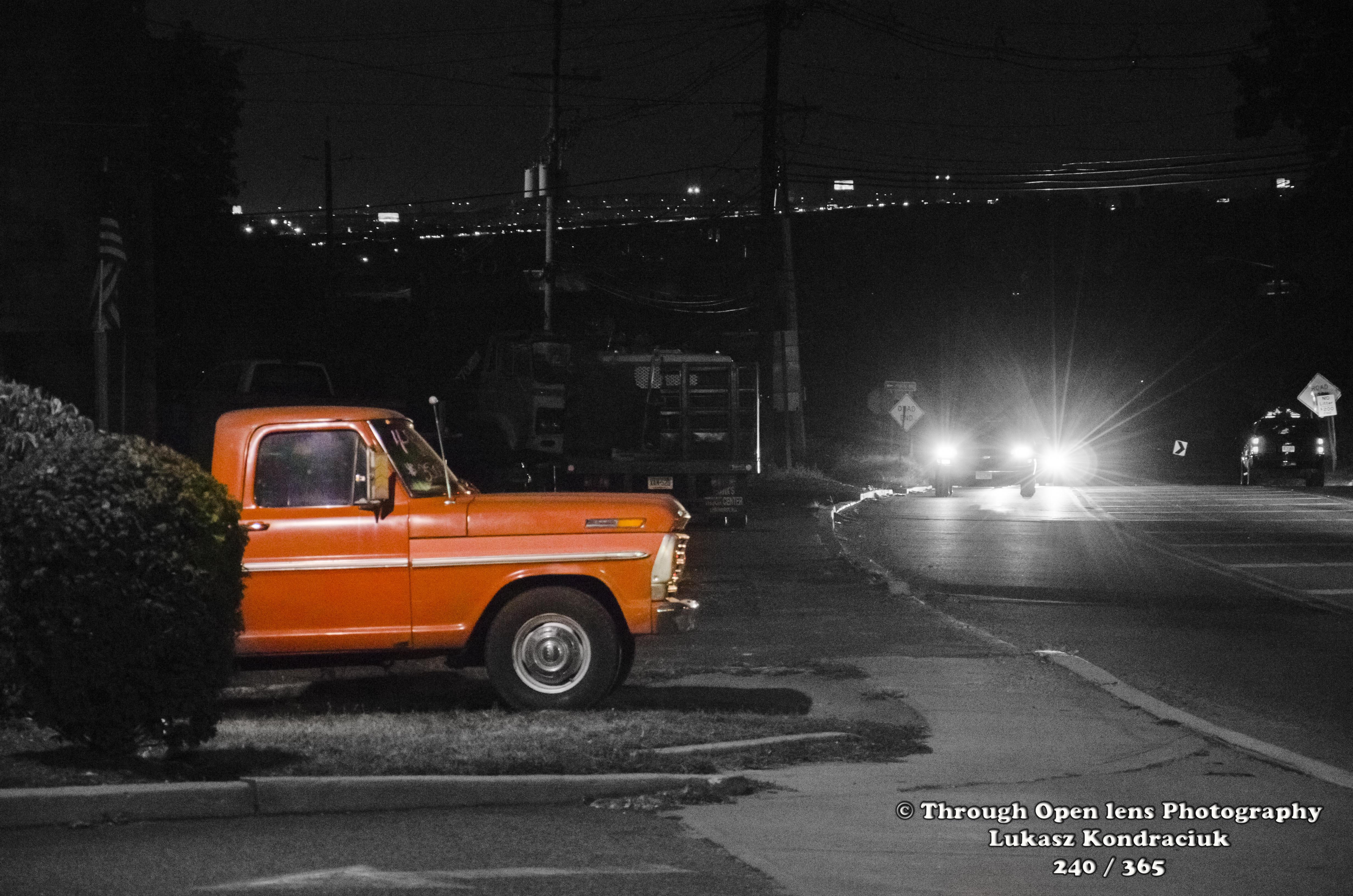
Out Of The Shadows Into The Light.

Orange Truck

F/5.6, 1/30, ISO 800.

Day 240 / 365

A police officer sees a man driving around with a pickup truck full of penguins. He pulls the guy over and says: “You can’t drive around with penguins in this town! Take them to the zoo immediately.” The guy says OK, and drives away.  The next day, the officer sees the guy still driving around with the truck full of penguins, and they’re all wearing sun glasses.  He pulls the guy over and demands: “I thought I told you to take these penguins to the zoo yesterday?”

The guy replies: “I did… today I’m taking them to the beach!”

Interesting Fact: In the early days of automobile manufacturing, vehicles were sold as a chassis only, and third parties added bodies on top.[5] In 1913 the Galion Allsteel Body Company, an early developer of the pickup and dump truck, built and installed hauling boxes on slightly modified Ford Model T chassis,[6] and from 1917 on the Model TT. Seeking part of this market share, Dodge introduced a 3/4-ton pickup with cab and body constructed entirely of wood in 1924.[7] In 1925 Ford followed up with a Model T-based steel-bodied, half-ton with an adjustable tailgate and heavy-duty rear springs.[8] Billed it as the “Ford Model T Runabout with Pickup Body,” it sold for US$281. 34,000 were built. In 1928 it was replaced by the Model A which had a closed-cab, safety glass windshield, roll-up side windows and three-speed transmission. In 1931 Chevrolet produced its first factory-assembled pickup.[9] Ford Australia produced the first Australian “ute” in 1932.[10] During the second world war, the United States government halted the product of privately-owned pickup trucks. ( https://en.wikipedia.org/wiki/Pickup_truck )