Just Because Something Isn’t Happening For You Right Now, Doesn’t Mean That It Will Never Happen

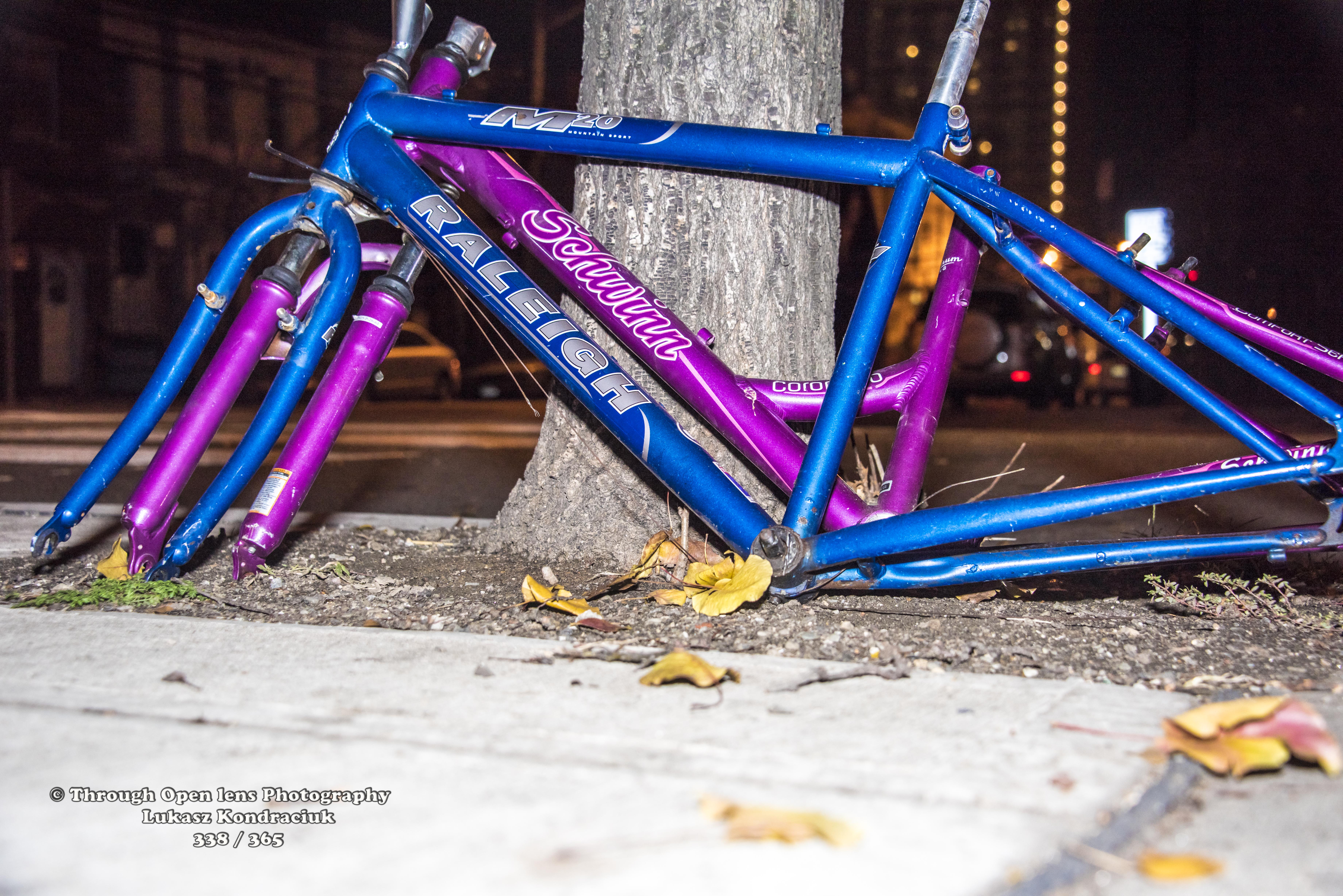
bikes frames

F/5.6, 1/60, ISO 320.

Day 338 / 365

Do you know what is the hardest part of learning to ride a bike?

The pavement.

Interesting Fact: There are several early but unverified claims for the invention of bicycle-like machines. The earliest comes from a sketch said to be from 1493 and attributed to Gian Giacomo Caprotti, a pupil of Leonardo da Vinci. In 1998 Hans-Erhard Lessing described this as a purposeful fraud.[1][2] However, the authenticity of the bicycle sketch is still vigorously maintained by followers of Prof. Augusto Marinoni, a lexicographer and philologist, who was entrusted by the Commissione Vinciana of Rome with the transcription of da Vinci’s Codex Atlanticus. ( https://en.wikipedia.org/wiki/History_of_the_bicycle )

Keep Your Head Up!

Carolina Wren

F/6.3, 1/800, ISO 800.

Carolina Wren

Day 332 / 365

What is a parrot’s favorite game?

Hide and Speak!

Interesting Fact: Unlike other wren species in its genus, only the male Carolina Wren sings the loud song. In other species, such as the Stripe-breasted Wren of Central America, both members of a pair sing together. The male and female sing different parts, and usually interweave their songs such that they sound like a single bird singing. ( https://www.allaboutbirds.org/guide/Carolina_Wren/lifehistory )


You Would Think, It Would Be Another Knock Knock Joke

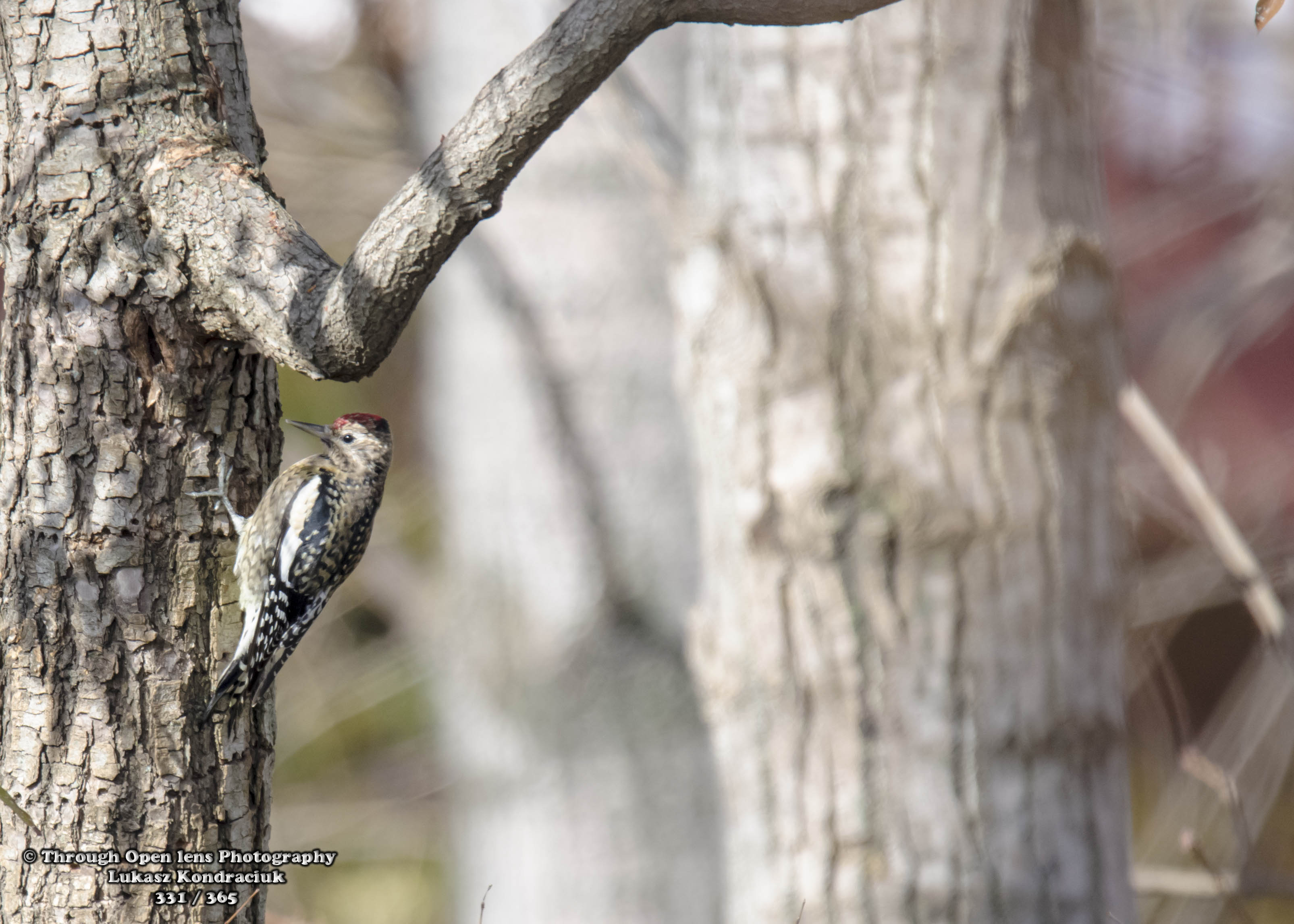
Yellow Bellied Sapsucker

F/ 6.3, 1/800, ISO 800.

Yellow Bellied Sapsucker

Day 331 / 365

What do you get if you cross a parrot with a woodpecker?

A bird that talks in mores code!

Interesting Fact: The sapwells made by Yellow-bellied Sapsuckers attract hummingbirds, which also feed off the sap flowing from the tree. In some parts of Canada, Ruby-throated Hummingbirds rely so much on sapwells that they time their spring migration with the arrival of sapsuckers. Other birds as well as bats and porcupines also visit sapsucker sapwells. ( https://www.allaboutbirds.org/guide/Yellow-bellied_Sapsucker/lifehistory )

I’m Glad I’m Not a Turkey!

Dark-eyed Junco

HAPPY THANKSGIVING EVERONE!!!

F/ 6.3, 1/640, ISO 900.

Dark-eyed Junco 

Day 330 / 365

Chicken talking to the turkey: “Only Thanksgiving and Christmas??? You’re lucky, with us its any Sunday.”

Interesting Fact: Juncos are the “snowbirds” of the middle latitudes. Over most of the eastern United States, they appear as winter sets in and then retreat northward each spring. Some juncos in the Appalachian Mountains remain there all year round, breeding at the higher elevations. These residents have shorter wings than the migrants that join them each winter. Longer wings are better suited to flying long distances, a pattern commonly noted among other studies of migratory vs. resident species.  ( https://www.allaboutbirds.org/guide/Dark-eyed_Junco/lifehistory )

How Is My Mohawk!

Tufted Titmouse

F/8.0, 1/125, ISO 320.

Tufted Titmouse

Day 329 / 365

Why did the chicken say, “Meow, oink, bow-wow, and moo?”

He was studying foreign languages.

Interesting Fact: Tufted Titmice hoard food in fall and winter, a behavior they share with many of their relatives, including the chickadees and tits. Titmice take advantage of a bird feeder’s bounty by storing many of the seeds they get. Usually, the storage sites are within 130 feet of the feeder. The birds take only one seed per trip and usually shell the seeds before hiding them. ( https://www.allaboutbirds.org/guide/Tufted_Titmouse/lifehistory )

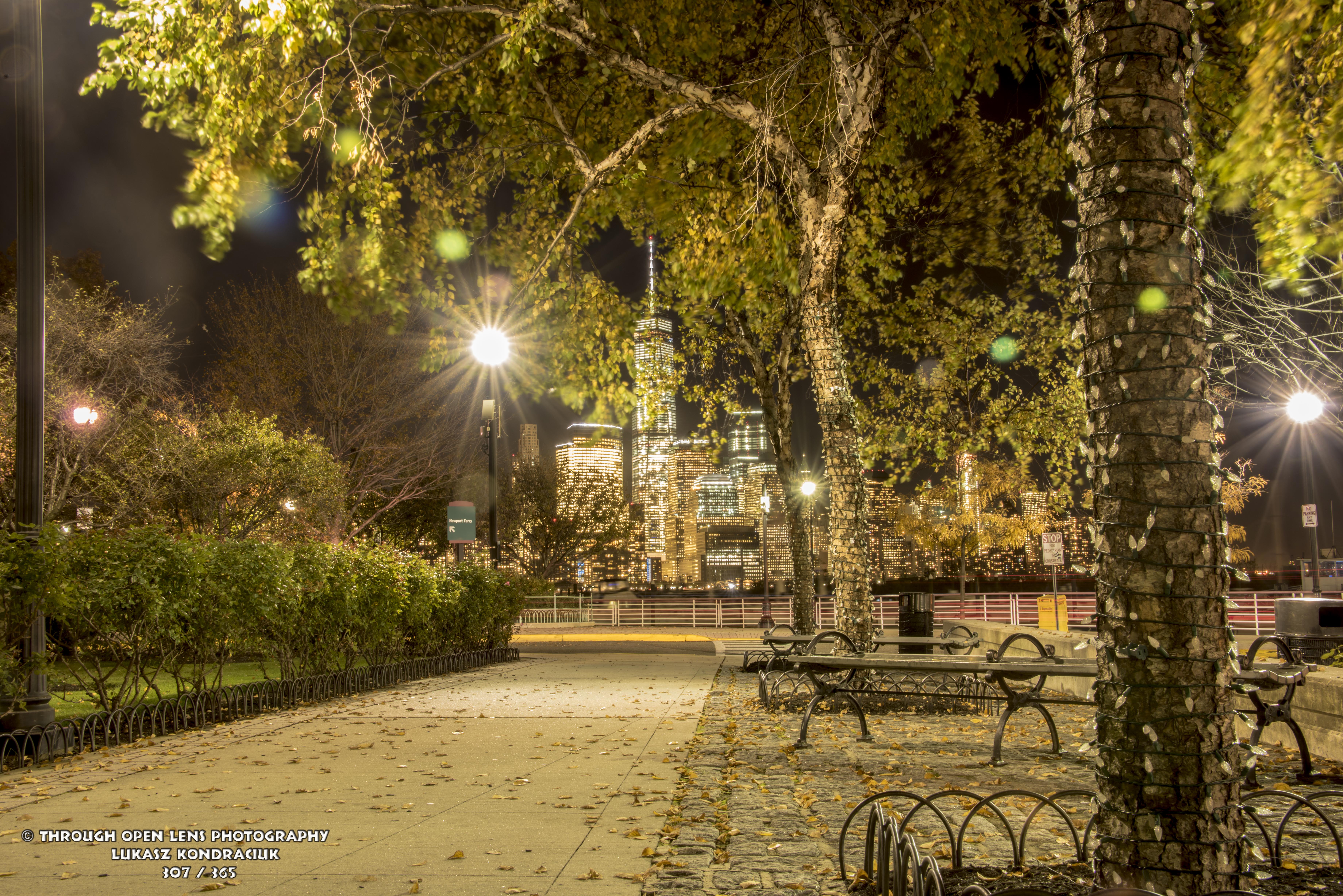
Dear Autumn, I Am Not Ready For What Comes Next

autumn night

F/ 25.0, 393.0, ISO 64.

Day 307 / 365

A couple goes to an art gallery. They find a picture of a naked women with only her privates covered with leaves.
The wife doesn’t like it and moves on but the husband keeps looking.
The wife asks: “What are you waiting for?”
The husband replies: “Autumn.”

Interesting Fact: As winter approaches, leaves make a coating for themselves which blocks their water source; in the absence of water, the leaves no longer produce chlorophyll (chlorophyll is what makes leaves green). ( http://www.metoffice.gov.uk/learning/learn-about-the-weather/how-weather-works/autumn-facts )

I’m Just Hanging Out

Golden-crowned Kinglet

F/6.3, 1/500, ISO 800.

Golden-crowned Kinglet

Day 289 / 365

When is the best time to buy birds?

When they’re going cheap!

Interesting Fact: The tiny Golden-crowned Kinglet is hardier than it looks, routinely wintering in areas where nighttime temperatures can fall below –40° Fahrenheit. ( https://www.allaboutbirds.org/guide/Golden-crowned_Kinglet/lifehistory )

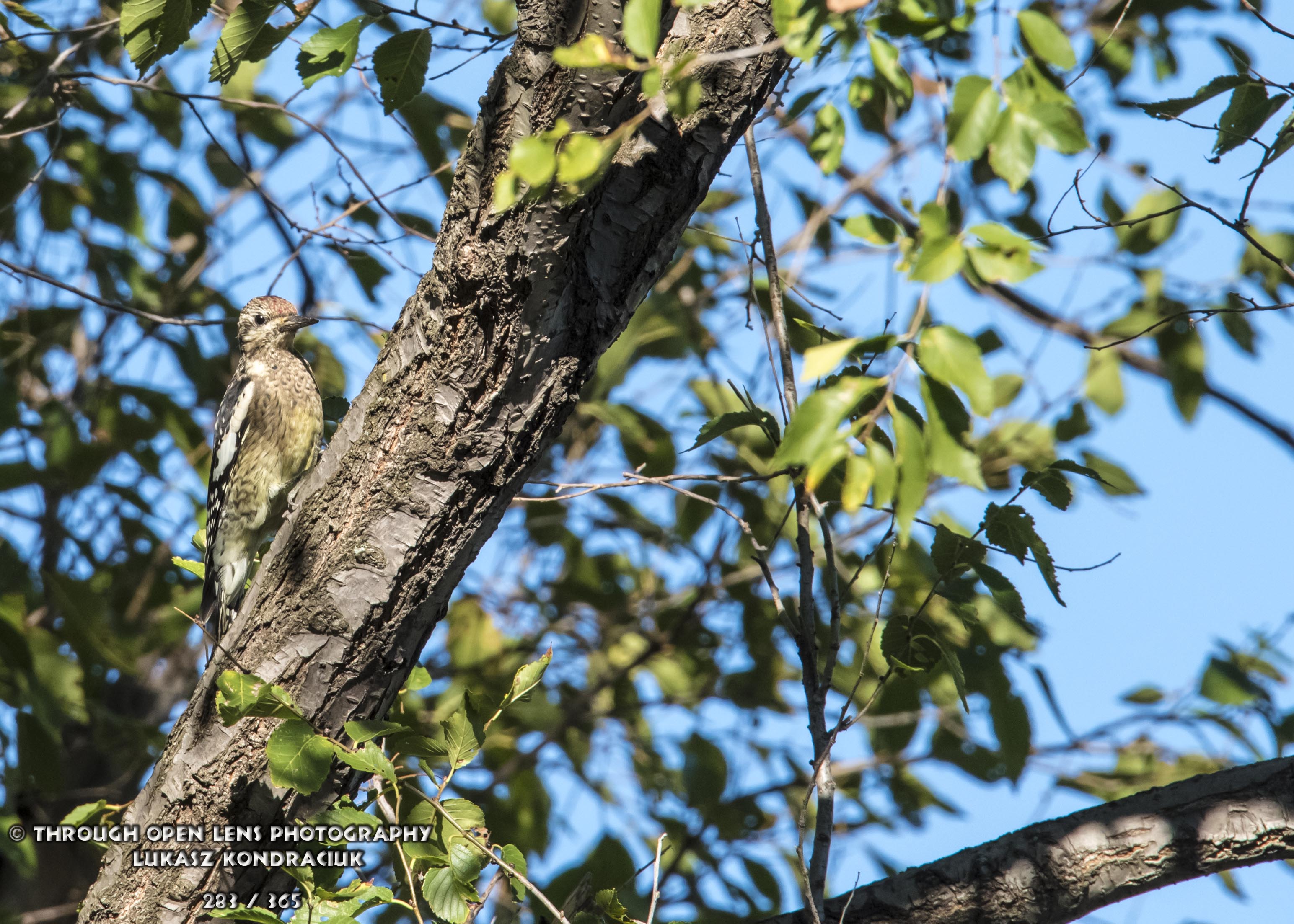
Knock, Knock, Knocking On Heavens Door!

Yellow bellied sapsucker juvenile

F/11.0, 1/640, ISO800.

Yellow Bellied Sapsucker ( Juvenile )

Day 284 / 365

I used to have a woodpecker called Woody, until he attacked my fiancé.

I still can’t believe Woody would peck her.

Interesting Fact: The Yellow-bellied Sapsucker makes two kinds of holes in trees to harvest sap. Round holes extend deep in the tree and are not enlarged. The sapsucker inserts its bill into the hole to probe for sap. Rectangular holes are shallower, and must be maintained continually for the sap to flow. The sapsucker licks the sap from these holes, and eats the cambium of the tree too. New holes usually are made in a line with old holes, or in a new line above the old.  ( http://www.allaboutbirds.org/guide/Yellow-bellied_Sapsucker/lifehistory )

You Make Me Blush!

House Finch

F/ 6.3, 1/640, ISO 800.

House Finch

Day 257 / 365

Why do birds lay eggs?

If they dropped them, they d break!

Interesting Fact: The House Finch was originally a bird of the western United States and Mexico. In 1940 a small number of finches were turned loose on Long Island, New York, after failed attempts to sell them as cage birds (“Hollywood finches”). They quickly started breeding and spread across almost all of the eastern United States and southern Canada within the next 50 years. ( http://www.allaboutbirds.org/guide/House_Finch/lifehistory )

I Want To Fly Like An Eagle

American Kestrel 1

F/6.3, 1/800, ISO 800.

American Kestrel

Day 255 / 365

Why did the American Kestrel cross the road, roll in the mud, and cross back?

He was a dirty double-crosser!

Interesting Fact: When nature calls, nestling kestrels back up, raise their tails, and squirt feces onto the walls of the nest cavity. The feces dry on the cavity walls and stay off the nestlings. The nest gets to be a smelly place, with feces on the walls and uneaten parts of small animals on the floor. ( http://www.allaboutbirds.org/guide/American_Kestrel/lifehistory )