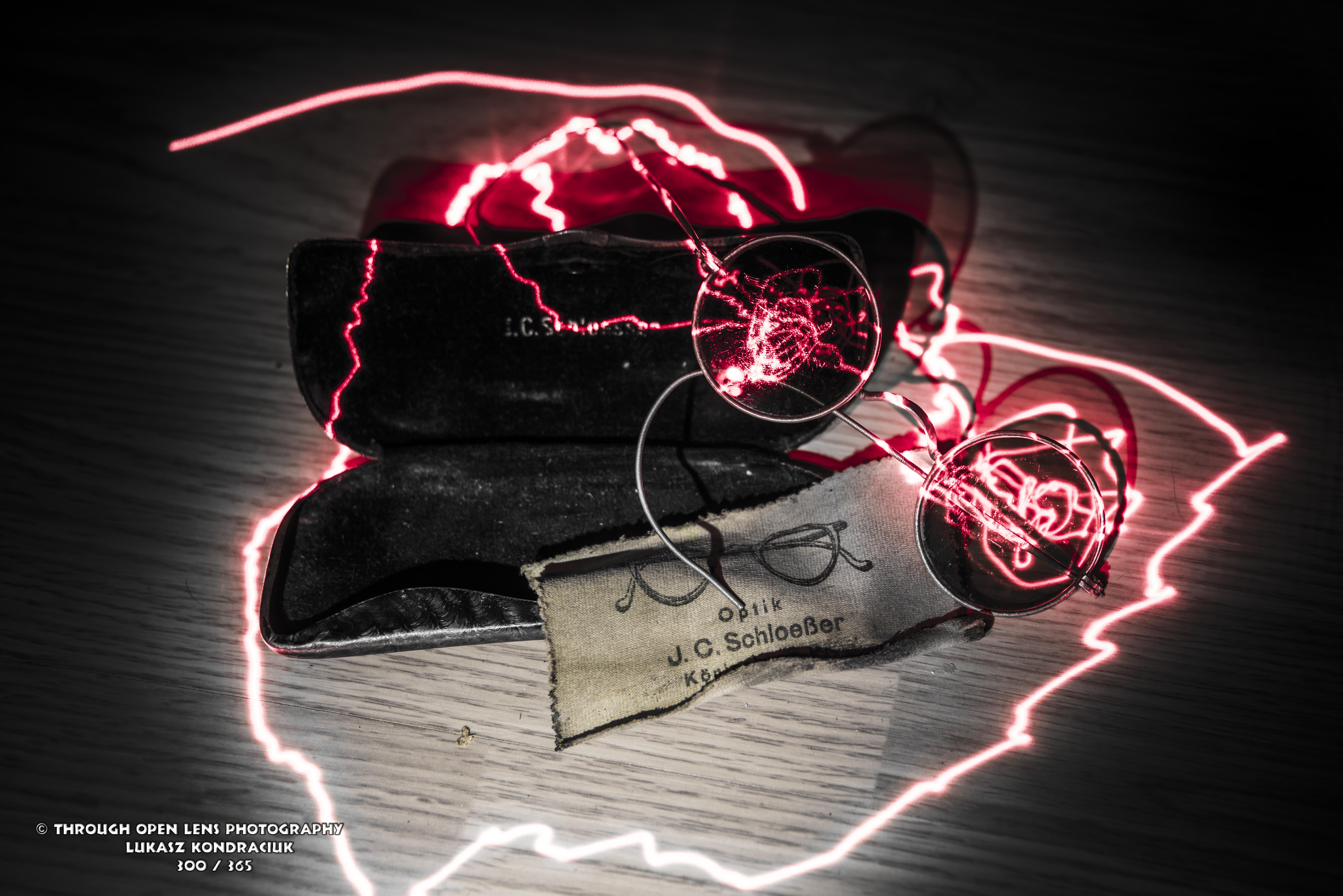
I Wear My Sunglasses At Night

sunglasses

F/ 5.3, 46.0, ISO 64.

Day 300 / 365

Two men who are out walking their dogs meet on a street corner.
One says to the other, “Boy it sure is hot today. I’d really like to go into the bar and get a beer, but the sign on the front door says, ‘No Pets Allowed,’ and I can’t leave Fido alone on the street.”
The other man replies, “No problem, just stand by the door and watch me, and you’ll be having that beer real soon!”
The second man reaches into his pocket and puts on a pair of dark sunglasses, and then walks into the bar. The bartender looks up and says, “Hey buddy, you can’t bring that dog in here!”
The man says, “But I’m blind, and this is my seeing-eye dog!”
The bartender says, “Oh, OK then.” The man drinks his beer and leaves.
The first man then puts on dark sunglasses and goes into the bar. The bartender looks up and says, “Hey buddy, you can’t bring that dog in here!”
The man says, “But I’m blind, and this is my seeing-eye dog!”
The bartender says, “Oh really? I’ve never heard of a Chihuahua seeing-eye dog!!”
The man, thinking quickly, blurts out, “Oh, man! You mean they gave me a Chihuahua?!?”

Interesting Fact: In prehistoric and historic time, Inuit peoples wore flattened walrus ivory “glasses,” looking through narrow slits to block harmful reflected rays of the sun. It is said that the Roman emperor Nero liked to watch gladiator fights with emeralds. These, however, appear to have worked rather like mirrors. Sunglasses made from flat panes of smoky quartz, which offered no corrective powers but did protect the eyes from glare were used in China in the 12th century or possibly earlier. Ancient documents describe the use of such crystal sunglasses by judges in ancient Chinese courts to conceal their facial expressions while questioning witnesses. ( https://en.wikipedia.org/wiki/Sunglasses#History )


Rock Out!

guitar

F/3.5, 118.0, ISO 64.

Day 299 / 365

How do you know someone’s a really good guitarist?

He’ll tell you!

Interesting Fact: Before the development of the electric guitar and the use of synthetic materials, a guitar was defined as being an instrument having “a long, fretted neck, flat wooden soundboard, ribs, and a flat back, most often with incurved sides”.[1] The term is used to refer to a number of chordophones that were developed and used across Europe, beginning in the 12th century and, later, in the Americas.[2] A 3,300-year-old stone carving of a Hittite bard playing a stringed instrument is the oldest iconographic representation of a chordophone and clay plaques from Babylonia show people playing an instrument that has a strong resemblance to the guitar, indicating a possible Babylonian origin for the guitar. ( https://en.wikipedia.org/wiki/Guitar )


You Don’t Know Quack!

Ruddy Duck 1

F/ 13.0, 1/640, ISO 800.

Ruddy Duck

Day 298 / 365

A man and a duck are walking down the street together. Suddenly the man notices a low-flying airplane coming right for them. The man yells “DUCK!!!!” and the duck looks back at the man with an angry face and yells “MAN!!!!”

Interesting Fact: Ruddy Ducks are very aggressive toward each other and toward other species, especially during the breeding season. They are even known to chase rabbits feeding on the shore. ( https://www.allaboutbirds.org/guide/Ruddy_Duck/lifehistory )

Excuse Me?! I Hear Everything That You Saying! 

Boston Terrier

F/ 5.6, 1/60, ISO 200.

Boston Terrier

Day 297 / 365

What does this dog and my phone have in common?

They both have collar I.D.

Interesting Fact: The Boston terrier breed originated around 1870, when Robert C. Hooper of Boston, purchased a dog, Judge from Edward Burnett known later as Hooper’s Judge, who was of a Bull and Terrier type lineage. Hooper’s Judge is either directly related to the original Bull and Terrier breeds of the 19th and early 20th centuries, or Judge is the result of modern English Bulldogs being crossed into terriers created in the 1860s for show purposes, like the White English Terrier. The American Kennel Club cites Hooper’s Judge as the ancestor of almost all true modern Boston Terriers. ( https://en.m.wikipedia.org/wiki/Boston_Terrier )

Style Is Away To Say Who You Are Without Having To Speak

the walk

F/ 5.3, 1/60, ISO 320.

Day 296 / 365

I’ve never understood the fashion industry, those people are so clothes minded.

Interesting Fact:  The first official Fashion Week started in 1943 in New York. Its main purpose was to distract the attention away from French fashion during World War II and kickstart the way for American designers. ( http://www.younghollywood.com/scene/15-amazing-fashion-facts.html )

Come On, Ride The Train, It’s The Choo Choo Train

train tracks

F/5.6, 1/20, ISO 500.

Day 295 / 365

Why is the railroad angry?

Because people are always crossing it!

Interesting Fact: The streets of New York were very crowded in the late 1800s. Inventor Alfred Ely Beach wanted to build a train underground. The government said no. So, he built it in secret, digging out of the rented basement of an apartment store. His subway opened in 1870. ( http://easyscienceforkids.com/all-about-trains/ )

Ha Ha Ha Ha Ha Ha Ha!!! Are You Scared Yet?!

halloween mask

F/5.3, 1/13, ISO 64.

Day 294 / 365

A woman whose husband often came home drunk decided to cure him of the habit. One Halloween night, she put on a devil suit and hid behind a tree to intercept him on the way home.
When her husband came by, she jumped out and stood before him with her red horns, long tail, and pitchfork.
“Who are you?” he asked.
“I’m the Devil!” she responded.
“Well, come on home with me,” he said, “I married your sister!”

Interesting Fact:  Halloween costumes are costumes worn on or around Halloween, a festival which falls on October 31. An early reference to wearing costumes at Halloween comes from Scotland in 1585, but they may pre-date this. There are many references to the custom during the 18th and 19th centuries in the Celtic countries of Scotland, Ireland, Mann and Wales. It has been suggested that the custom comes from the Celtic festivals of Samhain and Calan Gaeaf, or from the practise of “souling” at Hallowtide. Wearing costumes and mumming has long been associated with festivals at other times of the year, such as on Christmas.[1] Halloween costumes are traditionally based on frightening supernatural or folkloric beings. However, by the 1930s costumes based on characters in mass media such as film, literature, and radio were popular. Halloween costumes have tended to be worn mainly by young people, but since the mid-20th century they have been increasingly worn by adults also. ( https://en.wikipedia.org/wiki/Halloween_costume )

10-up !!!

mushrooms

F/5.6, 1/60, ISO 100.

Day 293 /365

What would a mushroom car say?

Shroom shroom!

Interesting Fact: Modern studies suggest mushrooms can be useful for antibacterial, anti-inflammatories and antioxidants. While also helping to reduce blood pressure, moderate blood sugar, reduce cholesterol, enhance the immune system, reduce stress and help in fighting many types of cancer.  ( http://www.sciencekids.co.nz/sciencefacts/food/mushrooms.html )

Hooked On Quack!

Green-winged Teal

F/6.3, 1/160, ISO 500.

Green-Winged Teal

Day 292 / 365

A duck, a skunk and a deer went out for dinner at a restaurant one night.

When it came time to pay,

the skunk didn’t have a scent,

the deer didn’t have a buck,

so they put the meal on the duck’s bill.

Interesting Fact: Green-winged Teal, more than any other species of duck, prefer to seek food on mud flats. Where mud flats are lacking, they prefer shallow marshes or temporarily flooded agricultural lands. They usually eat vegetative matter consisting of seeds, stems, and leaves of aquatic and emergent vegetation. ( http://www.withmephotographyblog.com/8-interesting-facts-about-the-green-winged-teal )

You Can Run, But You Can’t Hide

Peregrine Falcon

F/10.0, 1/400, ISO 250.

Peregrine Falcon

Day 291 / 365

What birds spend all their time on their knees?

Birds of prey!

Interesting Fact: The name “peregrine” means wanderer, and the Peregrine Falcon has one of the longest migrations of any North American bird. Tundra-nesting falcons winter in South America, and may move 25,000 km (15,500 mi) in a year. Maps of the migration of individual falcons determined by satellite telemetry can be seen at Environment Canada. ( http://www.allaboutbirds.org/guide/Peregrine_Falcon/lifehistory )