This is Maverick, I feel the need… …the need for speed!

Red-tailed Hawk

F/ 6.3, 1/800, ISO 800.

Red-tailed Hawk

Day 333 / 365

Why did the Hawk cross the road?

To eat the chicken!

Interesting Fact: Red-tailed Hawks have been seen hunting as a pair, guarding opposite sides of the same tree to catch tree squirrels. ( https://www.allaboutbirds.org/guide/Red-tailed_Hawk/lifehistory )


Keep Your Head Up!

Carolina Wren

F/6.3, 1/800, ISO 800.

Carolina Wren

Day 332 / 365

What is a parrot’s favorite game?

Hide and Speak!

Interesting Fact: Unlike other wren species in its genus, only the male Carolina Wren sings the loud song. In other species, such as the Stripe-breasted Wren of Central America, both members of a pair sing together. The male and female sing different parts, and usually interweave their songs such that they sound like a single bird singing. ( https://www.allaboutbirds.org/guide/Carolina_Wren/lifehistory )


You Would Think, It Would Be Another Knock Knock Joke

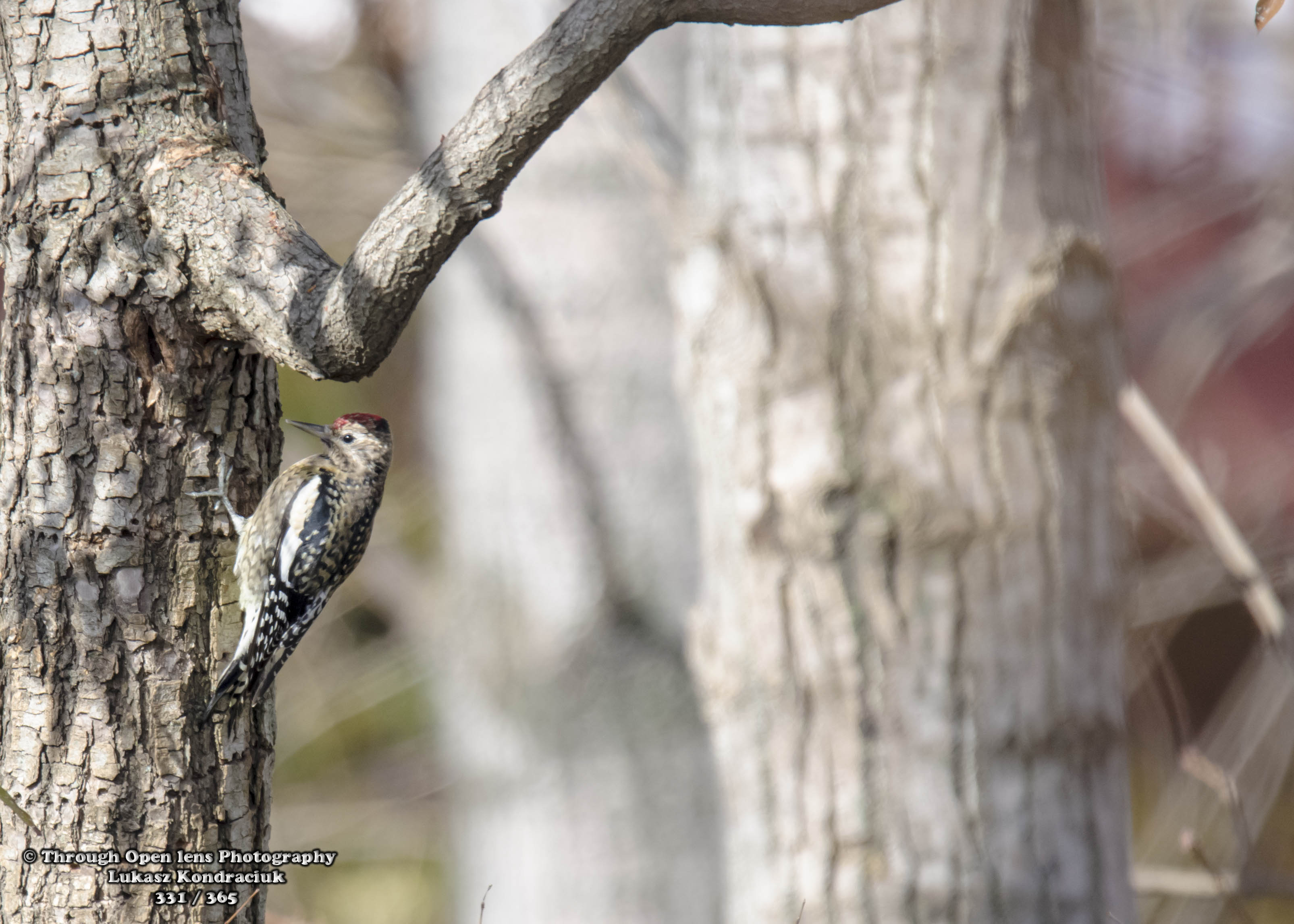
Yellow Bellied Sapsucker

F/ 6.3, 1/800, ISO 800.

Yellow Bellied Sapsucker

Day 331 / 365

What do you get if you cross a parrot with a woodpecker?

A bird that talks in mores code!

Interesting Fact: The sapwells made by Yellow-bellied Sapsuckers attract hummingbirds, which also feed off the sap flowing from the tree. In some parts of Canada, Ruby-throated Hummingbirds rely so much on sapwells that they time their spring migration with the arrival of sapsuckers. Other birds as well as bats and porcupines also visit sapsucker sapwells. ( https://www.allaboutbirds.org/guide/Yellow-bellied_Sapsucker/lifehistory )

I’m Glad I’m Not a Turkey!

Dark-eyed Junco

HAPPY THANKSGIVING EVERONE!!!

F/ 6.3, 1/640, ISO 900.

Dark-eyed Junco 

Day 330 / 365

Chicken talking to the turkey: “Only Thanksgiving and Christmas??? You’re lucky, with us its any Sunday.”

Interesting Fact: Juncos are the “snowbirds” of the middle latitudes. Over most of the eastern United States, they appear as winter sets in and then retreat northward each spring. Some juncos in the Appalachian Mountains remain there all year round, breeding at the higher elevations. These residents have shorter wings than the migrants that join them each winter. Longer wings are better suited to flying long distances, a pattern commonly noted among other studies of migratory vs. resident species.  ( https://www.allaboutbirds.org/guide/Dark-eyed_Junco/lifehistory )

How Is My Mohawk!

Tufted Titmouse

F/8.0, 1/125, ISO 320.

Tufted Titmouse

Day 329 / 365

Why did the chicken say, “Meow, oink, bow-wow, and moo?”

He was studying foreign languages.

Interesting Fact: Tufted Titmice hoard food in fall and winter, a behavior they share with many of their relatives, including the chickadees and tits. Titmice take advantage of a bird feeder’s bounty by storing many of the seeds they get. Usually, the storage sites are within 130 feet of the feeder. The birds take only one seed per trip and usually shell the seeds before hiding them. ( https://www.allaboutbirds.org/guide/Tufted_Titmouse/lifehistory )

It’s 5 O’clock Somewhere!!

The Hamilton Inn

F/ 18.0, 38.0, ISO 64.

Day 327 / 365

A man goes into a bar and seats himself on a stool. The bartender looks at him and says, “What’ll it be buddy?”

The man says, “Set me up with seven whiskey shots and make them doubles.” The bartender does this and watches the man slug one down, then the next, then the next, and so on until all seven are gone almost as quickly as they were served. Staring in disbelief, the bartender asks why he’s doing all this drinking.

“You’d drink them this fast too if you had what I have.”

The bartender hastily asks, “What do you have pal?”

The man quickly replies, “I have a dollar.”

Interesting Fact: The inhabitants of Great Britain have been drinking ale since the Bronze Age, but it was with the arrival of the Romans and the establishment of the Roman road network that the first inns called tabernae,[5] in which the traveller could obtain refreshment, began to appear. After the departure of Roman authority and the fall of the Romano-British kingdoms, the Anglo-Saxons established alehouses that grew out of domestic dwellings. The Anglo-Saxon alewife would put a green bush up on a pole to let people know her brew was ready.[6] These alehouses formed meeting houses for the villagers to meet and gossip and arrange mutual help within their communities. Here lie the beginnings of the modern pub. They became so commonplace that in 965 King Edgar decreed that there should be no more than one alehouse per village.  ( https://en.wikipedia.org/wiki/Pub#History )


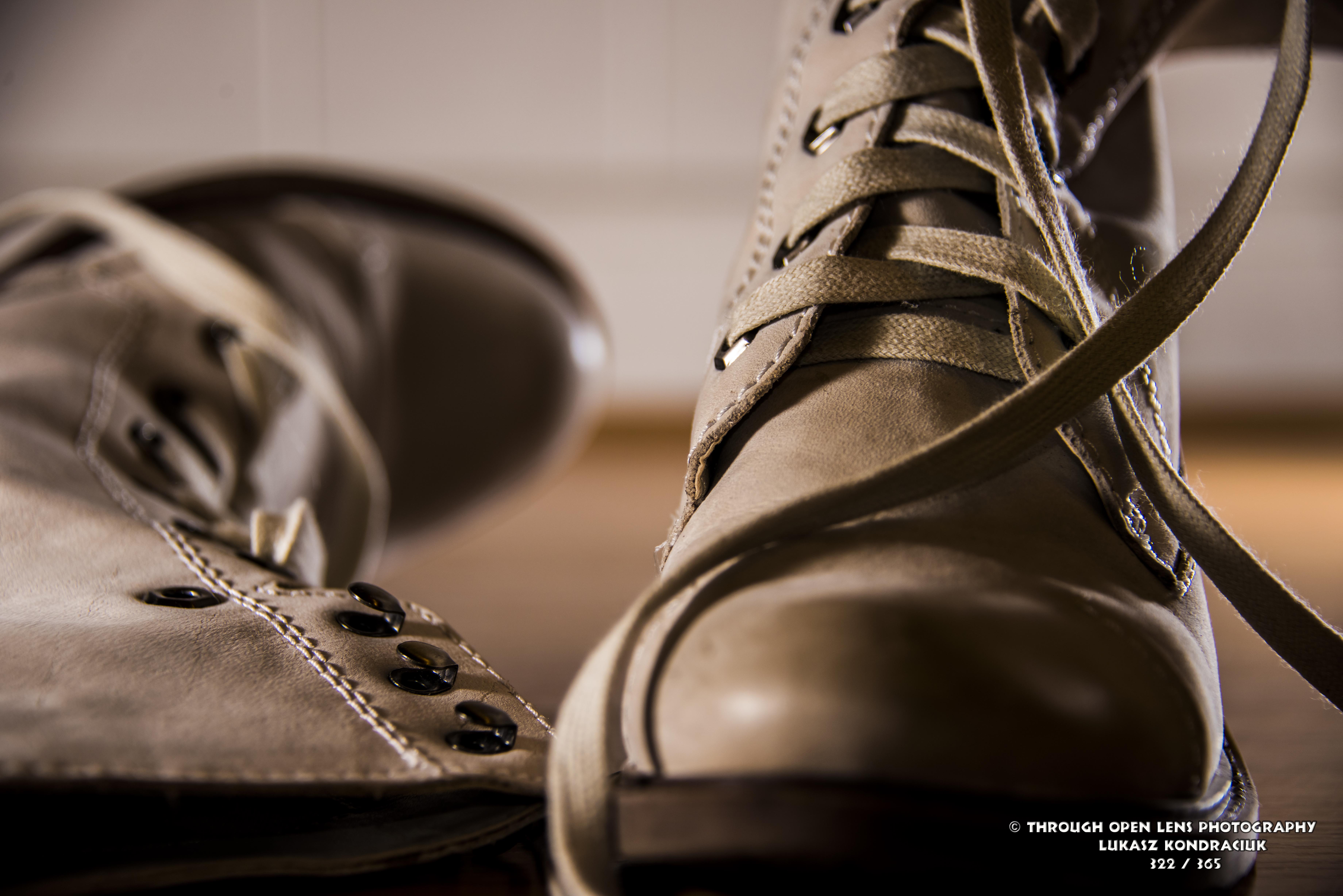
Those Boots Are Made For Walking

boots

F/5.3, 1/60, ISO 200.

Day 322 / 365

A little boy was standing and crying in the classroom, so the teacher asked him what was wrong. “I can’t find my boots,” the little boy sobbed.
The teacher looked around the room and saw a pair of boots. “Are these yours?” she asked. “No, those aren’t mine,” he cried.
The teacher and the little boy searched all over the classroom for his boots. Finally, the teacher gave up and said, “Are you SURE those aren’t your boots?” “Yes, I’m sure,” sobbed the boy. “Mine had snow on them!”

Interesting Fact: Early boots consisted of separate leggings, soles, and uppers worn together to provide greater ankle protection than shoes or sandals. Around 1000 BC, these components were more permanently joined to form a single unit that covered the feet and lower leg, often up to the knee. A type of soft leather ankle boots were worn by nomads in eastern Asia, and carried to China to India and Russia around AD 1200 to 1500 by Mongol invaders. The Inuit and Aleut natives of Alaska developed traditional winter boots of caribou skin or sealskin featuring decorative touches of seal intestine, dog hair and wolverine fur. 17th century European boots were influenced by military styles, featuring thick soles and turnover tops that were originally designed to protect horse mounted soldiers. In the 1700s, distinctive, knee-high boots worn by Hessian soldiers fighting in the American Revolutionary War influenced the development of the iconic heeled cowboy boots worn by cattlemen in the American west. ( https://en.wikipedia.org/wiki/Boot#History )

I Think I’m On The Right Track

Light Rail

F/ 14.0 , 25.0, ISO 200.

Day 320 / 365

What do you call a train that eats toffee?

A chew, chew train.

Interesting Fact: The system began operating its first segment in April 2000, expanded in phases during the next decade, and was completed with the opening of its southern terminus on January 31, 2011. The line generally runs parallel to the Hudson River and Upper New York Bay, while its northern end and its western branch travel through the lower Hudson Palisades. HBLR has twenty-four stations along a total track length of just over 34 miles (55 km) and serves over 54,000 weekday passengers.[1] There are plans for expansion through extensions and additional stations. ( https://en.wikipedia.org/wiki/Hudson%E2%80%93Bergen_Light_Rail#Historical_overview )

I Just Wanna Fly!

Red-tailed Hawk

F/ 9.0, 1/320, ISO 500.

Red-tailed Hawk

Day 319 / 365

What birds spend all their time on their knees?

Birds of prey!

Interesting Fact: Birds are amazingly adapted for life in the air. The Red-tailed Hawk is one of the largest birds you’ll see in North America, yet even the biggest females weigh in at only about 3 pounds. A similar-sized small dog might weigh 10 times that. ( https://www.allaboutbirds.org/guide/Red-tailed_Hawk/lifehistory )

That Taste A Little Weird?

Gadwall

F/ 11.0, 1/400, ISO 320.

Gadwall Ducks

Ring Billed Gulls

Day 218 / 365

A duck goes into a bar and says, ‘I would like a drink. I am old enough.’
The bartender replies, ‘You need to be able to prove who you are.’
The duck pulls out a mirror. He looks in it, nods his head, and says, ‘Yep, that’s me.’
.
Interesting Fact: Female Gadwall produce an egg a day while they are laying their 7–12-egg clutches. To meet their demand for protein during this stressful time, female Gadwall eat more invertebrates than males during this period—in addition to using reserves of nutrients they’ve stored in their bodies during the winter. ( https://www.allaboutbirds.org/guide/Gadwall/lifehistory )