I’d Climb The Highest Mountain

Dark-eyed Junco 1

F/11.0, 1/500, ISO 320.

Dark-eyed Junco 

How long do chickens work?

Around the cluck!

Interesting Fact: The Dark-eyed Junco is one of the most common birds in North America and can be found across the continent, from Alaska to Mexico, from California to New York. A recent estimate set the junco’s total population at approximately 630 million individuals.  ( https://www.allaboutbirds.org/guide/Dark-eyed_Junco/lifehistory )

We Like Warm Hugs!

snowman

F/8.0, 1/250, ISO 100.

What do Snowmen call their offspring?

Chill-dren.

Interesting Fact: Documentation of the first snowman is unclear. However, Bob Eckstein, author of The History of the Snowman documented snowmen from medieval times, by researching artistic depictions in European museums, art galleries, and libraries. The earliest documentation he found was a marginal illustration from a work titled Book of Hours from 1380, found in Koninklijke Bibliotheek, in The Hague. ( https://en.wikipedia.org/wiki/Snowman#History )

Silly Goose!

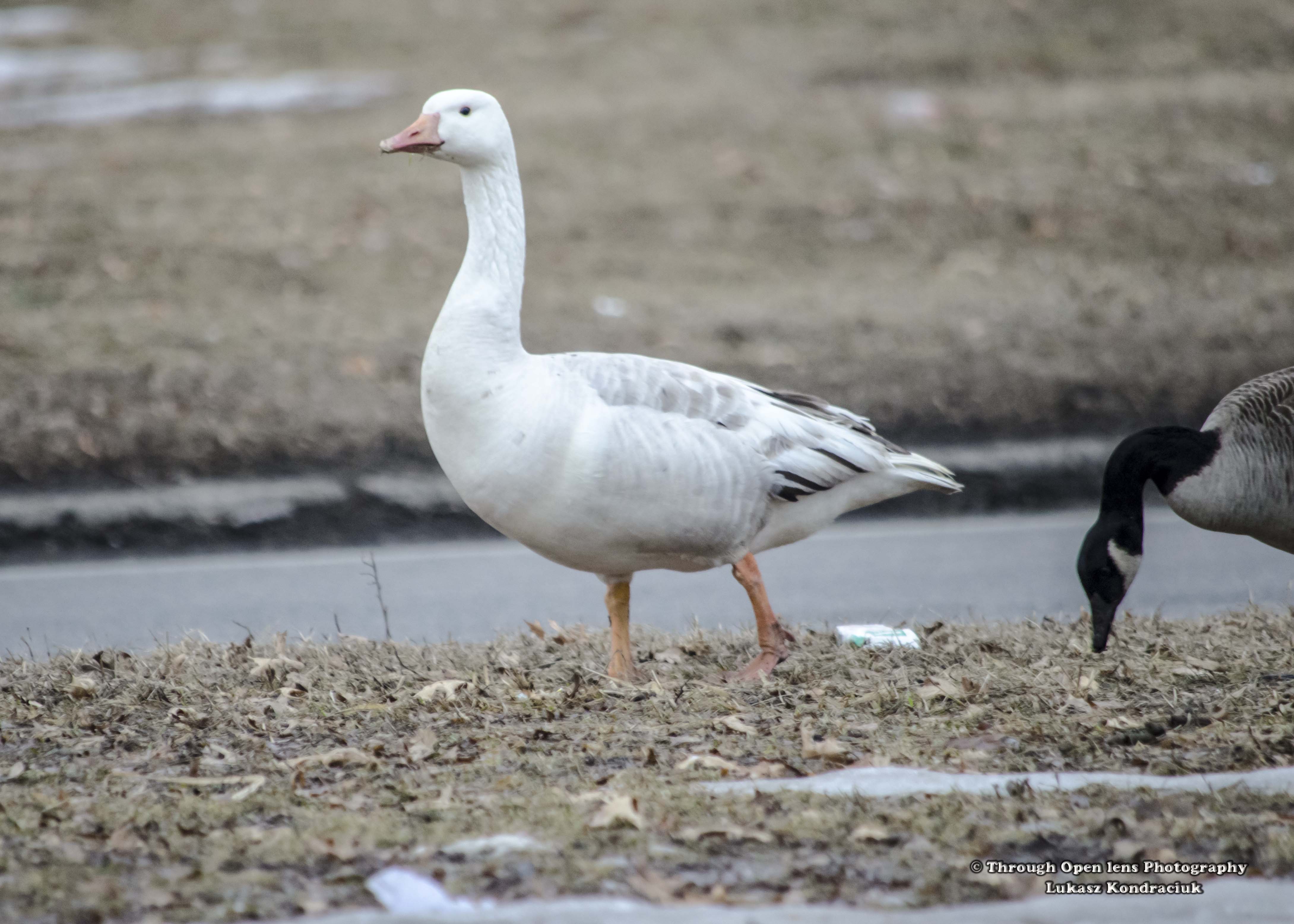
Snow Goose

F/ 5.6, 1/125, ISO 1600.

Snow Goose

What grows down, when it grows up?

A goose.

Interesting Fact:  Snow Goose hunting in the eastern United States was stopped in 1916 because of low population levels. Hunting was allowed again in 1975 after populations had recovered. Since then, their populations have continued to grow, to the point that some areas of tundra nesting habitat are starting to suffer. ( https://www.allaboutbirds.org/guide/Snow_Goose/lifehistory )

Freezing Wipeout!

surfing wipeouts

F/11.0, 1/500, ISO 800.

Two surfers are at getting ready to paddle out: Surfer one: “Hey, guess what! I got a new longboard for my wife!” Surfer two: “Great trade!”

Interesting Fact: For centuries, surfing was a central part of ancient Polynesian culture. Surfing may have first been observed by Europeans at Tahiti in 1767 by Samuel Wallis and the crew members of the Dolphin who were the first Europeans to visit the island in June of that year. Another candidate is the botanist Joseph Banks[2] being part of the first voyage of James Cook on the HMS Endeavour, who arrived on Tahiti on 10 April 1769. Lieutenant James King was the first person to write about the art of surfing on Hawaii when he was completing the journals of Captain James Cook upon Cook’s death in 1779. ( https://en.m.wikipedia.org/wiki/Surfing )

My New Years Resolution Is 1080p

2016

Happy New Year Everyone!

Welcome 2016!

F/10.0, 1/400, ISO 400.

New Years Resolutions List

  1. Lose weight by inventing an anti-gravity machine
  2. Stop repeating myself again, and again, and again.
  3. I will read the manual… just as soon as I can find it.
  4. I will stop making lists…..

Interesting Fact: There are two ways to make ice sculpture: You can carve into a block of ice or make a mold. Blocks of ice are obtained from frozen rivers and lakes. Typically water that freezes slowly makes clear ice and is preferred by artists to make ice sculptures. In some places, artificial blocks of ice are made for this purpose. ( http://www.ehow.com/about_5393158_history-ice-sculptures.html )


Last Day!!!

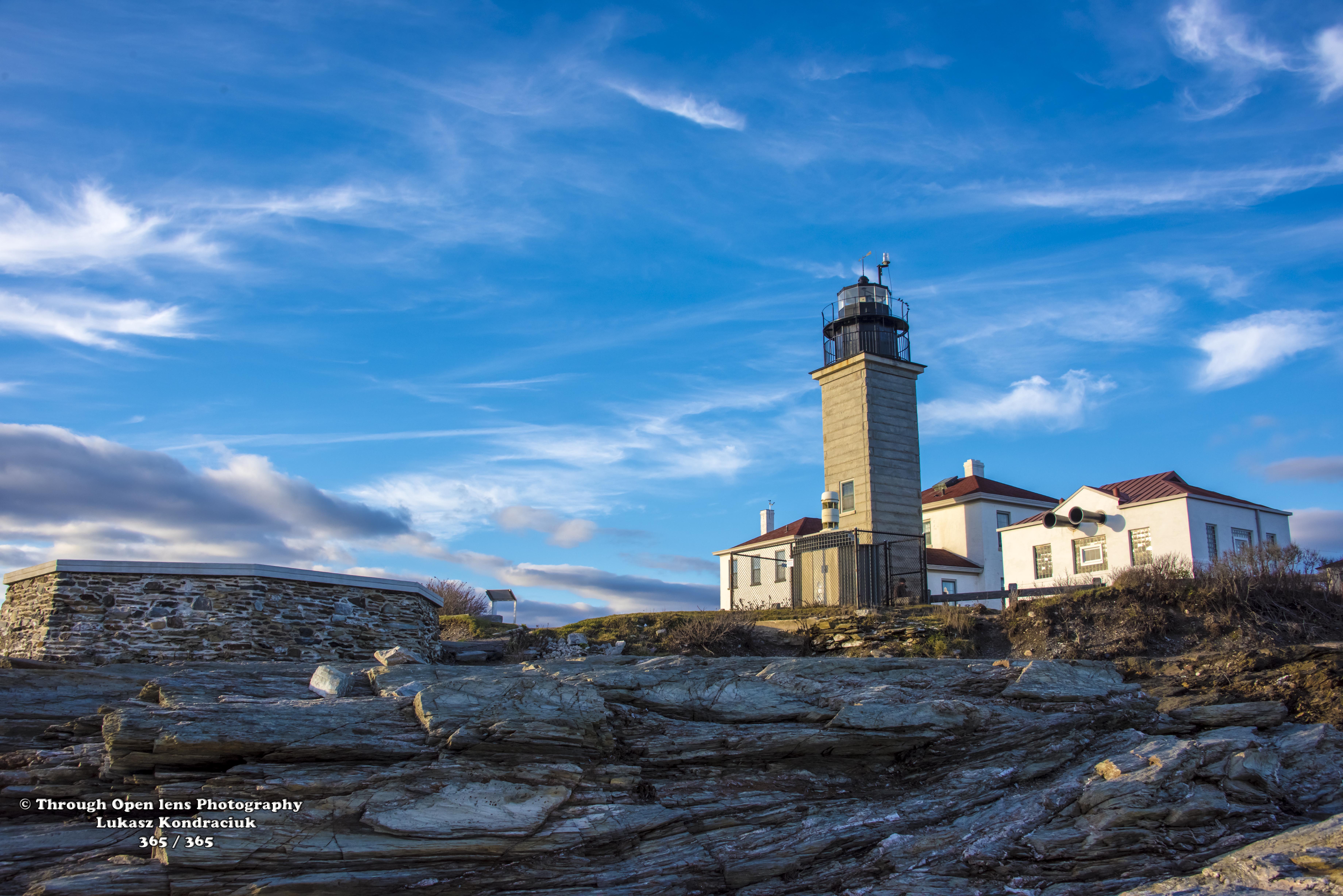
Beavertail Lighthouse

F/11.0, 1/500, ISO 400.

Day 365 / 365

What did the ocean say to the lighthouse?

Nothing; it just waved.

Interesting Fact: Prior to the establishment of a lighthouse at Beavertail, local Native Americans would keep pitch fires burning, to warn sailors away from the rocky coastline. The earliest records of the town of Jamestown making reference to construction of a beacon date to 1712, and mention a watch house in 1705.[2] In 1749, a wooden tower was built, and the light (which was then known as “Newport Light”) became the third lighthouse established in the colonies, preceded only by Boston Light in Boston Harbor, and Brant Point Light, Nantucket. A fire was lit at the top of the tower, as was common for the time. Four years later it burned down and was replaced by a stone tower. ( https://en.wikipedia.org/wiki/Beavertail_Lighthouse#History )

If I Had A Billion Dollars

mansions

F/11.0, 1/640, ISO 800.

Day 364 / 365

The other day I was showing my new girlfriend around the mansion, the 60 acre garden onto the jetty where the 3 yachts were moored then onto the garage with over 30 classic cars. Oh the look on her face was magic.
I can’t wait to see it when I tell her I’m the gardener.

Interesting Fact: Newport Rhode Island Mansions beginning in the mid-nineteenth century, wealthy southern planters seeking to escape the heat began to build summer cottages on Bellevue Avenue such as Kingscote (1839).[13] Around the middle of the century, wealthy Yankees such as the Wetmore family also began constructing larger mansions such as Chateau-sur-Mer (1852) nearby.[14] Most of these early families made a substantial part of their fortunes in the Old China Trade. ( https://en.wikipedia.org/wiki/Newport,_Rhode_Island )

Drink Up For Past, Present And The Future!

White Horse Tavern

F/5.6, 1/60, ISO 320.

Day 363 / 365

A brain walks into a bar and says, “I’ll have a pint of beer please.”

The barman looks at him and says “Sorry, I can’t serve you.”

“Why not?” askes the brain.

“You’re already out of your head.”

Interesting Fact: Frances Brinley constructed the original building on the site in 1652.[2] In 1673, the lot was sold to William Mayes, and the building was enlarged to become a tavern.[2] The building was also used for large meetings, including use as a Rhode Island General Assembly meeting place, a court house, and a city hall.[2] William Mayes, Sr., obtained a tavern license in 1687 and William Mayes, Jr., a well-known pirate, operated the tavern through the early eighteenth century.[2] The operation was named “The White Horse Tavern” in 1730 by owner Jonathan Nichols.[2] During the American Revolution, Tories and British troops were quartered there around the time of the British occupation and the Battle of Rhode Island.[2] After years of neglect as a boarding house, Newport’s Van Bueren family donated money to the private Preservation Society of Newport to restore the building in 1952.[2] After the restoration, the building was sold and once again operated as a private tavern and restaurant.[2] As of 2015, it still remains a popular drinking and dining location. ( https://en.wikipedia.org/wiki/White_Horse_Tavern_(Newport,_Rhode_Island)#History )

Duck Duck Duck Duck Duck Duck Goose!

Duck Duck Goose

F/ 6.3, 1/ 640, ISO 2800.

Green-Winged Teal

Canada Goose

Day 362 / 365

Where did the duck go when he was sick?

To the Ducktor

Interesting Fact: The American and Eurasian forms of the Green-winged Teal were formerly considered different species. The Eurasian teal differ from the American by lacking the vertical white shoulder stripe and having a horizontal white stripe along the back instead. Eurasian teal show up casually each year along both the Pacific and Atlantic coasts. ( https://www.allaboutbirds.org/guide/Green-winged_Teal/lifehistory )

Birds Go Tweet Tweet!

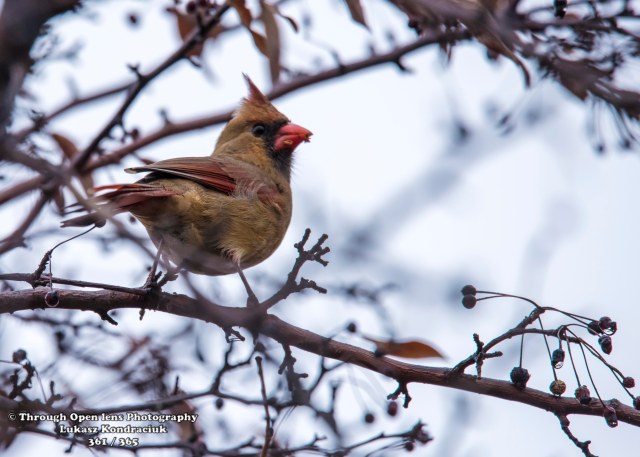
Northern Cardinal

F/ 8.0, 1/250, ISO 500.

Northern Cardinal

Day 361 / 365

The mail carrier had a registered letter that needed a signature for a party on his route. Receiving no response to his knock on the front door, he went around to the back door which he found open, except for the screen door. He knocked. A high pitch voice from inside said, “Come in.”Upon entering the kitchen, he was confronted by the largest German Shepard he had ever seen. The dog bared his fangs menacingly, forcing the mail man against the wall. The mail man shouted, “Lady, call off you dog before he eats me alive.” The only response he got was that same high pitch voice coming from the next room saying, “Come in.”Pressing his body against the wall, he slowly worked his way to the door way leading to the next room. Looking around, he saw the room was empty, except for a parrot in a cage. After the threat from the huge dog, he was becoming quite irate and said to the parrot.”Darn you, don’t you know any words besides ‘Come in?”Without a moments hesitation the parrot responded, “Sic him!!!”

Interesting Fact: Northern Cardinals hop through low branches and forage on or near the ground. Cardinals commonly sing and preen from a high branch of a shrub. The distinctive crest can be raised and pointed when agitated or lowered and barely visible while resting. You typically see cardinals moving around in pairs during the breeding season, but in fall and winter they can form fairly large flocks of a dozen to several dozen birds. During foraging, young birds give way to adults and females tend to give way to males. Cardinals sometimes forage with other species, including Dark-eyed Juncos, White-throated Sparrows, other sparrow species, Tufted Titmice, goldfinches, and Pyrrhuloxias. They fly somewhat reluctantly on their short, round wings, taking short trips between thickets while foraging. Pairs may stay together throughout winter, but up to 20 percent of pairs split up by the next season. ( https://www.allaboutbirds.org/guide/Northern_Cardinal/lifehistory )