Swim At Your Own Risk!

Pied-Billed Grebe Juvenile

F/6.3, 1/640, ISO 6400.

Pied-Billed Grebe ( Juvenile )

Day 286 / 365

What robs you while you’re in the bathtub?

A robber ducky.

Interesting Fact: Pied-billed Grebes can trap water in their feathers, giving them great control over their buoyancy. They can sink deeply or stay just at or below the surface, exposing as much or as little of the body as they wish. The water-trapping ability may also aid in the pursuit of prey by reducing drag in turbulent water. ( http://www.allaboutbirds.org/guide/Pied-billed_Grebe/lifehistory )

Walking On Water Ain’t Easy!

Great Blue Heron 1

F/ 6.3, 1/160, ISO 320.

Great Blue Heron

Day 273 / 365

What holiday is observed by all birds?

Feather’s Day!

Interesting Fact: Great Blue Herons aren’t likely to visit a typical backyard. However, they are sometimes unwelcome visitors to yards that include fish ponds. A length of drain pipe placed in the pond can provide fish with a place to hide from feeding herons. Herons, like most of our birds, are legally protected by the Migratory Bird Treaty Act. ( http://www.allaboutbirds.org/guide/great_blue_heron/lifehistory )

May You Always Have A Seashell In Your Pocket And Sand Between Your Toes!

seashells

F/11.0, 1/500, ISO 160.

Day 271 / 365

Why does the mermaid wear seashells?

Because she grew out of her B-shells.

Interesting Fact: The turn of a snail’s shell is called a whorl. In 99 percent of all snail species, that whorl goes in a clockwise direction. ( http://www.ehow.com/facts_5233555_seashell-kids.html )

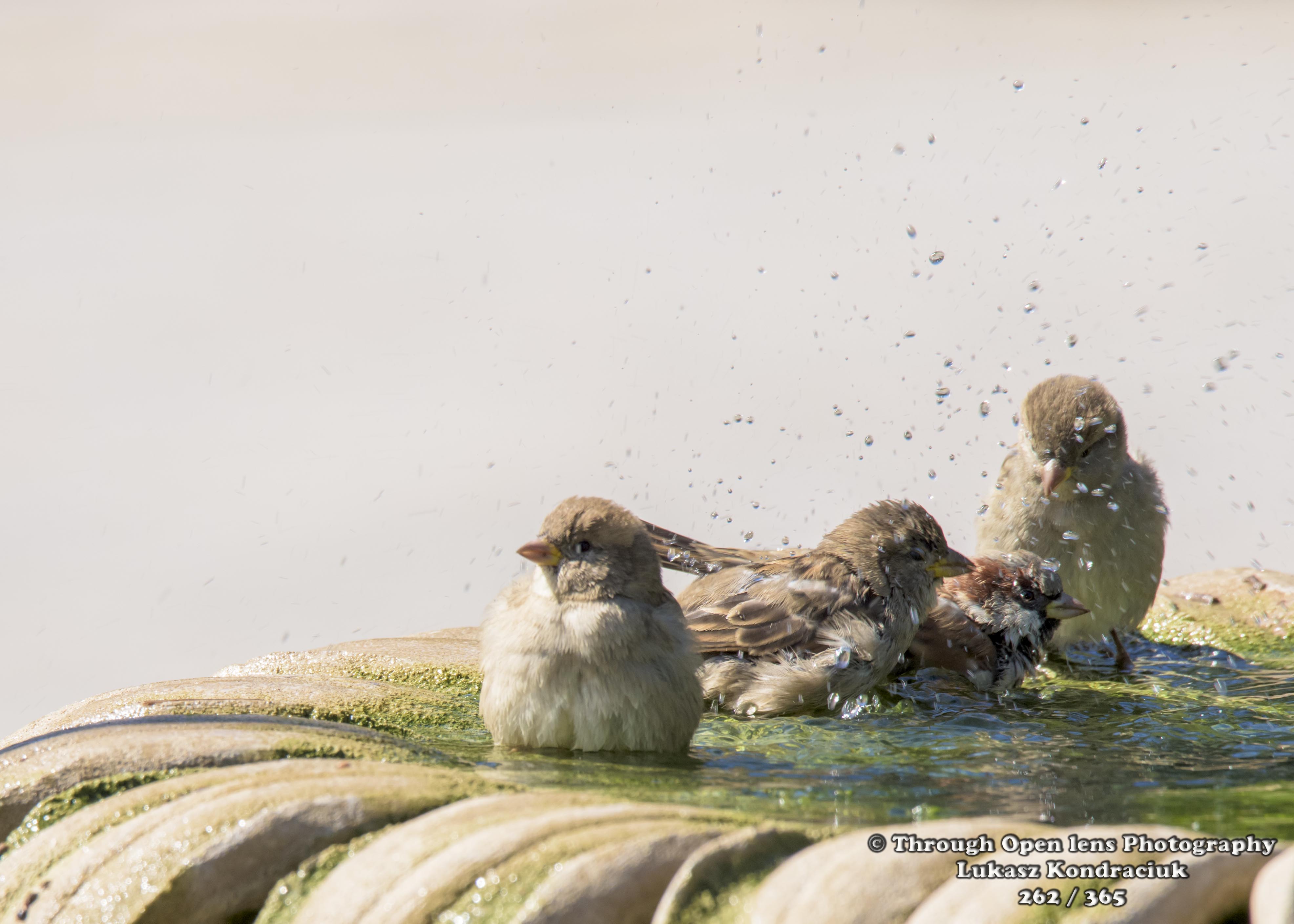
Pool Party!

House Sparrows

F/11.0, 1/400, ISO 400.

House Sparrows

Day 263 / 365

Two small time thieves had been sent by the Big Boss to steal a van load of goods from a bathroom suppliers. One stayed in the van as look out and the other went into the storeroom. Fifteen minutes went by, then half an hour, then an hour, and no sign of him. The look out finally grew impatient and went to look for his partner. Inside the store the two came face to face. “Where have you been?” demanded the worried look out “The boss told me to take a bath, but I couldn’t find the soap and a towel.”

Interesting Fact: House Sparrows in flocks have a pecking order much the way chickens in a farmyard do. You can begin to decipher the standings by paying attention to the black throats of the males. Males with larger patches of black tend to be older and dominant over males with less black. By wearing this information on their feathers, sparrows can avoid some fights and thereby save energy. ( http://www.allaboutbirds.org/guide/House_Sparrow/lifehistory )


Park Closes At Dusk!

park bench

F/10.0, 30.0, ISO 100.

Day 245 / 365

I woke up on a park bench and had no idea where I had been

And then I remembered, I’d been to the park

Interesting Fact: The first parks were English deer parks,[citation needed] land set aside for hunting by royalty and the aristocracy in medieval times. They had walls or thick hedges around them to keep game animals (e.g., stags) in and people out. It was strictly forbidden for commoners to hunt animals in these deer parks. ( https://en.wikipedia.org/wiki/Park#History )


We Claim This Island! Now What Do We Do?

Great Egrets

F/6.3, 1/1250, ISO 400.

Great Egrets

Day 235 / 365

Why does the bird bring toilet paper to the party?

Because he is a party pooper.

Interesting Fact: The pristinely white Great Egret gets even more dressed up for the breeding season. A patch of skin on its face turns neon green, and long plumes grow from its back. Called aigrettes, those plumes were the bane of egrets in the late nineteenth century, when such adornments were prized for ladies’ hats. ( http://www.allaboutbirds.org/guide/Great_Egret/lifehistory )


You Are The Mint To My Mojito!

Mojito

F/4.8, 1/60, ISO 100.

Mojito

Day 234 / 365

When life hands you lemons, find someone with tequila and salt!

Interesting Fact: Havana is the birthplace of the Mojito, although the exact origin of this classic cocktail is the subject of debate. One story traces the Mojito to a similar 16th century drink known as “El Draque”, after Francis Drake.[4] In 1586, after his successful raid at Cartagena de Indias Drake’s ships sailed towards Havana but there was an epidemic of dysentery and scurvy on board. It was known that the local South American Indians had remedies for various tropical illnesses; so a small boarding party went ashore on Cuba and came back with ingredients for a medicine which was effective. The ingredients were aguardiente de caña (a crude form of rum, translates as fire water from sugar cane) added with local tropical ingredients; lime, sugarcane juice and mint.[8] Drinking lime juice in itself would have been a great help in staving off scurvy and dysentery.[9] Tafia/Rum was used as soon as it became widely available to the British (ca. 1650). Mint, lime and sugar were also helpful in hiding the harsh taste of this spirit. While this drink was not called a Mojito at this time, it was still the original combination of these ingredients. ( https://en.wikipedia.org/wiki/Mojito )

Party On My Log!

Double-crested Cormorants

F/ 6.3, 1/500, ISO 320.

Double-crested Cormorants

Day 230 / 365

Which side of the Cormorant has the most feathers?

The outside.

Interesting Fact: Cormorants often stand in the sun with their wings spread out to dry. They have less preen oil than other birds, so their feathers can get soaked rather than shedding water like a duck’s. Though this seems like a problem for a bird that spends its life in water, wet feathers probably make it easier for cormorants to hunt underwater with agility and speed. ( http://www.allaboutbirds.org/guide/Double-crested_Cormorant/lifehistory#at_food )


Like Walking On Water Only Better! 

Paddleboarding

F/6.3, 1/800, ISO 200.

Day 227 / 365

How do paddle boarders say “hello” to each other?

They wave!

Interesting Fact: Historically, Africans and indeed many other river based and coastal cultures, have stood up within their canoes and upon rafts and paddled standing for thousands of years. Conceptually therefore, the idea of standing and paddling using an extended canoe paddle is far from being a new concept. ( https://en.m.wikipedia.org/wiki/Standup_paddleboarding )

Families Are Like Fudge Mostly Sweet With A Few Nuts

Greater Yellowlegs 1

F/ 6.3, 1/1000, ISO 640.

Greater Yellowlegs

Day 223 / 365

How do baby birds learn to fly?

They wing it!

Interesting Fact: They often feed actively, running after fish or other fast-moving aquatic prey. ( http://identify.whatbird.com/obj/252/overview/Greater_Yellowlegs.aspx )