Don’t Chirp With Your Mouth Full!

House Finch

F/ 10.0, 1/400, ISO 320.

House Finch

Day 347 / 365

Three birds were walking down the street. Two walked into a bar, the other one ducked!

Interesting Fact: The red of a male House Finch comes from pigments contained in its food during molt (birds can’t make bright red or yellow colors directly). So the more pigment in the food, the redder the male. This is why people sometimes see orange or yellowish male House Finches. Females prefer to mate with the reddest male they can find, perhaps raising the chances they get a capable mate who can do his part in feeding the nestlings. ( https://www.allaboutbirds.org/guide/House_Finch/lifehistory )

Don’t Wait For The Perfect Moment. Take The Moment And Make It Perfect.

Belted Kingfisher

F/10.0, 1/400, ISO 400.

Belted Kingfisher    

Day 339 / 365

A guy calls his boss and says “I can’t come to work today

The boss asks why and the guy says “It’s my eyes.”

“What’s wrong with your eyes?” asks the boss.

“I just can’t see myself coming to work, so I’m going fishing instead….”

Interesting Fact: As nestlings, Belted Kingfishers have acidic stomachs that help them digest bones, fish scales, and arthropod shells. But by the time they leave the nest, their stomach chemistry apparently changes, and they begin regurgitating pellets which accumulate on the ground around fishing and roosting perches. Scientists can dissect these pellets to learn about the kingfisher’s diet without harming or even observing any wild birds. ( https://www.allaboutbirds.org/guide/Belted_Kingfisher/lifehistory )

This is Maverick, I feel the need… …the need for speed!

Red-tailed Hawk

F/ 6.3, 1/800, ISO 800.

Red-tailed Hawk

Day 333 / 365

Why did the Hawk cross the road?

To eat the chicken!

Interesting Fact: Red-tailed Hawks have been seen hunting as a pair, guarding opposite sides of the same tree to catch tree squirrels. ( https://www.allaboutbirds.org/guide/Red-tailed_Hawk/lifehistory )


Keep Your Head Up!

Carolina Wren

F/6.3, 1/800, ISO 800.

Carolina Wren

Day 332 / 365

What is a parrot’s favorite game?

Hide and Speak!

Interesting Fact: Unlike other wren species in its genus, only the male Carolina Wren sings the loud song. In other species, such as the Stripe-breasted Wren of Central America, both members of a pair sing together. The male and female sing different parts, and usually interweave their songs such that they sound like a single bird singing. ( https://www.allaboutbirds.org/guide/Carolina_Wren/lifehistory )


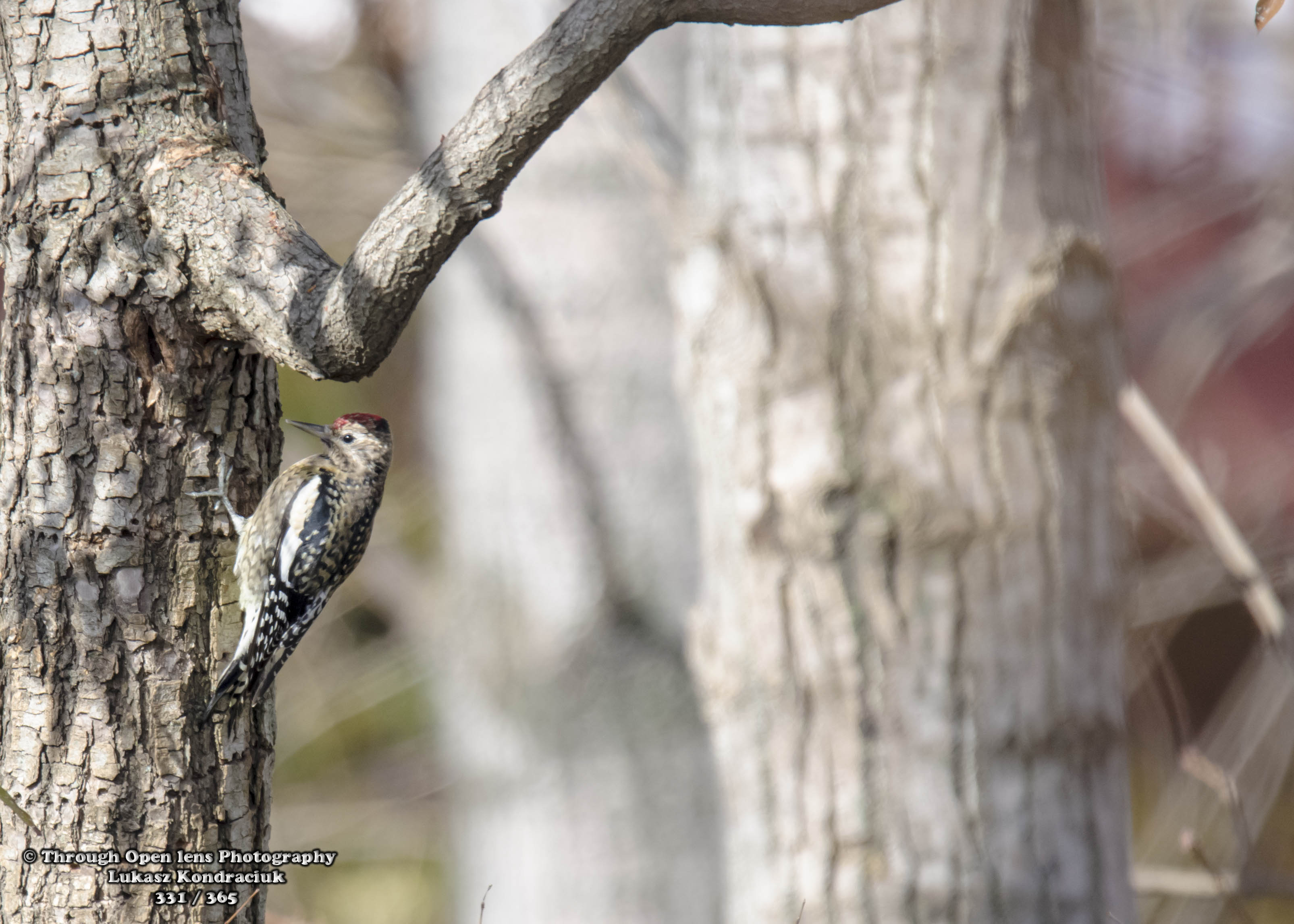
You Would Think, It Would Be Another Knock Knock Joke

Yellow Bellied Sapsucker

F/ 6.3, 1/800, ISO 800.

Yellow Bellied Sapsucker

Day 331 / 365

What do you get if you cross a parrot with a woodpecker?

A bird that talks in mores code!

Interesting Fact: The sapwells made by Yellow-bellied Sapsuckers attract hummingbirds, which also feed off the sap flowing from the tree. In some parts of Canada, Ruby-throated Hummingbirds rely so much on sapwells that they time their spring migration with the arrival of sapsuckers. Other birds as well as bats and porcupines also visit sapsucker sapwells. ( https://www.allaboutbirds.org/guide/Yellow-bellied_Sapsucker/lifehistory )

I’m Glad I’m Not a Turkey!

Dark-eyed Junco

HAPPY THANKSGIVING EVERONE!!!

F/ 6.3, 1/640, ISO 900.

Dark-eyed Junco 

Day 330 / 365

Chicken talking to the turkey: “Only Thanksgiving and Christmas??? You’re lucky, with us its any Sunday.”

Interesting Fact: Juncos are the “snowbirds” of the middle latitudes. Over most of the eastern United States, they appear as winter sets in and then retreat northward each spring. Some juncos in the Appalachian Mountains remain there all year round, breeding at the higher elevations. These residents have shorter wings than the migrants that join them each winter. Longer wings are better suited to flying long distances, a pattern commonly noted among other studies of migratory vs. resident species.  ( https://www.allaboutbirds.org/guide/Dark-eyed_Junco/lifehistory )

How Is My Mohawk!

Tufted Titmouse

F/8.0, 1/125, ISO 320.

Tufted Titmouse

Day 329 / 365

Why did the chicken say, “Meow, oink, bow-wow, and moo?”

He was studying foreign languages.

Interesting Fact: Tufted Titmice hoard food in fall and winter, a behavior they share with many of their relatives, including the chickadees and tits. Titmice take advantage of a bird feeder’s bounty by storing many of the seeds they get. Usually, the storage sites are within 130 feet of the feeder. The birds take only one seed per trip and usually shell the seeds before hiding them. ( https://www.allaboutbirds.org/guide/Tufted_Titmouse/lifehistory )

I Just Wanna Fly!

Red-tailed Hawk

F/ 9.0, 1/320, ISO 500.

Red-tailed Hawk

Day 319 / 365

What birds spend all their time on their knees?

Birds of prey!

Interesting Fact: Birds are amazingly adapted for life in the air. The Red-tailed Hawk is one of the largest birds you’ll see in North America, yet even the biggest females weigh in at only about 3 pounds. A similar-sized small dog might weigh 10 times that. ( https://www.allaboutbirds.org/guide/Red-tailed_Hawk/lifehistory )

That Taste A Little Weird?

Gadwall

F/ 11.0, 1/400, ISO 320.

Gadwall Ducks

Ring Billed Gulls

Day 218 / 365

A duck goes into a bar and says, ‘I would like a drink. I am old enough.’
The bartender replies, ‘You need to be able to prove who you are.’
The duck pulls out a mirror. He looks in it, nods his head, and says, ‘Yep, that’s me.’
.
Interesting Fact: Female Gadwall produce an egg a day while they are laying their 7–12-egg clutches. To meet their demand for protein during this stressful time, female Gadwall eat more invertebrates than males during this period—in addition to using reserves of nutrients they’ve stored in their bodies during the winter. ( https://www.allaboutbirds.org/guide/Gadwall/lifehistory )

The Duck Says Quack!

Ruddy Duck

F/ 10.0, 1/400, ISO 250.

Ruddy Duck

Day 312 / 365

What did the duck say when he dropped the dishes?

I hope I didn’t quack any!”
Interesting Fact: Though Ruddy Ducks are native to the Americas, one population became established in England after captive ducks escaped in 1952. This population grew to about 3,500 individuals by 1992, and now appears to be expanding into the Netherlands, France, Belgium, and Spain. ( https://www.allaboutbirds.org/guide/Ruddy_Duck/lifehistory ).