No. Stop Don’t SWALLOW That!

Tree Swallow

F/ 5.6, 1/500, ISO 125.

Tree Swallow

What do you call a chicken in the 1960’s?

A funky chicken.

Interesting Fact: Migrating and wintering Tree Swallows can form enormous flocks numbering in the hundreds of thousands. They gather about an hour before sunset and form a dense cloud above a roost site (such as a cattail marsh or grove of small trees), swirling around like a living tornado. With each pass, more birds drop down until they are all settled on the roost. ( https://www.allaboutbirds.org/guide/Tree_Swallow/lifehistory )

Don’t Lose Hope When The Sun Goes Down The Stars Come Out

sunset

F/13.0, 1/640, ISO 320.

Some people can tell what time it is by looking at the sun.

But I have never been able to make out the numbers.

Interesting Fact: Sunset colors are typically more brilliant than sunrise colors, because the evening air contains more particles than morning air. ( https://en.wikipedia.org/wiki/Sunset#Historically )


Don’t Stick Your Beak Where It Doesn’t Belong

Ring-billed Gull

F/9.0, 1/200, ISO 100.

Ring-billed Gull

What do you get when you cross a bird and a lawn mower?

Shredded tweet.

Interesting Fact: Many, if not most, Ring-billed Gulls return to breed at the colony where they hatched. Once they have bred, they are likely to return to the same breeding spot each year, often nesting within a few meters of the last year’s nest site. Many individuals return to the same wintering sites each winter too.  ( https://www.allaboutbirds.org/guide/Ring-billed_Gull/lifehistory )

Best Thing About Sunsets Is Watching Them With You

marina sunset

F/ 14.0, 1/800, ISO 500.

Living on Earth might be expensive but at least you get a free trip around the Sun every year.


Interesting Fact:  The time of sunset varies throughout the year, and is determined by the viewer’s position on Earth, specified by longitude and latitude, and elevation. Small daily changes and noticeable semi-annual changes in the timing of sunsets are driven by the axial tilt of Earth, daily rotation of the Earth, the planet’s movement in its annual elliptical orbit around the Sun, and the Earth and Moon’s paired revolutions around each other. During winter and spring, the days get longer and sunsets occur later every day until the day of the latest sunset, which occurs after the summer solstice. In the Northern Hemisphere, the latest sunset occurs late in June or in early July, but not on the summer solstice of June 21. This date depends on the viewer’s latitude (connected with the Earth’s slower movement around the aphelion around July 4). Likewise, the earliest sunset does not occur on the winter solstice, but rather about two weeks earlier, again depending on the viewer’s latitude. In the Northern Hemisphere, it occurs in early December or late November (influenced by the Earth’s faster movement near its perihelion, which occurs around January 3). ( https://en.wikipedia.org/wiki/Sunset )

Wazzaap! Through Open Lens Turns 2 Today!

It has been two years since my first post and what a great two years it has been!  Thank You everyone for your support and I hope to continue entertaining you all throughout many years to come.

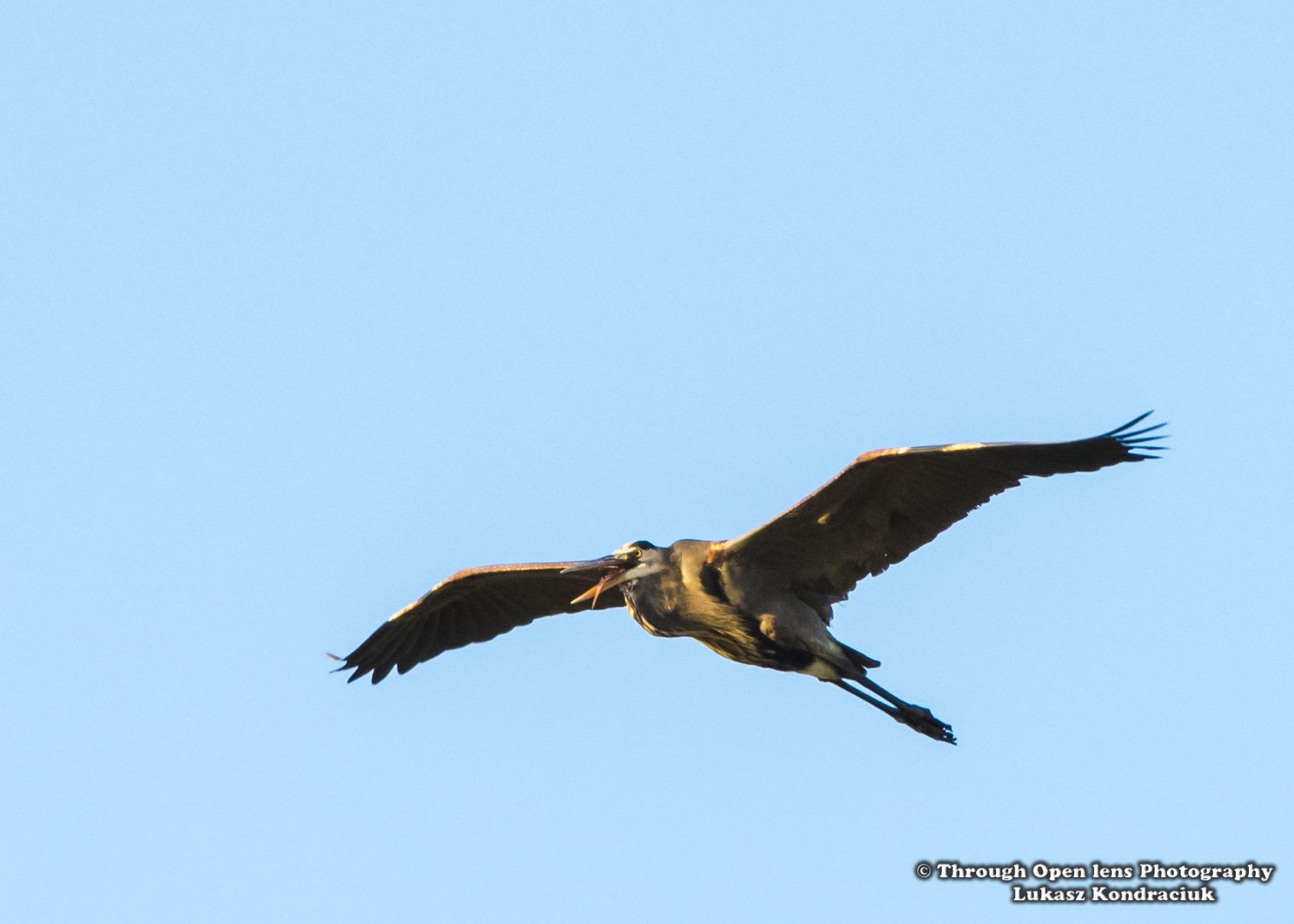
Great Blue Heron Wazzaap!

F/11.0, 1/500, ISO 640.

Great Blue Heron

A man is boasting to his buddies that he is taking his wife to Rome for their 40th wedding anniversary.
“What will you do for your 50th?” one of them asks.
“I’ll go and get her.”

Interesting Fact: Thanks to specially shaped neck vertebrae, Great Blue Herons can quickly strike prey at a distance.  ( https://www.allaboutbirds.org/guide/Great_Blue_Heron/lifehistory )

I Can See My Nest From Here!

Osprey

F/10.0, 1/400, ISO 500.

Osprey

What do you get when a chicken lays an egg on top of a barn?

An eggroll!

Interesting Fact: Ospreys are excellent anglers. Over several studies, Ospreys caught fish on at least 1 in every 4 dives, with success rates sometimes as high as 70 percent. The average time they spent hunting before making a catch was about 12 minutes—something to think about next time you throw your line in the water. ( https://www.allaboutbirds.org/guide/Osprey/lifehistory )

Stay Fly!

Bald Eagle ( Juvenile )

F/11.0,1/500, ISO 320.

Bald Eagle ( Juvenile )

How does a eagle greet the its prey in the water ?

“Pleased to eat you.”

Interesting Fact: Rather than do their own fishing, Bald Eagles often go after other creatures’ catches. A Bald Eagle will harass a hunting Osprey until the smaller raptor drops its prey in midair, where the eagle swoops it up. A Bald Eagle may even snatch a fish directly out of an Osprey’s talons. Fishing mammals (even people sometimes) can also lose prey to Bald Eagle piracy. See an example here. ( https://www.allaboutbirds.org/guide/Bald_Eagle/lifehistory )

It’s Magical!

Getty Center

F/ 8.0, 1/250, ISO 100.

Getty Center

California Week Two

It had been anything but an easy afternoon for the teacher who took six of her pupils through the Museum of Natural History, but their enthusiastic interest in the stuffed animals and their open-eyed wonder at the prehistoric fossils amply repaid her.

“Well, boys, where have you been all afternoon?” asked the father of two of the party that evening.

The answer came back with joyous promptness: “Oh, pop! Teacher took us to a dead circus.”

Interesting Fact: In 1984, Richard Meier was chosen to be the architect of the Center.[8] After an extensive conditional-use permit process,[4] construction by the Hathaway Dinwiddie Construction Company[9] began in August 1989.[10] The construction was significantly delayed, with the planned completion date moved from 1988 to 1995 (as of 1990).[11] By 1995, however, the campus was described as only “more than halfway complete”. ( https://en.wikipedia.org/wiki/Getty_Center#Location_and_history )


Life Is A Garden, Dig It!

Getty Museum

F/ 8.0, 1/250, ISO 100.

Getty Center

California Week

Two elderly women are walking through a museum and get separated.
As soon as they meet up with each other again, one of them appears quite flustered and says, “Goodness, gracious! Did you see the statue of the naked man back there? I’ve never been so shocked. How can they possibly display such a thing. My gosh, the penis on it was so large!”
Whereupon, the other old lady accidentally blurts out, “Yes, and cold, too!”

Interesting Fact:  Originally, the Getty Museum started in J. Paul Getty‘s house located in Pacific Palisades in 1954. He expanded the house with a museum wing. In the 1970s, Getty built a replica of an Italian villa on his home’s property to better house his collection, which opened in 1974. After Getty’s death in 1976, the entire property was turned over to the Getty Trust for museum purposes. However, the collection outgrew the site, which has since been renamed the Getty Villa, and management sought a location more accessible to Los Angeles. The purchase of the land upon which the Center is located, a campus of 24 acres (9.7 ha) on a 110-acre (45 ha) site in the Santa Monica Mountains above Interstate 405, surrounded by 600 acres (240 ha) kept in a natural state, was announced in 1983.[4] The site cost $25 million.[5] The top of the hill is 900 feet (270 m) above I-405, high enough that on a clear day it is possible to see not only the Los Angeles skyline but also the San Bernardino Mountains, and San Gabriel Mountains to the east as well as the Pacific Ocean to the west. ( https://en.wikipedia.org/wiki/Getty_Center#Location_and_history )


Day Is Behind Us, Watch Out Night, Here We Go!

cali sunset

F/ 10.0, 1/500, ISO 100.

California Week

Three men were in a NASA conference room to decide how to spend $10 billion.
“I think we should put our men on Mars!” said the first man.
“Ooh, good idea,” said the other two.
“I think we should put our men on Venus!” said the second man.
“Ooh, good idea,” said the other two.
“I think we should put our men on the Sun!”
“How are you going to do that?”
“Easy. We go at night.”

Interesting Fact: The 16th-century astronomer Nicolaus Copernicus was the first to present to the world a detailed and eventually widely accepted mathematical model supporting the premise that the Earth is moving and the Sun actually stays still, despite the impression from our point of view of a moving Sun. ( https://en.wikipedia.org/wiki/Sunset#Historically )