
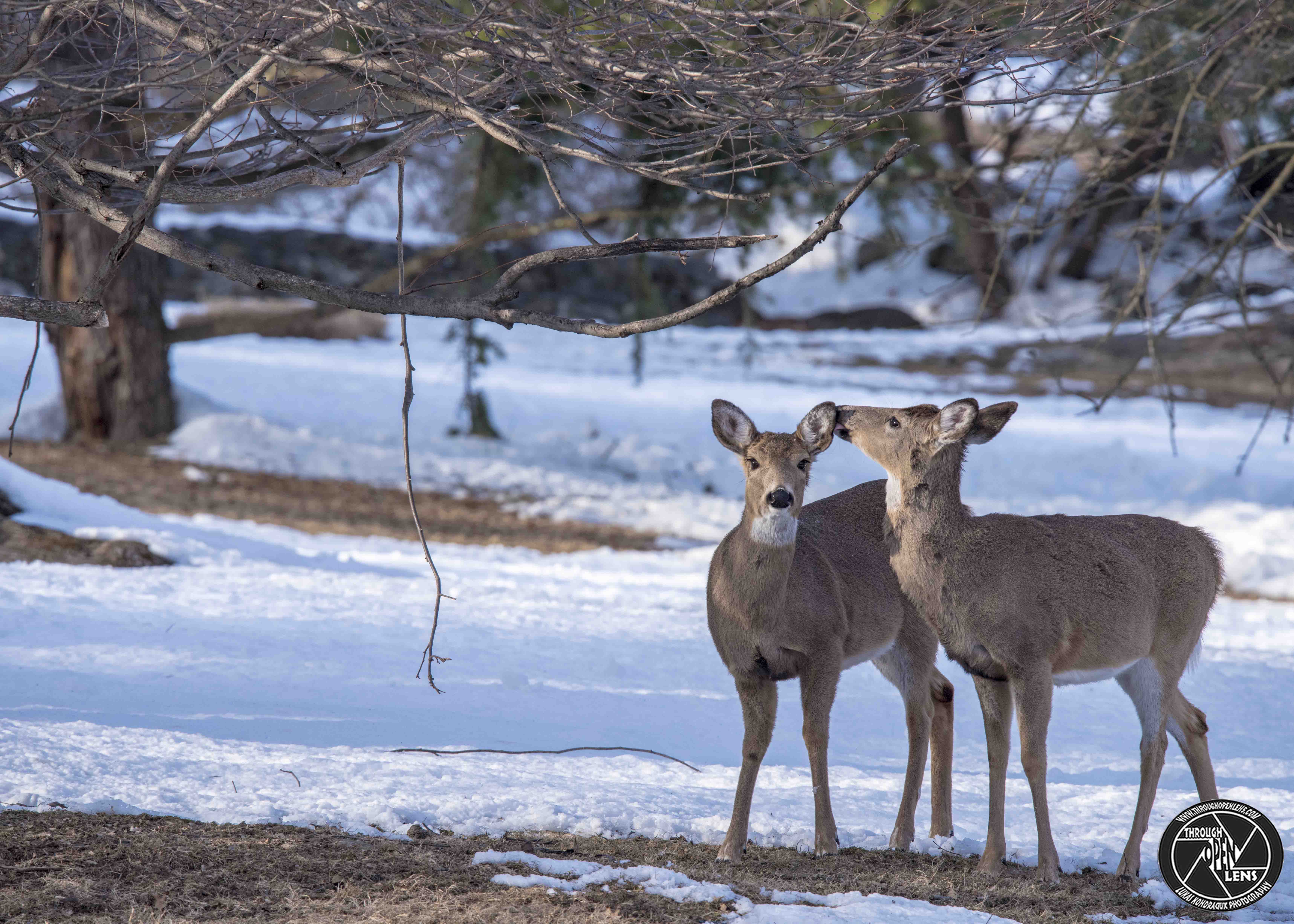
F/10.0, 1/400, ISO 640.
White-Tailed Deer
Who did Bambi invite to his birthday party?
His nearest and deer-est friends.
Interesting Fact: Although most often thought of as forest animals depending on relatively small openings and edges, white-tailed deer can equally adapt themselves to life in more open prairie, savanna woodlands, and sage communities as in the Southwestern United States and northern Mexico. These savanna-adapted deer have relatively large antlers in proportion to their body size and large tails. Also, a noticeable difference exists in size between male and female deer of the savannas. The Texas white-tailed deer (O. v. texanus), of the prairies and oak savannas of Texas and parts of Mexico, are the largest savanna-adapted deer in the Southwest, with impressive antlers that might rival deer found in Canada and the northern United States. Populations of Arizona (O. v. couesi) and Carmen Mountains (O. v. carminis) white-tailed deer inhabit montane mixed oak and pine woodland communities.[21] The Arizona and Carmen Mountains deer are smaller, but may also have impressive antlers, considering their size. The white-tailed deer of the Llanos region of Colombia and Venezuela (O. v. apurensis and O. v. gymnotis) have antler dimensions similar to the Arizona white-tailed deer. ( https://en.wikipedia.org/wiki/White-tailed_deer )
 Through Open Lens