Peek A Boo!

White-breasted Nuthatch 1

F/ 6.3, 1/160, ISO 320.

White-breasted Nuthatch

What do you call a crazy chicken ?

A cuckoo cluck !

Interesting Fact: In winter, White-breasted Nuthatches join foraging flocks led by chickadees or titmice, perhaps partly because it makes food easier to find and partly because more birds can keep an eye out for predators. One study found that when titmice were removed from a flock, nuthatches were more wary and less willing to visit exposed bird feeders. ( https://www.allaboutbirds.org/guide/White-breasted_Nuthatch/lifehistory )

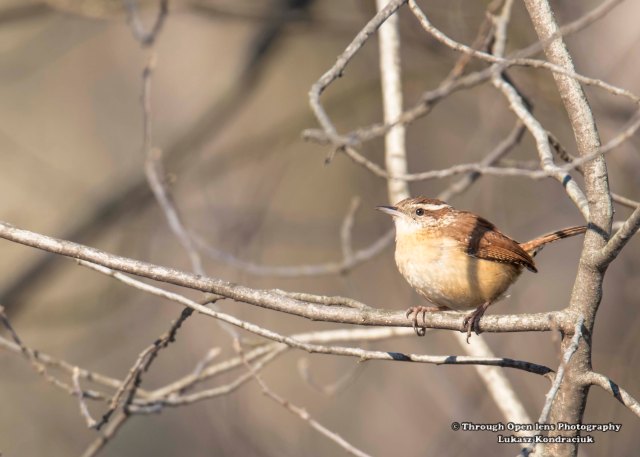
Catching Some Rays

Carolina Wren 1

F/8.0, 1/250, ISO 320.

Carolina Wren

Why did the bird join he air force?

He wanted to be a parrot trooper!

Interesting Fact: A pair bond may form between a male and a female at any time of the year, and the pair will stay together for life. Members of a pair stay together on their territory year-round, and forage and move around the territory together. ( https://www.allaboutbirds.org/guide/Carolina_Wren/lifehistory )

Branch Out To Something New

Tufted Titmouse 1

F/10.0, 1/400, ISO 320.

Tufted Titmouse

Why does a chicken coop have two doors ?

Because if had four doors it would be a chicken sedan!

Interesting Fact: Unlike many chickadees, Tufted Titmouse pairs do not gather into larger flocks outside the breeding season. Instead, most remain on the territory as a pair. Frequently one of their young from that year remains with them, and occasionally other juveniles from other places will join them. Rarely a young titmouse remains with its parents into the breeding season and will help them raise the next year’s brood. ( https://www.allaboutbirds.org/guide/Tufted_Titmouse/lifehistory )

I’d Climb The Highest Mountain

Dark-eyed Junco 1

F/11.0, 1/500, ISO 320.

Dark-eyed Junco 

How long do chickens work?

Around the cluck!

Interesting Fact: The Dark-eyed Junco is one of the most common birds in North America and can be found across the continent, from Alaska to Mexico, from California to New York. A recent estimate set the junco’s total population at approximately 630 million individuals.  ( https://www.allaboutbirds.org/guide/Dark-eyed_Junco/lifehistory )

The Mask Of Waxwing!

Cedar Waxwing

F/11.0, 1/500, ISO 400.

Cedar Waxwing

Why didn’t the chicken skeleton cross the road?

Because he didn’t have enough guts

Interesting Fact: The Cedar Waxwing is one of the few North American birds that specializes in eating fruit. It can survive on fruit alone for several months. Brown-headed Cowbirds that are raised in Cedar Waxwing nests typically don’t survive, in part because the cowbird chicks can’t develop on such a high-fruit diet. ( https://www.allaboutbirds.org/guide/Cedar_Waxwing/lifehistory )


Got Crabs?

Common Loon


F/ 10.0, 1/400, ISO 800.

Common Loon ( Juvenile )

Did you hear about the crab that went to the seafood disco?

He pulled a muscle

Interesting Fact: The Common Loon swims underwater to catch fish, propelling itself with its feet. It swallows most of its prey underwater. The loon has sharp, rearward-pointing projections on the roof of its mouth and tongue that help it keep a firm hold on slippery fish. ( https://www.allaboutbirds.org/guide/Common_Loon/lifehistory )


Freezing Wipeout!

surfing wipeouts

F/11.0, 1/500, ISO 800.

Two surfers are at getting ready to paddle out: Surfer one: “Hey, guess what! I got a new longboard for my wife!” Surfer two: “Great trade!”

Interesting Fact: For centuries, surfing was a central part of ancient Polynesian culture. Surfing may have first been observed by Europeans at Tahiti in 1767 by Samuel Wallis and the crew members of the Dolphin who were the first Europeans to visit the island in June of that year. Another candidate is the botanist Joseph Banks[2] being part of the first voyage of James Cook on the HMS Endeavour, who arrived on Tahiti on 10 April 1769. Lieutenant James King was the first person to write about the art of surfing on Hawaii when he was completing the journals of Captain James Cook upon Cook’s death in 1779. ( https://en.m.wikipedia.org/wiki/Surfing )

I’m Watching You Watching Me!

American Kestrel

F/ 13.0, 1/500, ISO 500.

American Kestrel

So there is this parrot and he knows a bunch of swear words and the owner says , “If you don’t stop swearing I’m going to sick you in the freezer.” So the parrot starts swearing and the guy puts him in the freezer. The parrot continues cussing up a storm but after a few minutes the parrot suddenly stops. The guy says “Will you stop swearing now?” and the parrot says “I’ll stop, but first I want to know what the chicken did.”

Interesting Fact: In winter in many southern parts of the range, female and male American Kestrels use different habitats. Females use the typical open habitat, and males use areas with more trees. This situation appears to be the result of the females migrating south first and establishing winter territories, leaving males to the more wooded areas. (  https://www.allaboutbirds.org/guide/American_Kestrel/lifehistory )

I Hear You Loud And Clear!

Ruddy Duck

F/ 9.0, 1/320, ISO 250.

Ruddy Duck

Duck Week Continues!

A duck walks into a bar, sits down at the barstool, and waits for the bartender. The bartender walks up, hands the duck a menu, waits a while, and comes back to take his order. “What’ll it be?” the bartender says.

The duck says, “I think I’ll have the grapes.”

“Well, I’m sorry sir, but this is a bar, we don’t serve grapes here. Now, I’ll let you look a bit longer and wave when you know what you want.”

The duck looks at the menu, then waves the bartender down.

“Ok, you got your order?” The duck nods, saying, “I’ll think I’ll have the grapes.”

The bartender, kind of peeved from the duck, says, “Look Mac, we don’t have any grapes here. This is a bar. We don’t serve grapes, so what will you have?!”

The duck looks at him in the eyes and says, “I’ll have the grapes.”

The bartender, enraged, shouts, “If you ask for the grapes one more time I’m going to nail your feathered a** to the barstool!!” The bartender cools off a bit. “Now what will you get?!”

“Got any nails?”

“OF COURSE WE DON’T HAVE ANY NAILS! WHAT DO YOU THINK THIS IS? A HARDWARE STORE?”

“Good, got any grapes?”

Interesting Fact: Ruddy Ducks get harassed by Horned Grebes, Pied-billed Grebes, and American Coots during the breeding season. The grebes sometimes attack Ruddy Ducks from below the water, a behavior known as “submarining.” ( https://www.allaboutbirds.org/guide/Ruddy_Duck/lifehistory )

Swimming With Purpose!

Harlequin Duck

F/ 10.0, 1/400, ISO 400.

Harlequin Duck

Duck Week!

What time does a duck wake up?

At the quack of dawn!

Interesting Fact: When engaged in behavioral interactions, the Harlequin Duck gives distinctly unducklike squeaks, the source of one of its local names: sea mouse. ( https://www.allaboutbirds.org/guide/Harlequin_Duck/lifehistory )