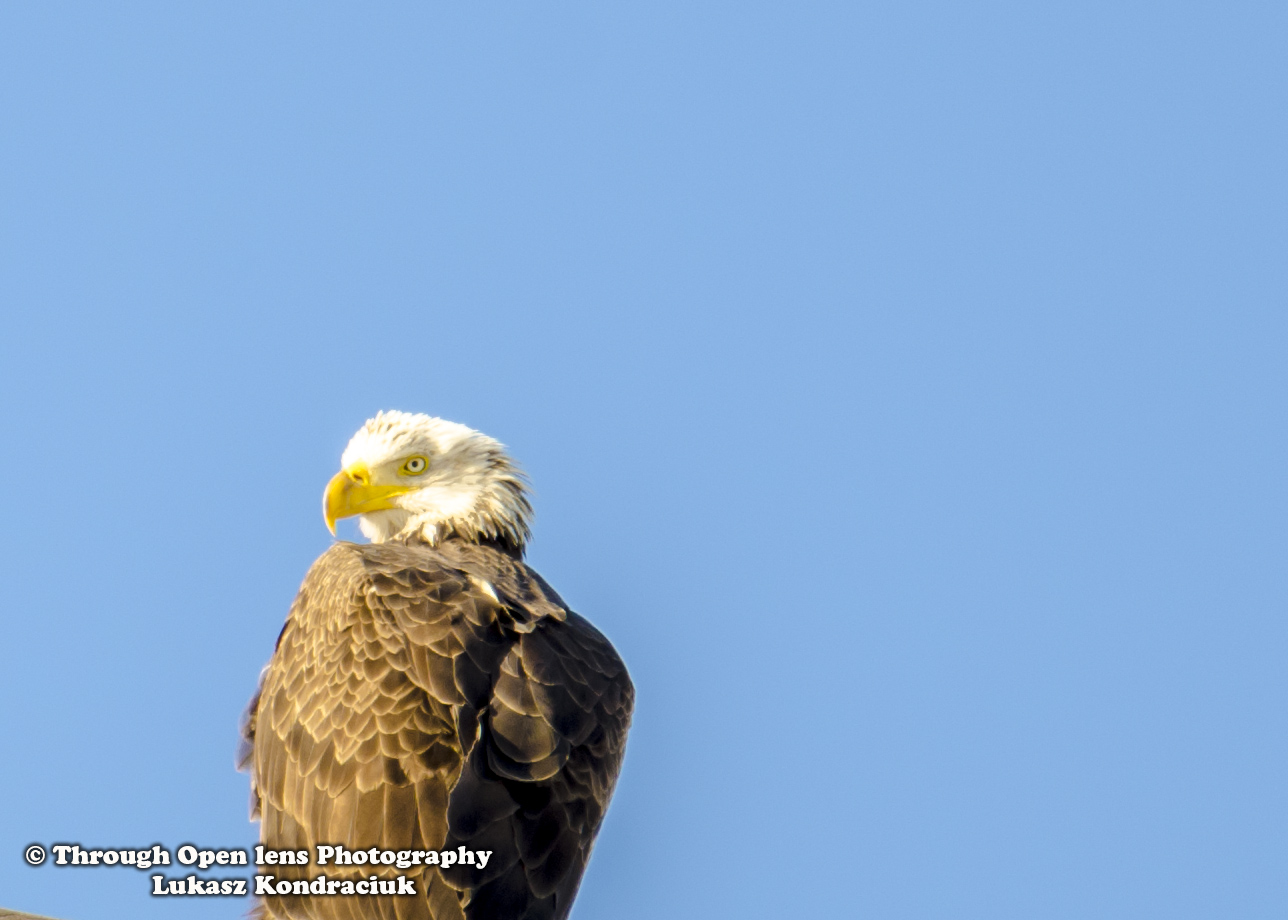
Why You Looking At Me Like That?!

Happy 4th Of July!

Bald Eagle

F/6.3, 1/320, ISO 200.

Bald Eagle

What do you call a sick eagle?

Ill-eagle!

Interesting Fact: Had Benjamin Franklin prevailed, the U.S. emblem might have been the Wild Turkey. In 1784, Franklin disparaged the national bird’s thieving tendencies and its vulnerability to harassment by small birds. “For my own part,” he wrote, “I wish the Bald Eagle had not been chosen the Representative of our Country. He is a Bird of bad moral Character. He does not get his Living honestly. … Besides he is a rank Coward: The little King Bird not bigger than a Sparrow attacks him boldly and drives him out of the District.”  ( https://www.allaboutbirds.org/guide/Bald_Eagle/lifehistory )


Car Is In Garage We Will Poop On The Roof Then!

Brown Pelicans 1

F/5.6, 1/500, ISO 250.

Brown Pelicans

Do you know what the white stuff in bird poop is?

That’s bird poop, too!

Interesting Fact: Pelicans incubate their eggs with the skin of their feet, essentially standing on the eggs to keep them warm. In the mid-twentieth century the pesticide DDT caused pelicans to lay thinner eggs that cracked under the weight of incubating parents. After nearly disappearing from North America in the 1960s and 1970s, Brown Pelicans made a full comeback thanks to pesticide regulations. ( https://www.allaboutbirds.org/guide/Brown_Pelican/lifehistory )


I Am Not Your Dinner!

Wild Turkey

F/6.3, 1/50, ISO 250.

Wild Turkey 

What happened to the turkey that got in a fight?

He got the stuffing knocked out of him!

Interesting Fact: In the early 1500s, European explorers brought home Wild Turkeys from Mexico, where native people had domesticated the birds centuries earlier. Turkeys quickly became popular on European menus thanks to their large size and rich taste from their diet of wild nuts. Later, when English colonists settled on the Atlantic Coast, they brought domesticated turkeys with them. ( https://www.allaboutbirds.org/guide/Wild_Turkey/lifehistory )


I Shall Give You Light!

Sandy Hook Light

F/9.0, 1/320, ISO 100.

Sandy Hook Light

What’s the difference between a lighthouse keeper and a jeweler?

One watches seas, and the other sees watches.

Interesting Fact: The light was built to aid mariners entering the southern end of the New York Harbor. It was originally called New York Lighthouse because it was funded through a New York Assembly lottery and a tax on all ships entering the Port of New York. The lighthouse has endured an attempt to destroy it as an aid to British navigation by Benjamin Tupper,[5] and a subsequent occupancy of British soldiers during the Revolutionary War.  ( https://en.wikipedia.org/wiki/Sandy_Hook_Light )

Bigger Is Better! 


Toronto

F/8.0, 1/250, ISO 100.

A Police officer pulled over a vehicle for speeding.

 Police officer: “Can you identify yourself, sir?”

 Driver pulls out his mirror and says: “Yes, it’s me.”

Interesting Fact: When Europeans first arrived at the site of present-day Toronto, the vicinity was inhabited by the Iroquois,[54] who by then had displaced the Wyandot people that had occupied the region for centuries before c. 1500.[55] The name Toronto is likely derived from the Iroquois word tkaronto, meaning “place where trees stand in the water”.[56] This refers to the northern end of what is now Lake Simcoe, where the Huron had planted tree saplings to corral fish. A portage route from Lake Ontario to Lake Huron running through this point, the Toronto Carrying-Place Trail, led to widespread use of the name. In the 1660s, the Iroquois established two villages within what is today Toronto, Ganatsekwyagon on the banks of the Rouge River and Teiaiagonon the banks of the Humber River. By 1701, the Mississauga had displaced the Iroquois, who abandoned the Toronto area at the end of the Beaver Wars. ( https://en.m.wikipedia.org/wiki/Toronto

Now That Is What I Call Braking News ! 


Breaking News

F/5.0, 1/125, ISO 100.

Toronto, Canada CP 24 News 

 A woman telephoned her local newspaper to let them know that she had just given birth to eighteen children. 

The reporter didn’t quite hear the message and said, “Would you repeat that?” 

“Not if I can help it,” replied the woman.

Interesting Fact: The channel was licensed by the Canadian Radio-television and Telecommunications Commission (CRTC) in 1996 as Pulse 24,[1] and launched on March 30, 1998 as CablePulse 24, under the ownership of CHUM Limited and minority partner Sun Media, owner of the Toronto Sun daily newspaper. The channel was named as an extension of CITY-TV’s newscasts, which were then known as CityPulse. For the first 10 years after its inception, CP24’s programming was anchored and featured reports from Citytv personalities, live CityPulse news broadcasts were immediately repeated on CP24 after their initial broadcast on CITY-TV (except for breaking news coverage), and special coverage was simulcast between the channel and the television station. Select programming from other CHUM stations would also be featured on the channel including The NewMusic and Fashion Television. ( https://en.m.wikipedia.org/wiki/CP24 )

Keep On Shining Bright! 

Fort Niagara Light

F/ 5.6, 1/400, ISO 100.

Fort Niagara Light

Did you hear about the lighthouse keeper’s daughter?

She never went out at night.

Interesting Fact: The lighthouse was established in 1782 atop the “French Castle”, a structure still located within Old Fort Niagara. The current tower was first lit in 1872, having been removed from the French Castle to allow for more room for officer’s quarters. The light was deactivated in 1996, having been replaced by a light beacon at the US Coast Guard Station Niagara. ( https://en.m.wikipedia.org/wiki/Fort_Niagara_Light )

Let’s Get Back On Track!

High Line Park

F/7.1, 1/200, ISO 320.

How do trees access the internet?

They log on.

Interesting Fact: The High Line (also known as the High Line Park) is a 1.45-mile-long (2.33 km) New York City linear park built in Manhattan on an elevated section of a disused New York Central Railroad spur called the West Side Line.[1] Inspired by the 3-mile (4.8-kilometer) Promenade plantée (tree-lined walkway), a similar project in Paris completed in 1993, the High Line has been redesigned and planted as an aerial greenway and rails-to-trails park. (

Where flowers bloom, so does hope.

Crocus

F/8.0, 1/250, IOS 320.

Crocus

What did the big flower say to the little one?

You’re really growing, bud!

Interesting Fact: The first crocus seen in the Netherlands, where crocus species are not native, were from corms brought back in the 1560s from Constantinople by the Holy Roman Emperor’s ambassador to the Sublime Porte, Ogier Ghiselin de Busbecq. A few corms were forwarded to Carolus Clusius at the botanical garden in Leiden. By 1620, the approximate date of Ambrosius Bosschaert‘s painting (illustration, below), new garden varieties had been developed, such as the cream-colored crocus feathered with bronze at the base of the bouquet, similar to varieties still on the market. Bosschaert, working from a preparatory drawing to paint his composed piece spanning the whole of spring, exaggerated the crocus so that it passes for a tulip, but its narrow, grass-like leaves give it away. ( https://en.wikipedia.org/wiki/Crocus#History )

Wanna Play?!

dogs

F/4.0, 1/1000, ISO 450.

German Shepherd – ( Zbój )

Pit Bull & Akita ( Mix ) – ( Rex )

What did the dog say to the tree?

Bark

Interesting Fact: The origin of the domestic dog (Canis lupus familiaris or Canis familiaris) is not clear. Whole genome sequencing indicates that the dog, the gray wolf and the extinct Taymyr wolf diverged at around the same time 27,000–40,000 years ago.[7] These dates imply that the earliest dogs arose in the time of human hunter-gatherers and not agriculturists.[31] Modern dogs are more closely related to ancient wolf fossils that have been found in Europe than they are to modern gray wolves.[32] Nearly all dog breeds’ genetic closeness to the gray wolf are due to admixture,[31] except several Arctic dog breeds are close to the Taimyr wolf of North Asia due to admixture. ( https://en.wikipedia.org/wiki/Dog )