Going to Christmas Eve Party!

christmas eve

F/ 7.1, 1/200, ISO 640, Photoshop CS6.

Northern Shoveler Ducks

Day 358 / 365

Twenty ways to confuse Santa Claus

1. Instead of milk and cookies, leave him a salad, and a note explaining that you think he could stand to lose a few pounds.

2. While he’s in the house, go find his sleigh and write him a speeding ticket.

3. Leave him a note, explaining that you’ve gone away for the holidays. Ask if he would mind watering your plants.

4. While he’s in the house, replace all his reindeer with exact replicas. Then wait and see what happens when he tries to get them to fly.

5. Keep an angry bull in your living room. If you think a bull goes crazy when he sees a little red cape, wait until he sees that big, red Santa suit!

6. Build an army of mean-looking snowmen on the roof, holding signs that say “We hate Christmas,” and “Go away Santa.”

7. Leave a note by the telephone, telling Santa that Mrs. Claus called and wanted to remind him to pick up some milk and a loaf of bread on his way home.

8. Throw a surprise party for Santa when he comes down the chimney. Refuse to let him leave until the strippers arrive.

9. While he’s in the house, find the sleigh and sit in it. As soon as he comes back and sees you, tell him that he shouldn’t have missed that last payment, and take off.

10. Leave a plate filled with cookies and a glass of milk out, with a note that says, “For The Tooth Fairy. :)” Leave another plate out with half a stale cookie and a few drops of skim milk in a dirty glass with a note that says, “For Santa. :(”

11. Take everything out of your house as if it’s just been robbed. When Santa arrives, show up dressed like a policeman and say, “Well, well. They always return to the scene of the crime.”

12. Leave out a copy of your Christmas list with last-minute changes and corrections.

13. While he’s in the house, cover the top of the chimney with barbed wire.

14. Leave lots of hunting trophies and guns out where Santa’s sure to see them. Go outside, yell, “Ooh! Look! A deer! And he’s got a red nose!” and fire a gun.

15. Leave Santa a note, explaining that you’ve moved. Include a map with unclear and hard-to-read directions to your new house.

16. Set a bear trap at the bottom of the chimney. Wait for Santa to get caught in it, and then explain that you’re sorry, but from a distance, he looked like a bear.

17. Leave out a Santa suit, with an attached dry-cleaning bill.

18. Paint “hoof-prints” all over your face and clothes. While he’s in the house, go out on the roof. When he comes back up, act like you’ve been “trampled.” Threaten to sue for personal injury.

19. Instead of ornaments, decorate your tree with Easter eggs.

20. Dress up like the Easter Bunny. Wait for Santa to come and then say, “This neighborhood ain’t big enough for the both of us.

Interesting Fact: Christmas Eve refers to the evening or entire day preceding Christmas Day, a widely celebrated festival commemorating the birth of Jesus of Nazareth.[4] Christmas Day is observed around the world, and Christmas Eve is widely observed as a full or partial holiday in anticipation of Christmas Day. Together, both days are considered one of the most culturally significant celebrations in Christendom and Western society. ( https://en.wikipedia.org/wiki/Christmas_Eve#Historical_events )

Staring Contest!

Northern Pintail Ducks

F/ 9.0, 1/320, ISO 250.

Northern Pintail Ducks

Day 354 / 365

What’s another name for a clever duck?

A wise quacker!

Interesting Fact: Like the Mallard, the Northern Pintail breeds in a variety of habitats all across northern North America and Eurasia. Also like the Mallard, island populations have splintered off and evolved into separate species. Two closely related forms can be found on Crozet and Kerguelen islands in the very southern Indian Ocean, known as Eaton’s Pintail (Anas eatoni) ( https://www.allaboutbirds.org/guide/Northern_Pintail/lifehistory )

Eat So You Will Be Big And Strong!

White-throated Sparrow

F/ 6.3, 1/60, ISO 320.

White-throated Sparrow

Day 353 / 365

A couple of birds made a date to meet on the ledge outside the tenth floor of a skyscraper. The female was there on time, but the male arrived an hour late. “Where were you? I was worried sick.” “It was such nice day, I decided to walk.”
Interesting Fact: Although they look nothing alike and aren’t particularly closely related, the White-throated Sparrow and the Dark-eyed Junco occasionally mate and produce hybrids. The resulting offspring look like grayish, dully marked White-throated Sparrows with white outer tail feathers. ( https://www.allaboutbirds.org/guide/White-throated_Sparrow/lifehistory )

Don’t Chirp With Your Mouth Full!

House Finch

F/ 10.0, 1/400, ISO 320.

House Finch

Day 347 / 365

Three birds were walking down the street. Two walked into a bar, the other one ducked!

Interesting Fact: The red of a male House Finch comes from pigments contained in its food during molt (birds can’t make bright red or yellow colors directly). So the more pigment in the food, the redder the male. This is why people sometimes see orange or yellowish male House Finches. Females prefer to mate with the reddest male they can find, perhaps raising the chances they get a capable mate who can do his part in feeding the nestlings. ( https://www.allaboutbirds.org/guide/House_Finch/lifehistory )

Don’t Wait For The Perfect Moment. Take The Moment And Make It Perfect.

Belted Kingfisher

F/10.0, 1/400, ISO 400.

Belted Kingfisher    

Day 339 / 365

A guy calls his boss and says “I can’t come to work today

The boss asks why and the guy says “It’s my eyes.”

“What’s wrong with your eyes?” asks the boss.

“I just can’t see myself coming to work, so I’m going fishing instead….”

Interesting Fact: As nestlings, Belted Kingfishers have acidic stomachs that help them digest bones, fish scales, and arthropod shells. But by the time they leave the nest, their stomach chemistry apparently changes, and they begin regurgitating pellets which accumulate on the ground around fishing and roosting perches. Scientists can dissect these pellets to learn about the kingfisher’s diet without harming or even observing any wild birds. ( https://www.allaboutbirds.org/guide/Belted_Kingfisher/lifehistory )

This is Maverick, I feel the need… …the need for speed!

Red-tailed Hawk

F/ 6.3, 1/800, ISO 800.

Red-tailed Hawk

Day 333 / 365

Why did the Hawk cross the road?

To eat the chicken!

Interesting Fact: Red-tailed Hawks have been seen hunting as a pair, guarding opposite sides of the same tree to catch tree squirrels. ( https://www.allaboutbirds.org/guide/Red-tailed_Hawk/lifehistory )


Keep Your Head Up!

Carolina Wren

F/6.3, 1/800, ISO 800.

Carolina Wren

Day 332 / 365

What is a parrot’s favorite game?

Hide and Speak!

Interesting Fact: Unlike other wren species in its genus, only the male Carolina Wren sings the loud song. In other species, such as the Stripe-breasted Wren of Central America, both members of a pair sing together. The male and female sing different parts, and usually interweave their songs such that they sound like a single bird singing. ( https://www.allaboutbirds.org/guide/Carolina_Wren/lifehistory )


You Would Think, It Would Be Another Knock Knock Joke

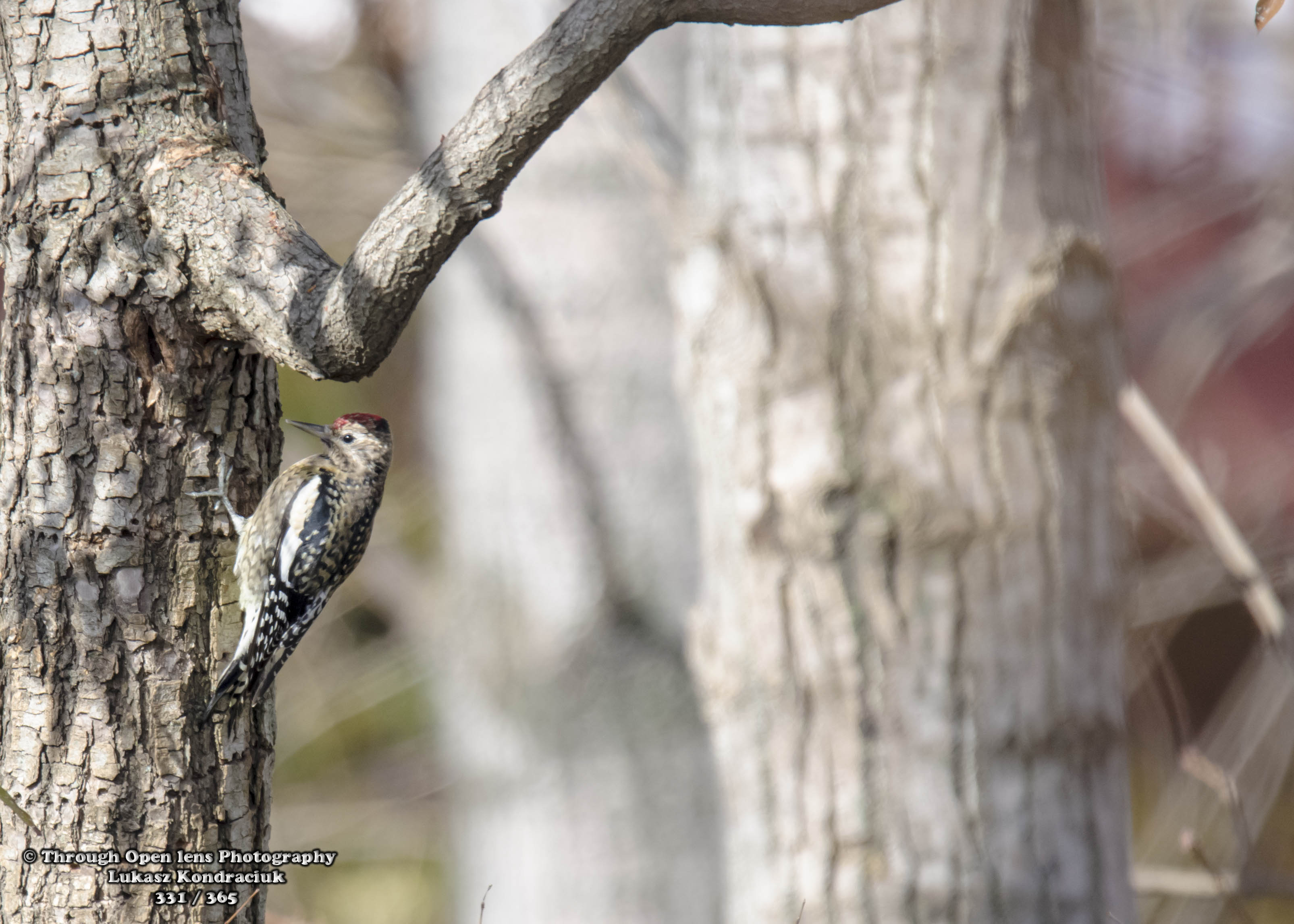
Yellow Bellied Sapsucker

F/ 6.3, 1/800, ISO 800.

Yellow Bellied Sapsucker

Day 331 / 365

What do you get if you cross a parrot with a woodpecker?

A bird that talks in mores code!

Interesting Fact: The sapwells made by Yellow-bellied Sapsuckers attract hummingbirds, which also feed off the sap flowing from the tree. In some parts of Canada, Ruby-throated Hummingbirds rely so much on sapwells that they time their spring migration with the arrival of sapsuckers. Other birds as well as bats and porcupines also visit sapsucker sapwells. ( https://www.allaboutbirds.org/guide/Yellow-bellied_Sapsucker/lifehistory )

I’m Glad I’m Not a Turkey!

Dark-eyed Junco

HAPPY THANKSGIVING EVERONE!!!

F/ 6.3, 1/640, ISO 900.

Dark-eyed Junco 

Day 330 / 365

Chicken talking to the turkey: “Only Thanksgiving and Christmas??? You’re lucky, with us its any Sunday.”

Interesting Fact: Juncos are the “snowbirds” of the middle latitudes. Over most of the eastern United States, they appear as winter sets in and then retreat northward each spring. Some juncos in the Appalachian Mountains remain there all year round, breeding at the higher elevations. These residents have shorter wings than the migrants that join them each winter. Longer wings are better suited to flying long distances, a pattern commonly noted among other studies of migratory vs. resident species.  ( https://www.allaboutbirds.org/guide/Dark-eyed_Junco/lifehistory )

How Is My Mohawk!

Tufted Titmouse

F/8.0, 1/125, ISO 320.

Tufted Titmouse

Day 329 / 365

Why did the chicken say, “Meow, oink, bow-wow, and moo?”

He was studying foreign languages.

Interesting Fact: Tufted Titmice hoard food in fall and winter, a behavior they share with many of their relatives, including the chickadees and tits. Titmice take advantage of a bird feeder’s bounty by storing many of the seeds they get. Usually, the storage sites are within 130 feet of the feeder. The birds take only one seed per trip and usually shell the seeds before hiding them. ( https://www.allaboutbirds.org/guide/Tufted_Titmouse/lifehistory )