Don’t Push My Buttons

keyboard

F/ 14.0, 10.0, ISO 160.

Day 323 / 365

Conversation between tech support and customer

Tech Support: Your password is the small letter ‘a’ as in apple, a capital letter ‘V’ as in Victor, and the number ‘7’.

Customer: Is that ‘7’ in capital letters?

Interesting Fact: From the 1940s until the late 1960s, typewriters were the main means of data entry and output for computing, becoming integrated into what were known as computer terminals. Because of the limitations of terminals based upon printed text in comparison to the growth in data storage, processing and transmission, a general move toward video-based computer terminals was effected by the 1970s, starting with the Datapoint 3300 in 1967. ( https://en.wikipedia.org/wiki/Computer_keyboard#History )

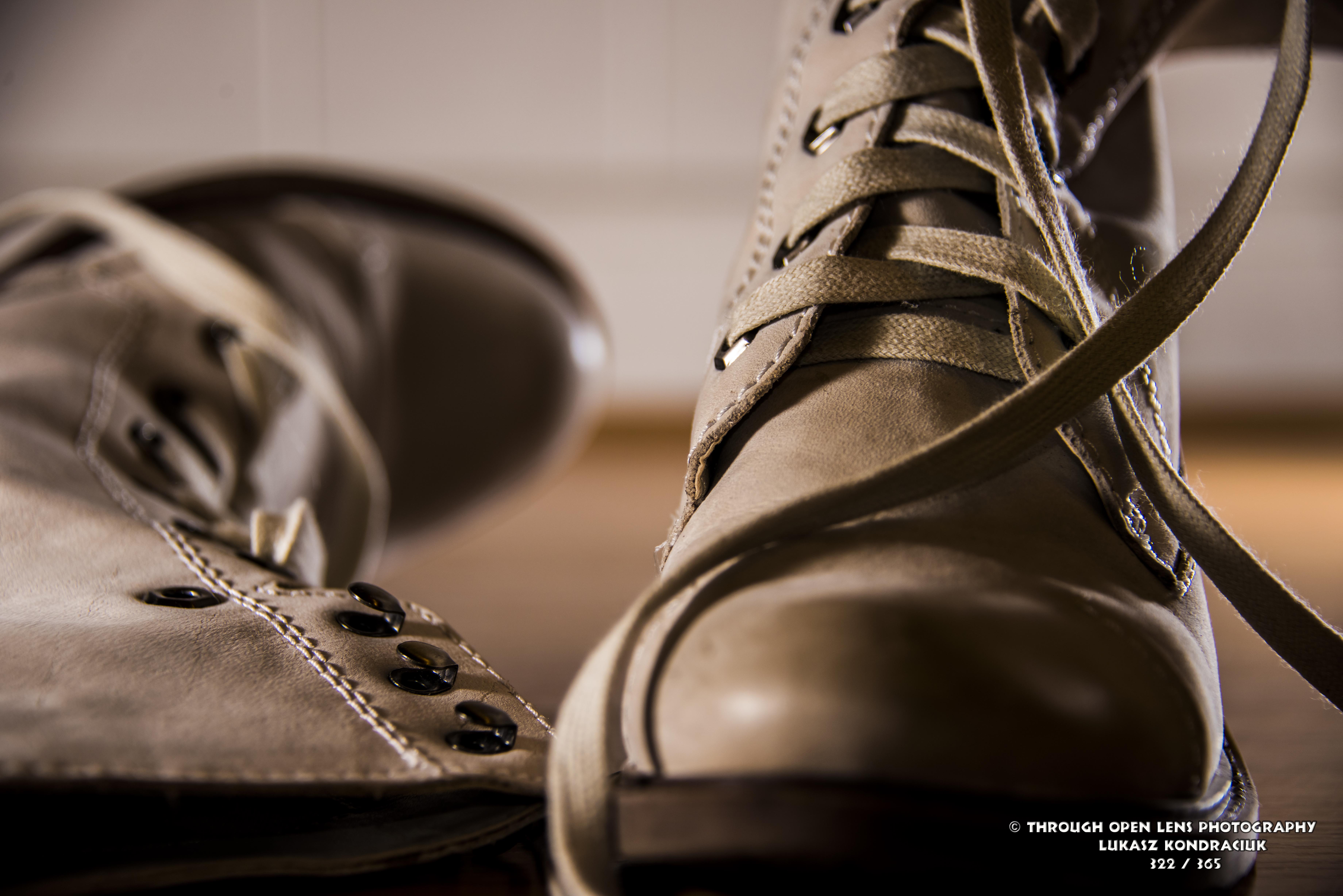
Those Boots Are Made For Walking

boots

F/5.3, 1/60, ISO 200.

Day 322 / 365

A little boy was standing and crying in the classroom, so the teacher asked him what was wrong. “I can’t find my boots,” the little boy sobbed.
The teacher looked around the room and saw a pair of boots. “Are these yours?” she asked. “No, those aren’t mine,” he cried.
The teacher and the little boy searched all over the classroom for his boots. Finally, the teacher gave up and said, “Are you SURE those aren’t your boots?” “Yes, I’m sure,” sobbed the boy. “Mine had snow on them!”

Interesting Fact: Early boots consisted of separate leggings, soles, and uppers worn together to provide greater ankle protection than shoes or sandals. Around 1000 BC, these components were more permanently joined to form a single unit that covered the feet and lower leg, often up to the knee. A type of soft leather ankle boots were worn by nomads in eastern Asia, and carried to China to India and Russia around AD 1200 to 1500 by Mongol invaders. The Inuit and Aleut natives of Alaska developed traditional winter boots of caribou skin or sealskin featuring decorative touches of seal intestine, dog hair and wolverine fur. 17th century European boots were influenced by military styles, featuring thick soles and turnover tops that were originally designed to protect horse mounted soldiers. In the 1700s, distinctive, knee-high boots worn by Hessian soldiers fighting in the American Revolutionary War influenced the development of the iconic heeled cowboy boots worn by cattlemen in the American west. ( https://en.wikipedia.org/wiki/Boot#History )

Are You Egging Me On?!

egg

F/5.6, 1/60, ISO 200.

Day 321 / 365

How do you make an egg roll?

You push it!

Interesting Fact: The dried egg industry developed in the 19th century, before the rise of the frozen egg industry.[9] In 1878, a company in St. Louis, Missouri started to transform egg yolk and white into a light-brown, meal-like substance by using a drying process.[9] The production of dried eggs significantly expanded during World War II, for use by the United States Armed Forces and its allies. ( https://en.wikipedia.org/wiki/Egg_(food)#History )

I Think I’m On The Right Track

Light Rail

F/ 14.0 , 25.0, ISO 200.

Day 320 / 365

What do you call a train that eats toffee?

A chew, chew train.

Interesting Fact: The system began operating its first segment in April 2000, expanded in phases during the next decade, and was completed with the opening of its southern terminus on January 31, 2011. The line generally runs parallel to the Hudson River and Upper New York Bay, while its northern end and its western branch travel through the lower Hudson Palisades. HBLR has twenty-four stations along a total track length of just over 34 miles (55 km) and serves over 54,000 weekday passengers.[1] There are plans for expansion through extensions and additional stations. ( https://en.wikipedia.org/wiki/Hudson%E2%80%93Bergen_Light_Rail#Historical_overview )

I Just Wanna Fly!

Red-tailed Hawk

F/ 9.0, 1/320, ISO 500.

Red-tailed Hawk

Day 319 / 365

What birds spend all their time on their knees?

Birds of prey!

Interesting Fact: Birds are amazingly adapted for life in the air. The Red-tailed Hawk is one of the largest birds you’ll see in North America, yet even the biggest females weigh in at only about 3 pounds. A similar-sized small dog might weigh 10 times that. ( https://www.allaboutbirds.org/guide/Red-tailed_Hawk/lifehistory )

That Taste A Little Weird?

Gadwall

F/ 11.0, 1/400, ISO 320.

Gadwall Ducks

Ring Billed Gulls

Day 218 / 365

A duck goes into a bar and says, ‘I would like a drink. I am old enough.’
The bartender replies, ‘You need to be able to prove who you are.’
The duck pulls out a mirror. He looks in it, nods his head, and says, ‘Yep, that’s me.’
.
Interesting Fact: Female Gadwall produce an egg a day while they are laying their 7–12-egg clutches. To meet their demand for protein during this stressful time, female Gadwall eat more invertebrates than males during this period—in addition to using reserves of nutrients they’ve stored in their bodies during the winter. ( https://www.allaboutbirds.org/guide/Gadwall/lifehistory )

Let Me Lift Up Your Smile

crane

F/14.0, 259.0, ISO 64.

Day 217 / 365

There were three workers; one crane operator, one pole climber, one guide.
The guide tied the crane to the end of a pole. The crane operator would then pick the pole up on end. The climber climbed to the top and dropped a tape measure which the guide promptly read and noted the measurement. The crane operator then lowered the pole to the ground and repsitioned to pick up another pole.
This went on several times when the foreman came over and asked why they couldn’t measure the poles while they were laying on the ground?
The worker replied, “we need to know how tall the poles are, not how long”.

source: http://www.jokebuddha.com/Crane#ixzz3rRDzfNPL

Interesting Fact: It is assumed that Roman engineers lifted these extraordinary weights by two measures. First, as suggested by Heron, a lifting tower was set up, whose four masts were arranged in the shape of a quadrangle with parallel sides, not unlike a siege tower, but with the column in the middle of the structure (Mechanica 3.5).[6] Second, a multitude of capstans were placed on the ground around the tower, for, although having a lower leverage ratio than treadwheels, capstans could be set up in higher numbers and run by more men (and, moreover, by draught animals).[7] This use of multiple capstans is also described by Ammianus Marcellinus (17.4.15) in connection with the lifting of the Lateranense obelisk in the Circus Maximus (ca. 357 AD). The maximum lifting capability of a single capstan can be established by the number of lewis iron holes bored into the monolith. In case of the Baalbek architrave blocks, which weigh between 55 and 60 tons, eight extant holes suggest an allowance of 7.5 ton per lewis iron, that is per capstan.[8] Lifting such heavy weights in a concerted action required a great amount of coordination between the work groups applying the force to the capstans. ( https://en.wikipedia.org/wiki/Crane_(machine)#History )

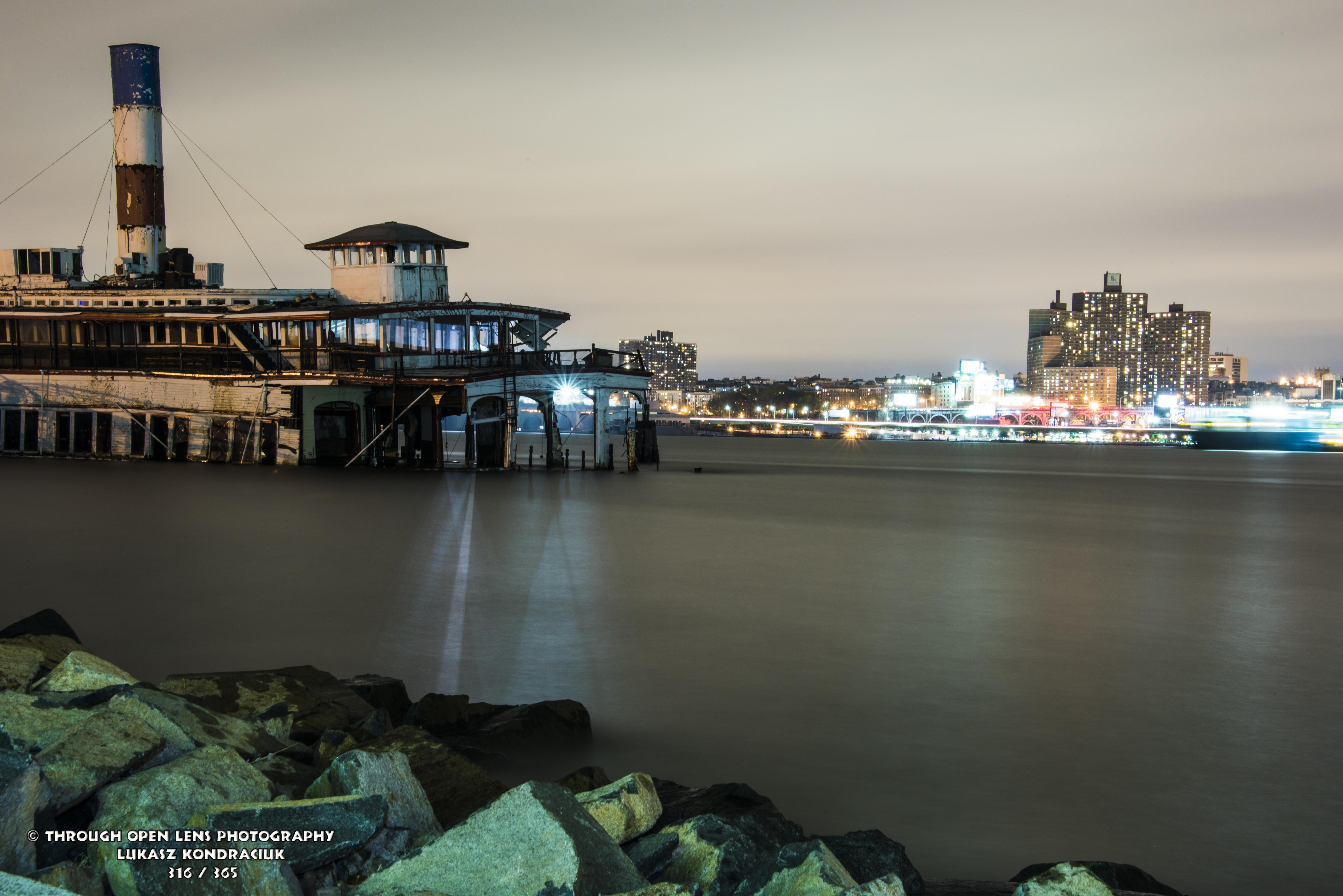
I Don’t Think Anyone Will Row Row Row That Boat Gently Down The Stream

Binghamton ferry

F/22.0, 159.0, ISO 64.

Day 316 / 365

What do you do with a sick boat?

Take it to the DOC!

Interesting Fact:

Binghamton was one of six identical screw-propelled double-ended ferryboats built by the Newport News Shipbuilding and Dry-dock Company at Newport News, Virginia in 1904-05 to designs by Gardner & Cox, naval architects. She was launched on February 20, 1905, with Miss Charlotte Emery, daughter of John M. Emery, the newly promoted superintendent of the Hoboken Ferry Company and Ferry Department of the DL&W, serving as her sponsor. Binghamton was completed a month later and left the Newport News yard on March 25 for the trip to Hoboken, New Jersey. She was placed in commission on April 3. Her Captain for the first crossing was Oren D. Relyea.

Her normal run was from the Hoboken Terminal to Barclay Street, a twelve-minute journey of approximately 1 and 3/4 miles, a trip made continuously nearly every day for more than sixty years (on occasion she substituted on the Hoboken – 23rd Street run). ( https://en.wikipedia.org/wiki/Binghamton_(ferryboat) )


It’s Not A 3D Print Of The Save Icon

Floppy disk

F/5.3, 1/60, ISO250.

Day 315 / 365

What does a baby computer call his father?

Data!

Interesting Fact: The earliest floppy disks, developed in the late 1960s, are 8 inches (200 mm) in diameter;[1] they became commercially available in 1971.[2] These disks and associated drives were produced and improved upon by IBM and other companies such as Memorex, Shugart Associates, and Burroughs Corporation.[3] The term “floppy disk” appeared in print as early as 1970,[4] and although in 1973 IBM announced its first media as “Type 1 Diskette” the industry continued to use the terms “floppy disk” or “floppy”. ( https://en.wikipedia.org/wiki/Floppy_disk )

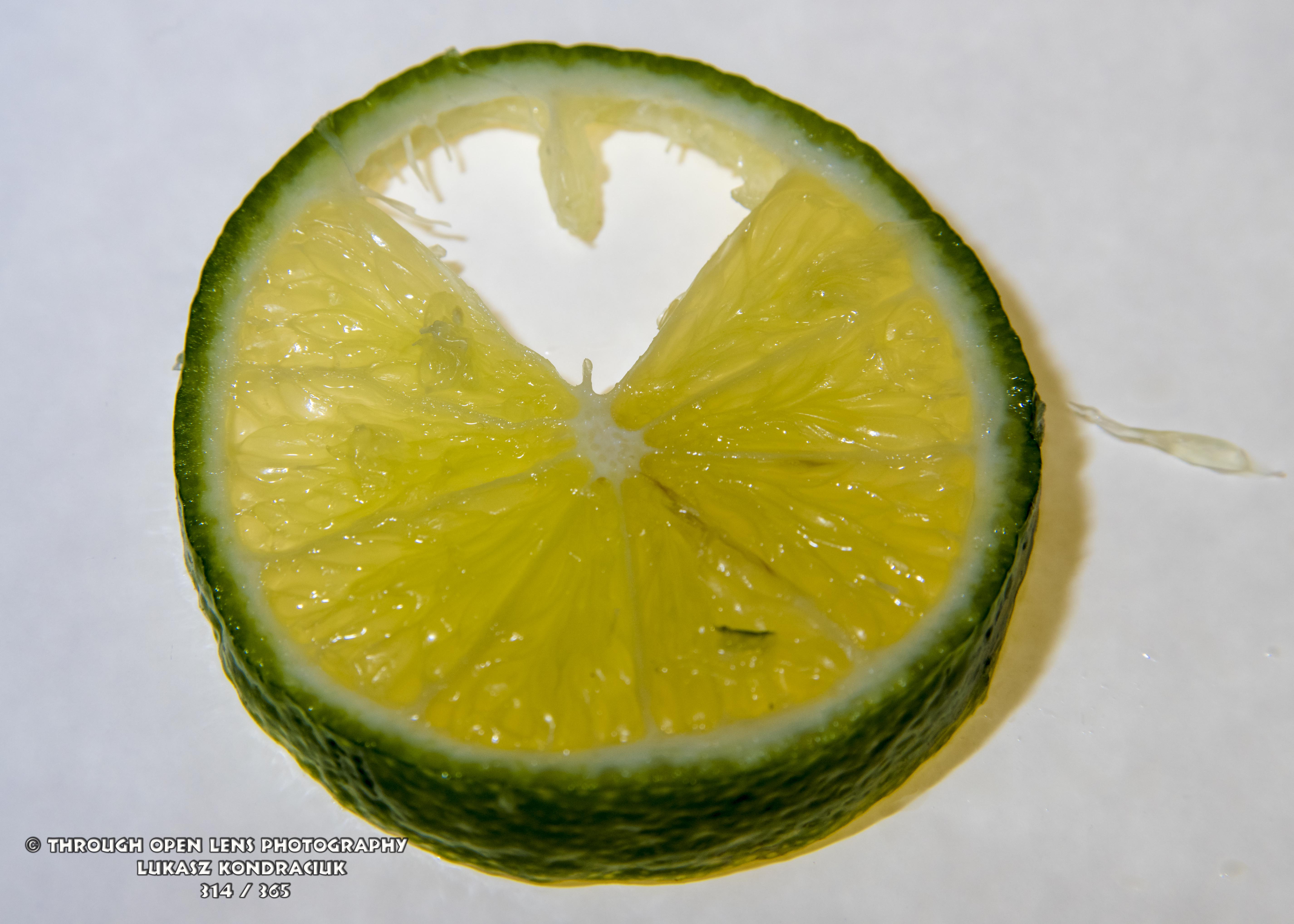
First They Are Sour Then They Are Sweet

lime

F/ 13.0, 1/60, ISO 320.

Day 314 / 365

There was a scientist who wanted to see how smart kids were before they went to kindergarten.
He blind-folded them and gave them a lime lifesaver to eat. He asked them if they knew what kind it was.
“Lime” they all replied
“Very good!” the scientist said “What about this one?” He gave them a honey flavored one and asked them if they knew what it was but no one knew.
“C’mon!” he said “It’s what your mommy calls your daddy”
All of the sudden one kid spits it out and yells out “EVERYBODY SPIT IT OUT – THEY’RE A$$HOLES!”

Interesting Fact: To prevent scurvy during the 19th century, British sailors were issued a daily allowance of citrus, such as lemon, and later switched to lime.[8] The use of citrus was initially a closely guarded military secret, as scurvy was a common scourge of various national navies, and the ability to remain at sea for lengthy periods without contracting the disorder was a huge benefit for the military. The British sailor thus acquired the nickname, “Limey” because of their usage of limes. ( https://en.m.wikipedia.org/wiki/Lime_(fruit) )