Splash Off!

American Black Duck

F/9.0, 1/320, ISO 320.

American Black Duck

Two monsters went duck-hunting with their dogs but without success. “I know what we’re doing wrong,” said the first one. “What’s that then?” asked the second. “We’re not throwing the dogs high enough!”

Interesting Fact: The colors of the bill and legs are used to determine their age and sex. These differences led to an earlier belief that there were two subspecies, a northern, red-legged race, and a southern “common” one. ( http://identify.whatbird.com/obj/392/overview/American_Black_Duck.aspx )
Wazzaap! Through Open Lens Turns 2 Today!

It has been two years since my first post and what a great two years it has been!  Thank You everyone for your support and I hope to continue entertaining you all throughout many years to come.

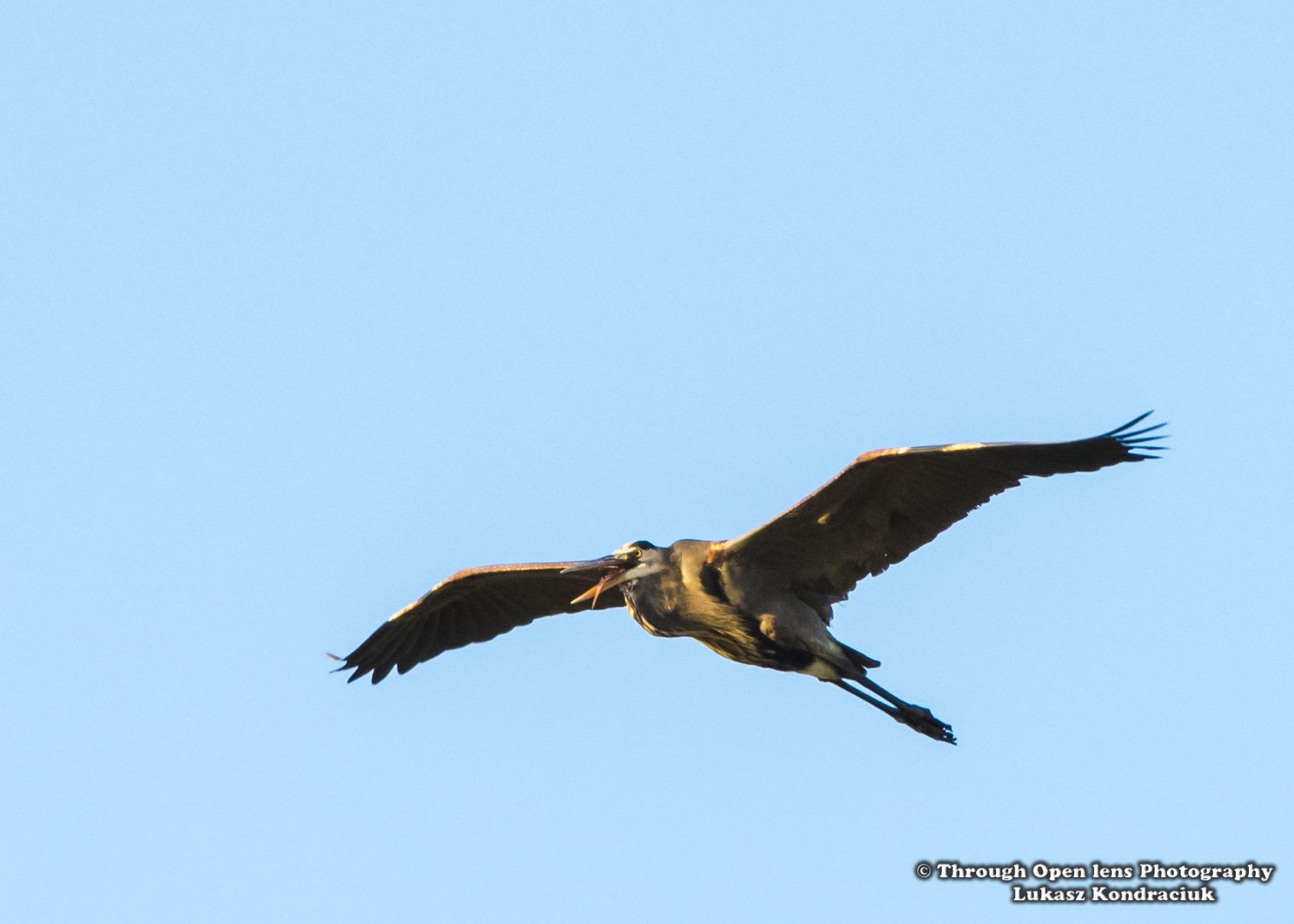
Great Blue Heron Wazzaap!

F/11.0, 1/500, ISO 640.

Great Blue Heron

A man is boasting to his buddies that he is taking his wife to Rome for their 40th wedding anniversary.
“What will you do for your 50th?” one of them asks.
“I’ll go and get her.”

Interesting Fact: Thanks to specially shaped neck vertebrae, Great Blue Herons can quickly strike prey at a distance.  ( https://www.allaboutbirds.org/guide/Great_Blue_Heron/lifehistory )

I Can See My Nest From Here!

Osprey

F/10.0, 1/400, ISO 500.

Osprey

What do you get when a chicken lays an egg on top of a barn?

An eggroll!

Interesting Fact: Ospreys are excellent anglers. Over several studies, Ospreys caught fish on at least 1 in every 4 dives, with success rates sometimes as high as 70 percent. The average time they spent hunting before making a catch was about 12 minutes—something to think about next time you throw your line in the water. ( https://www.allaboutbirds.org/guide/Osprey/lifehistory )

Stay Fly!

Bald Eagle ( Juvenile )

F/11.0,1/500, ISO 320.

Bald Eagle ( Juvenile )

How does a eagle greet the its prey in the water ?

“Pleased to eat you.”

Interesting Fact: Rather than do their own fishing, Bald Eagles often go after other creatures’ catches. A Bald Eagle will harass a hunting Osprey until the smaller raptor drops its prey in midair, where the eagle swoops it up. A Bald Eagle may even snatch a fish directly out of an Osprey’s talons. Fishing mammals (even people sometimes) can also lose prey to Bald Eagle piracy. See an example here. ( https://www.allaboutbirds.org/guide/Bald_Eagle/lifehistory )

Fly Free!!

Black Skimmer

F/5.6, 1/250, ISO 400.

Black Skimmer

California Week

How long do chickens work?

Around the cluck!

Interesting Fact: Although the Black Skimmer is active throughout the day, it is largely crepuscular (active in the dawn and dusk) and even nocturnal. Its use of touch to catch fish lets it be successful in low light or darkness.  ( https://www.allaboutbirds.org/guide/Black_Skimmer/lifehistory )

I Fly So High, I Can Reach The Sky!

Rough Legged Hawk

F/ 8.0, 1/320, ISO 100.

Rough Legged Hawk ( Dark  )

Is chicken soup good for your health?

Not if you’re the chicken!

Interesting Fact: Nonbreeding adults eat about a quarter-pound of food daily, or a tenth of their body mass—that’s about 5 small mammals. Nestlings start feeding themselves (swallowing lemmings whole) at about 16 days old. It’s estimated that a brood of 2 nestlings requires 26 pounds of food during the 40 days between hatching to fledging. ( https://www.allaboutbirds.org/guide/Rough-legged_Hawk/lifehistory )


SNOW!!! And Away I GO!!!

Common Merganser flying

F/5.3, 1/160, ISO 800.

Common Merganser

What did the parrot say when he saw a duck?

Polly want a quacker!

Interesting Fact: Common Mergansers are sometimes called sawbills, fish ducks, or goosanders. The word “merganser” comes from the Latin and roughly translates to “plunging goose”—a good name for this very large and often submerged duck. ( https://www.allaboutbirds.org/guide/Common_Merganser/lifehistory )

We Are Always Landing On Our Feet

Common Merganser

F/8.0, 1/2000, ISO 800.

Common Merganser

Duck Week Last Day

A duck walks into a bar and says to the bar tender “I’ll have a beer”.

The bartender says “Hey! where did you come from?”

The duck says “I’m working the construction site across the street”.

And the bartender says, “Well why are you working construction when you could be making millions in the circus?”

And the duck said “What would the circus want with a brick laying duck?”


Interesting Fact: You may see gulls trailing flocks of foraging Common Mergansers. They wait for the ducks to come to the surface and then try to steal their prey rather than fishing on their own. Occasionally even a Bald Eagle will try to steal a fish from a merganser. ( https://www.allaboutbirds.org/guide/Common_Merganser/lifehistory )

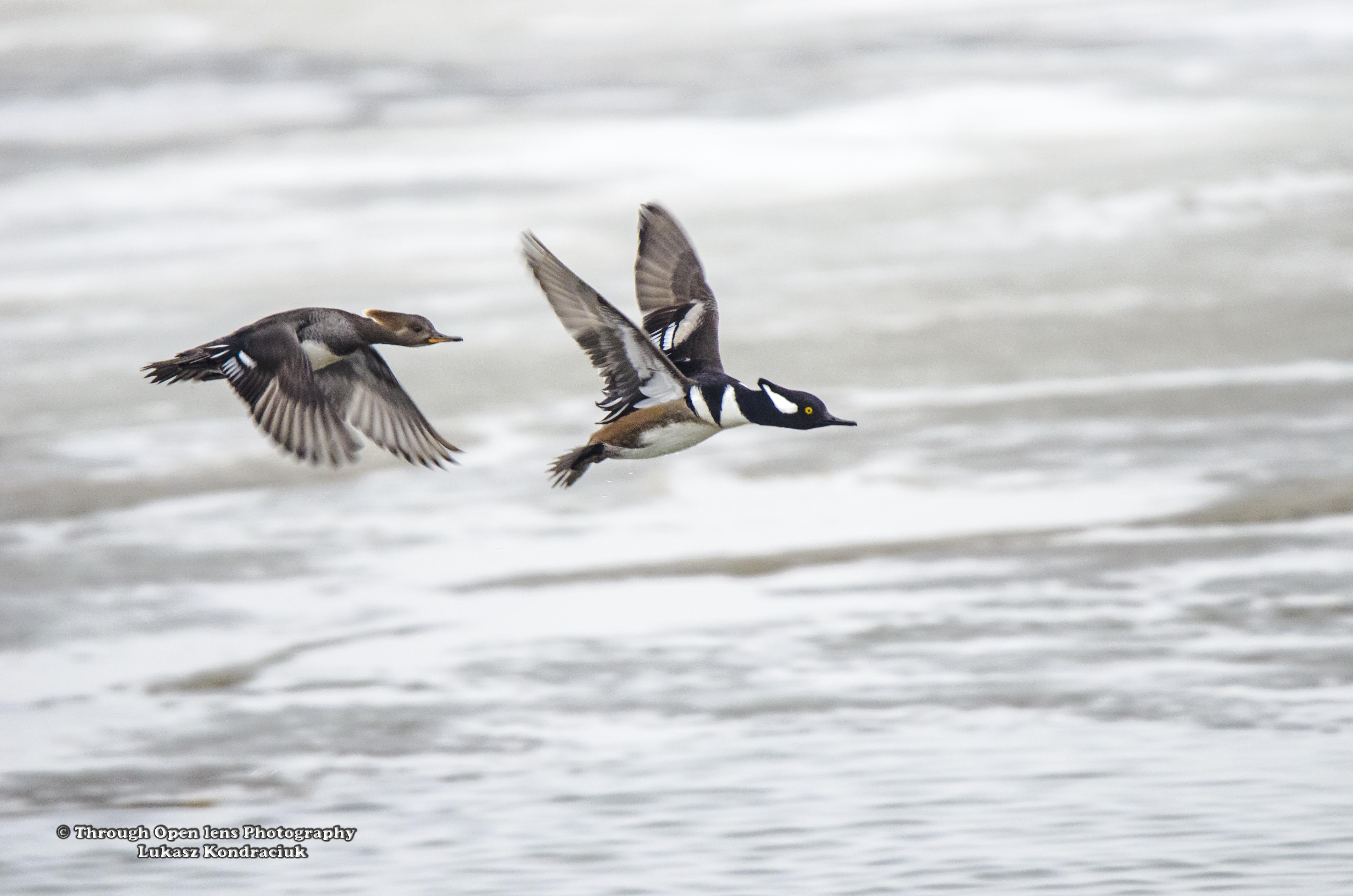
And They’re Off!

Hooded Mergansers

F/ 6.3, 1/400, ISO 1600.

Hooded Mergansers

Duck Week Continues!

A circus owner walked into a bar to see everyone crowded about a table watching a little show. On the table was an upside down pot and a duck tap dancing on it. The circus owner was so impressed that he offered to buy the duck from its owner. After some wheeling and dealing, they settled for $10,000 for the duck and the pot. Three days later the circus owner runs back to the bar in anger, “Your duck is a ripoff! I put him on the pot before a whole audience, and he didn’t dance a single step!” “So?” asked the ducks former owner, “did you remember to light the candle under the pot?”

Interesting Fact: Along with Wood Ducks and other cavity-nesting ducks, Hooded Mergansers often lay their eggs in other females’ nests. This is called “brood parasitism” and is similar to the practice of Brown-headed Cowbirds, except that the ducks only lay eggs in nests of their own species. Female Hooded Mergansers can lay up to about 13 eggs in a clutch, but nests have been found with up to 44 eggs in them. ( https://www.allaboutbirds.org/guide/Hooded_Merganser/lifehistory )

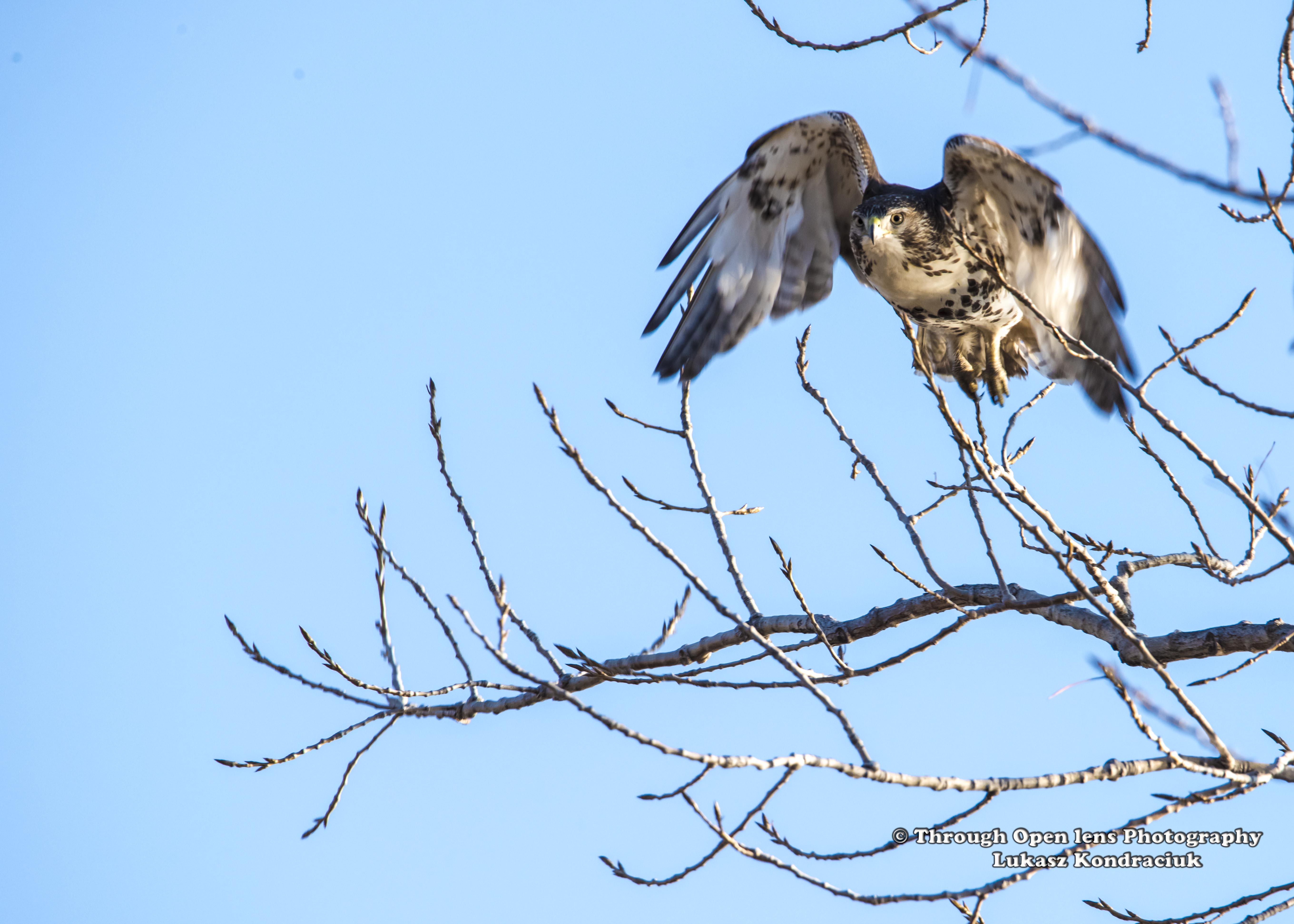
What’s Up?

Red tailed Hawk

F/11.0, 1/500, ISO400.

Red-tailed Hawk

What is a parrot’s favorite game?

Hide and Speak!

Interesting Fact: The “Harlan’s Hawk” breeds in Alaska and northwestern Canada, and winters on the southern Great Plains. This very dark form of the Red-tailed Hawk has a marbled white, brown, and gray tail instead of a red one. It’s so distinctive that it was once considered a separate species, until ornithologists discovered many individuals that were intermediate between Harlan’s and more typical Red-tailed Hawks. ( https://www.allaboutbirds.org/guide/Red-tailed_Hawk/lifehistory )