I Like To Watch What I Eat

Cooper’s Hawk 1

F/9.0. 1/320, ISO 320.

Cooper’s Hawk

On which side does a hawk have the most feathers?

On the outside.

Interesting Fact: Life is tricky for male Cooper’s Hawks. As in most hawks, males are significantly smaller than their mates. The danger is that female Cooper’s Hawks specialize in eating medium-sized birds. Males tend to be submissive to females and to listen out for reassuring call notes the females make when they’re willing to be approached. Males build the nest, then provide nearly all the food to females and young over the next 90 days before the young fledge. ( https://www.allaboutbirds.org/guide/Coopers_Hawk/lifehistory )

Stay Fly!

Bald Eagle ( Juvenile )

F/11.0,1/500, ISO 320.

Bald Eagle ( Juvenile )

How does a eagle greet the its prey in the water ?

“Pleased to eat you.”

Interesting Fact: Rather than do their own fishing, Bald Eagles often go after other creatures’ catches. A Bald Eagle will harass a hunting Osprey until the smaller raptor drops its prey in midair, where the eagle swoops it up. A Bald Eagle may even snatch a fish directly out of an Osprey’s talons. Fishing mammals (even people sometimes) can also lose prey to Bald Eagle piracy. See an example here. ( https://www.allaboutbirds.org/guide/Bald_Eagle/lifehistory )

I Have A Very Particular Set Of Skills To Find You

Merlin

F/11.0, 1/500, ISO 250.

Merlin

Two birds in a tree looking down on a man washing his car.
“If he doesn’t hurry up and finish,” says one bird to the
other, “I’ll poop myself.”

Interesting Fact: Merlins don’t build their own nests. Instead, they take over the old nests of other raptors or crows. They also use magpie nests, sometimes laying eggs right on top of the nest’s dome rather than inside the cavity. ( https://www.allaboutbirds.org/guide/Merlin/lifehistory )

This Way To The Airport, We Flying South!

Wild Turkeys

F/6.3, 1/125, ISO 320.

Wild Turkeys  

A lady was picking through the frozen turkeys at the grocery store, but couldn’t find one big enough for her family. She asked the stock boy, ‘Do these turkeys get any bigger?’

The stock boy answered, ‘No ma’am, they’re dead.’

Interesting Fact: When they need to, Turkeys can swim by tucking their wings in close, spreading their tails, and kicking. ( https://www.allaboutbirds.org/guide/Wild_Turkey/lifehistory )

A Change May Be Just Around The Corner!

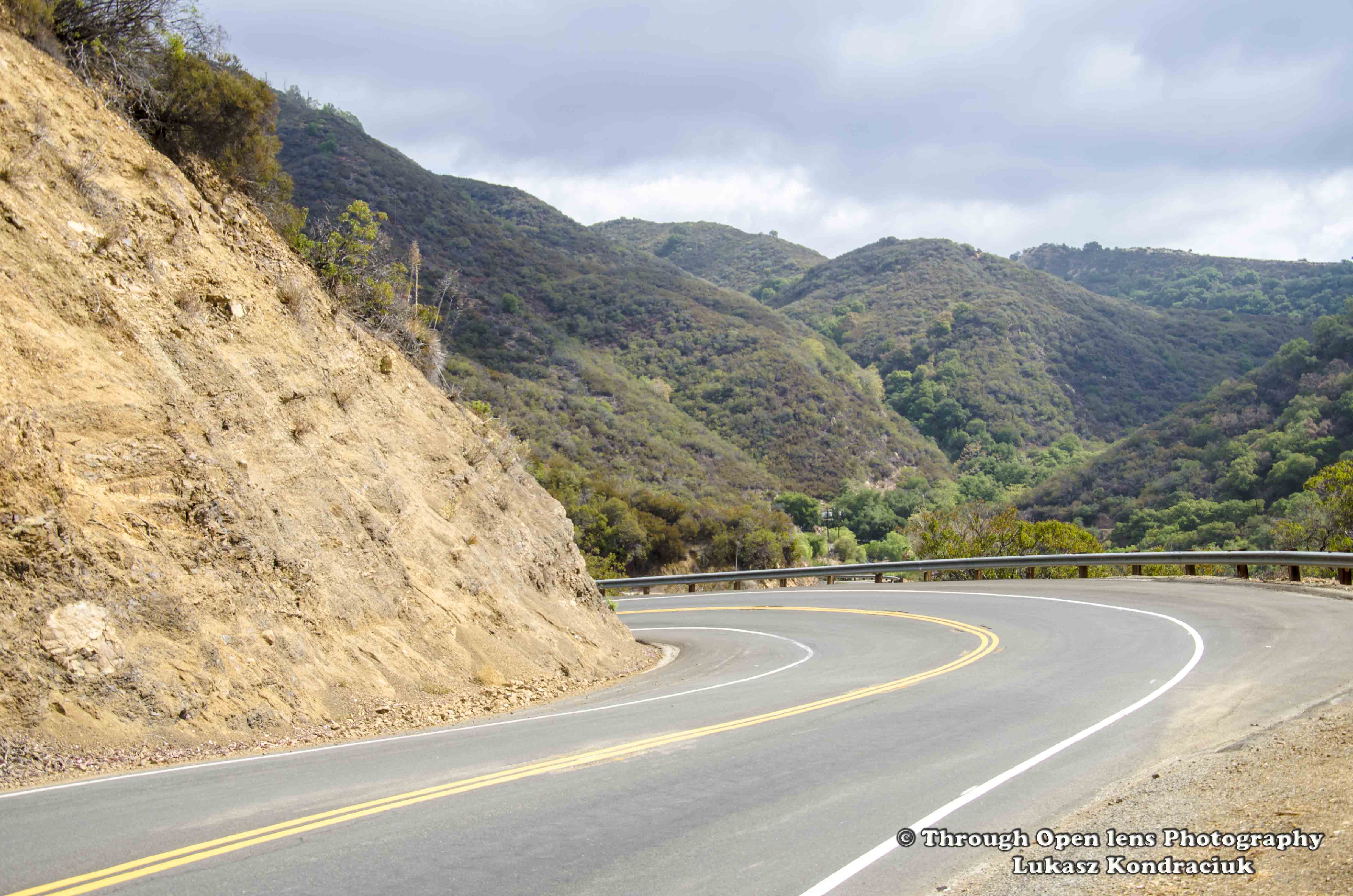
canyon road malibu

F/ 8.0 , 1/250, ISO 100.

California Week Two

Why didn’t the bicycle cross the road?

Because it was two tired

Interesting Fact: Explorer Juan Rodríguez Cabrillo is believed to have moored at Malibu Lagoon, at the mouth of Malibu Creek, to obtain fresh water in 1542. The Spanish presence returned with the California mission system, and the area was part of Rancho Topanga Malibu Sequit—a 13,000-acre (53 km2) land grant—in 1802. That ranch passed intact to Frederick Hastings Rindge in 1891. He and his widow, May K. Rindge, guarded their privacy zealously by hiring guards to evict all trespassers and fighting a lengthy court battle to prevent the building of a Southern Pacific railroad line through the ranch. Interstate Commerce Commission regulations would not support a railroad condemning property in order to build tracks that paralleled an existing line, so Frederick H. Rindge decided to build his own railroad through his property first. He died, and May K. Rindge followed through with the plans, building a line starting just inside the ranch’s property eastern boundary at Las Flores Canyon, and running 15 miles westward, past Pt. Dume. ( https://en.wikipedia.org/wiki/Malibu,_California#History )

Okay, Don’t Make Any Sudden Moves. Hop Inside My Mouth… If You Want To Live.

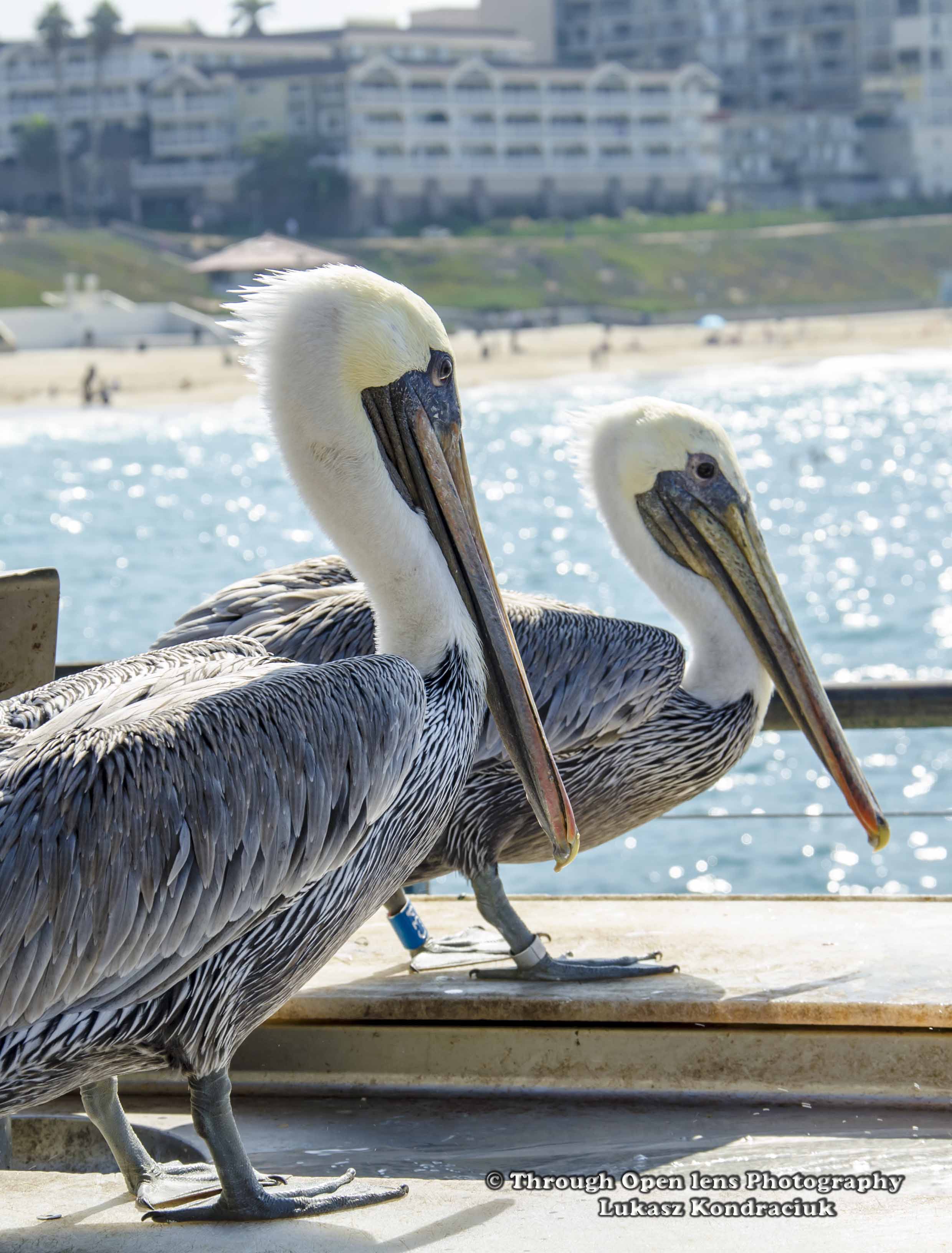
Brown Pelicans

F/8.0, 1/250, ISO 100.

Brown Pelicans

California Week Two 

Why was the pelican kicked out of the hotel?

Because he had a big bill!

Interesting Fact: While the Brown Pelican is draining the water from its bill after a dive, gulls often try to steal the fish right out of its pouch—sometimes while perching on the pelican’s head. Pelicans themselves are not above stealing fish, as they follow fishing boats and hang around piers for handouts. ( https://www.allaboutbirds.org/guide/Brown_Pelican/lifehistory )

Reverse Mohawk Is In!

Elegant Tern

F/5.6, 1/500, ISO 220.

Elegant Tern

California Week Two 

A sailor trying to sneak back to his ship about 3 o’clock in the morning was spotted by a chief petty officer who ordered him to explain his tardiness. The lame explanation didn’t work. “Take this broom and sweep every link on this anchor chain by morning or it’s the brig for you,” the chief said. The sailor began to sweep, but a tern landed on the broom handle and he couldn’t continue. He yelled at the bird, but it didn’t budge. He finally plucked it off the broom and gave it a toss. But the bird came right back and again landed on the handle. Over and over, the same routine was repeated. A toss, one sweep, and the bird was back. When morning came, the chief also was back. “What have you been doing all night? This chain is no cleaner than when you started!” “Honest, chief,” said the sailor, “I tossed a tern all night and couldn’t sweep a link.”

Interesting Fact: Unlike some of the smaller white terns, it is not very aggressive toward potential predators, relying on the sheer density of the nests and nesting close to other more aggressive species such as Heermann’s Gulls to avoid predation. ( http://identify.whatbird.com/obj/467/_/Elegant_Tern.aspx )


It’s Magical!

Getty Center

F/ 8.0, 1/250, ISO 100.

Getty Center

California Week Two

It had been anything but an easy afternoon for the teacher who took six of her pupils through the Museum of Natural History, but their enthusiastic interest in the stuffed animals and their open-eyed wonder at the prehistoric fossils amply repaid her.

“Well, boys, where have you been all afternoon?” asked the father of two of the party that evening.

The answer came back with joyous promptness: “Oh, pop! Teacher took us to a dead circus.”

Interesting Fact: In 1984, Richard Meier was chosen to be the architect of the Center.[8] After an extensive conditional-use permit process,[4] construction by the Hathaway Dinwiddie Construction Company[9] began in August 1989.[10] The construction was significantly delayed, with the planned completion date moved from 1988 to 1995 (as of 1990).[11] By 1995, however, the campus was described as only “more than halfway complete”. ( https://en.wikipedia.org/wiki/Getty_Center#Location_and_history )


Life Is A Garden, Dig It!

Getty Museum

F/ 8.0, 1/250, ISO 100.

Getty Center

California Week

Two elderly women are walking through a museum and get separated.
As soon as they meet up with each other again, one of them appears quite flustered and says, “Goodness, gracious! Did you see the statue of the naked man back there? I’ve never been so shocked. How can they possibly display such a thing. My gosh, the penis on it was so large!”
Whereupon, the other old lady accidentally blurts out, “Yes, and cold, too!”

Interesting Fact:  Originally, the Getty Museum started in J. Paul Getty‘s house located in Pacific Palisades in 1954. He expanded the house with a museum wing. In the 1970s, Getty built a replica of an Italian villa on his home’s property to better house his collection, which opened in 1974. After Getty’s death in 1976, the entire property was turned over to the Getty Trust for museum purposes. However, the collection outgrew the site, which has since been renamed the Getty Villa, and management sought a location more accessible to Los Angeles. The purchase of the land upon which the Center is located, a campus of 24 acres (9.7 ha) on a 110-acre (45 ha) site in the Santa Monica Mountains above Interstate 405, surrounded by 600 acres (240 ha) kept in a natural state, was announced in 1983.[4] The site cost $25 million.[5] The top of the hill is 900 feet (270 m) above I-405, high enough that on a clear day it is possible to see not only the Los Angeles skyline but also the San Bernardino Mountains, and San Gabriel Mountains to the east as well as the Pacific Ocean to the west. ( https://en.wikipedia.org/wiki/Getty_Center#Location_and_history )