Don’t Look At My Hole!

F/9.0, 1/320, ISO 160.

Hispaniolan Woodpecker

Why aren’t there any shark puppeteers?

They have no hands!

Interesting Fact: This woodpecker forages in small noisy groups; the diet is varied and includes insects, spiders, scorpions, lizards, fruit, seeds, grain and sap. It can catch flying insects on the wing, and larger food items are bashed on an “anvil” to break them up. ( https://en.wikipedia.org/wiki/Hispaniolan_woodpecker )

So Psyched To Head Bang Today!

F/10.0, 1/320, ISO 160.

Hispaniolan Woodpecker

What are three words you dread the most while making love?

“Honey, I’m home.”

Interesting Fact: Unlike most woodpeckers, the Hispaniolan woodpecker is a social species that takes advantage of having a large number of individual adult birds in the colony to protect a nesting bank or tree. There may be twenty pairs of birds in a colony, with several nesting in the same tree. The nests are excavated in trunks and branches, and discarded holes are reused by parrots, parakeets, trogons, the Antillean piculet and the golden swallow.https://en.wikipedia.org/wiki/Hispaniolan_woodpecker )

Head Banging Is My Stress Reduction!

F/6.3, 1/800, ISO 800.

Yellow-Bellied Sapsucker

Why did the police arrest the turkey?

They suspected it of fowl play!

Interesting Fact: Yellow-bellied Sapsuckers have been found drilling sapwells in more than 1,000 species of trees and woody plants, though they have a strong preference for birches and maples. ( https://www.allaboutbirds.org/guide/Yellow-bellied_Sapsucker )

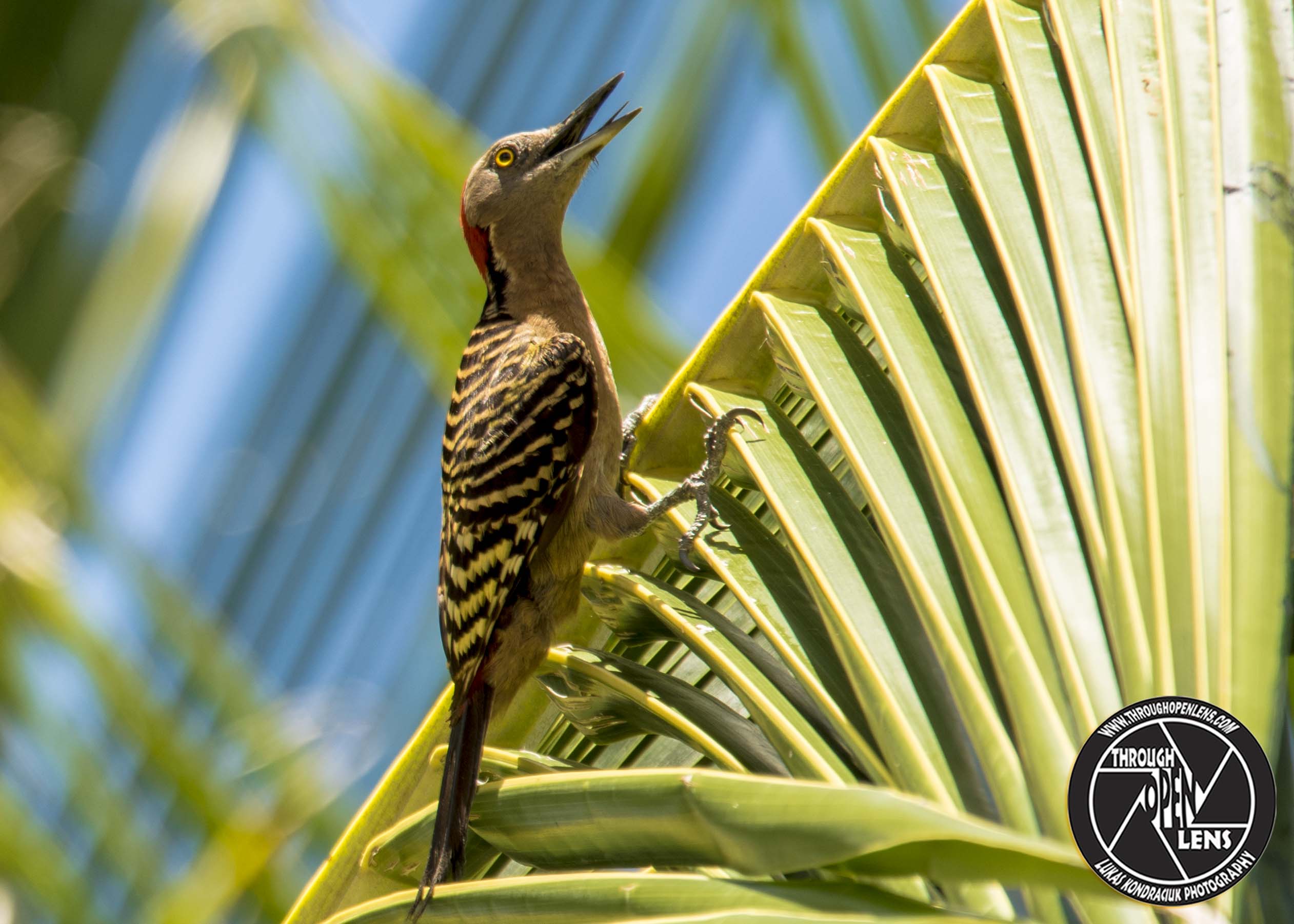
Things Are Looking Up!

F/7.1, 1/200, ISO 160.

Hispaniolan Woodpecker

What can you serve but never eat?

A volleyball.

Interesting Fact: This bird is endemic to Haiti and the Dominican Republic, its range extending from the coasts, over the deserts to the mountains in the centre of the island. It is mostly a woodland bird, found in both wet and dry, broadleaved and coniferous forests, but also occurs in mosaic forests, plantations, cactus scrub, mangrove areas, swamps, grassland, palm groves, wooded agricultural areas and urban parks. ( https://en.wikipedia.org/wiki/Hispaniolan_woodpecker )
Peck Me If You Can!

F/9.0, 1/1250, ISO 800.

Red-Bellied Woodpecker

Why did the owl, owl?

Because the woodpecker would peck ‘er!

Interesting Fact: A Red-bellied Woodpecker can stick out its tongue nearly 2 inches past the end of its beak. The tip is barbed and the bird’s spit is sticky, making it easier to snatch prey from deep crevices. Males have longer, wider-tipped tongues than females, possibly allowing a breeding pair to forage in slightly different places on their territory and maximize their use of available food. ( https://www.allaboutbirds.org/guide/Red-bellied_Woodpecker/lifehistory )