Only The Bold Get To The Top.

F/8.0, 1/250, ISO 320.

Red-Eared Slider Turtles

Why did the nurse go to art school?

To learn how to draw blood!

Interesting Fact: Red-eared sliders are almost entirely aquatic, but as they are cold-blooded, they leave the water to sunbathe to regulate their temperature. ( https://en.wikipedia.org/wiki/Red-eared_slider )


Be Cool Honey Bunny!

F/6.3, 1/160, ISO 250.

Eastern Cottontail Rabbit

What did the salad say when the cabbage interrupted their meal?

Lettuce alone!

Interesting Fact: The cottontail prefers an area where it can hide quickly but be out in the open. Forests, swamps, thickets, bushes, or open areas where shelter is close by are optimal habitation sites for this species.  ( https://en.wikipedia.org/wiki/Eastern_cottontail )

Ehh, What’s Up Doc?

F/6.3, 1/160, ISO 640.

Eastern Cottontail Rabbit

What did the rabbit give his girlfriend?

A 14 carrot ring!

Interesting Fact: There are several species of cottontail rabbit, but the eastern cottontail is the most common. This ubiquitous animal can be found from Canada to South America and, in the United States, from the East Coast to the Great Plains. Cottontails range from reddish brown to gray, but all feature the distinctive “cotton ball” tail for which they are named. ( http://www.nationalgeographic.com/animals/mammals/e/eastern-cottontail-rabbit/ )

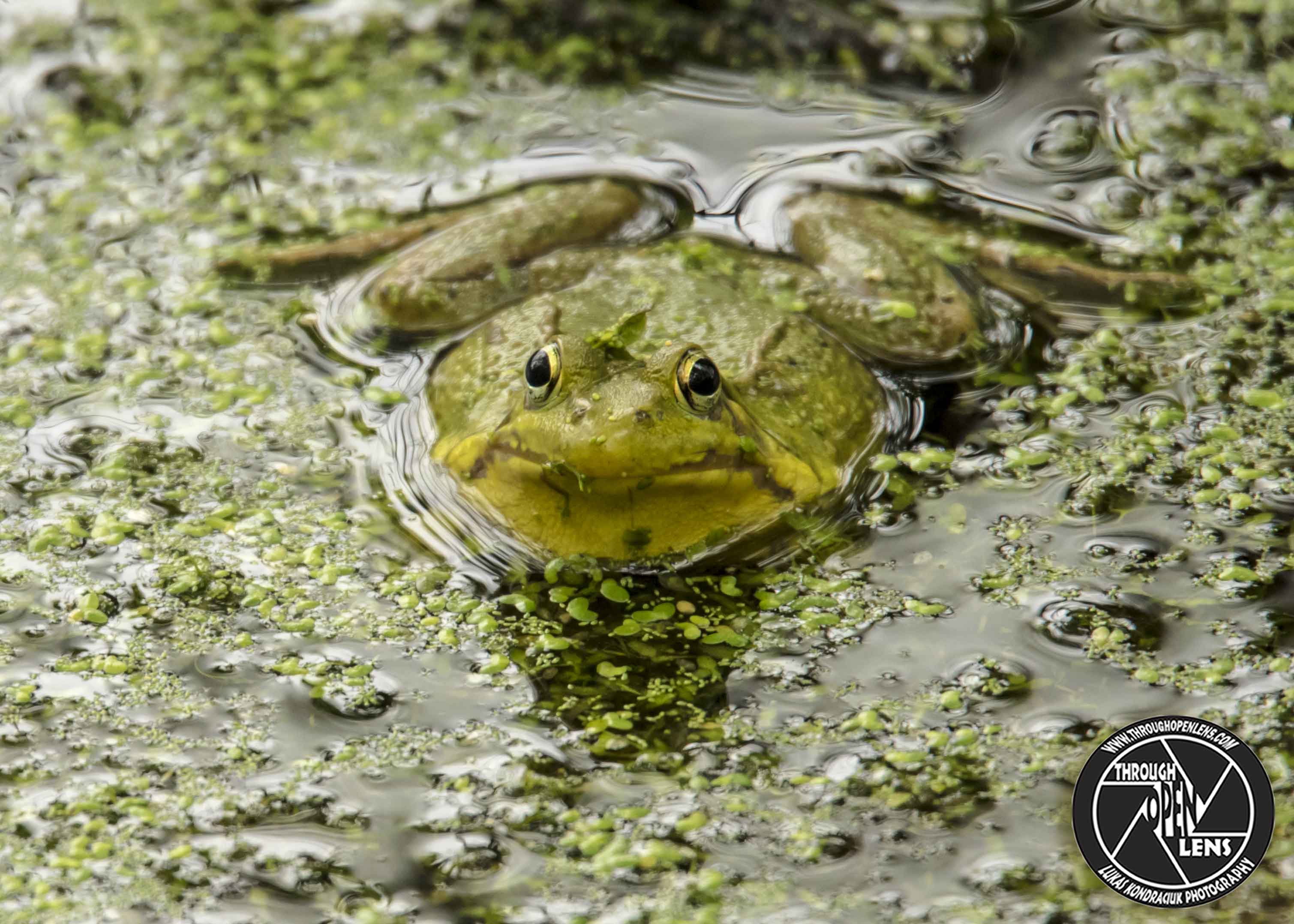
What? You Are Expecting A Prince Or Something?

F/6.3, 1/80, ISO 640.

Northern Green Frog

Why are frogs so happy?

They eat whatever bugs them!

Interesting Fact: The northern green frog dwells in marshes, swamps, ponds, lakes, springs, and other aquatic environment. It is active both day and night. ( https://en.wikipedia.org/wiki/Northern_green_frog )

Sorry… We Are Busy Sunbathing.

F/8.0, 1/250, ISO 320.

Red-Eared Slider Turtle

What did the Sewage Worker say to his apprentice?

Urine for a surprise.

Interesting Fact: Red-eared sliders do not hibernate, but actually brumate; while they become less active, they do occasionally rise to the surface for food or air. Brumation can occur to varying degrees. In the wild, red-eared sliders brumate over the winter at the bottoms of ponds or shallow lakes. They generally become inactive in October, when temperatures fall below 10 °C (50 °F).[9] During this time, the turtles enter a state of sopor, during which they do not eat or defecate, they remain nearly motionless, and the frequency of their breathing falls. Individuals usually brumate underwater, but they have also been found under banks and rocks, and in hollow stumps. In warmer winter climates, they can become active and come to the surface for basking. When the temperature begins to drop again, however, they quickly return to a brumation state. Sliders generally come up for food in early March to as late as the end of April. ( https://en.wikipedia.org/wiki/Red-eared_slider )

Everyday May Not Be Good, But There Is Something Good In Everyday.

F/9.0, 1/250, ISO 320.

Muskrat

Why did the dog sit in the shade?

Because he didn’t want to be a hot dog!

Interesting Fact: Native Americans have long considered the muskrat to be a very important animal. Some predict winter snowfall levels by observing the size and timing of muskrat lodge construction.[26]  In several Native American creation myths, the muskrat dives to the bottom of the primordial sea to bring up the mud from which the earth is created, after other animals have failed in the task. ( https://en.wikipedia.org/wiki/Muskrat#Behavior )