When You Stop Believing In Santa You Get Underwear

santa-was-here

F/ 4.5, 1/60, ISO 160.

Why is Christmas just like your job?

You do all the work and the fat guy with the suit gets all the credit.

Interesting Fact: Santa Claus, also known as Saint Nicholas, Saint Nick, Kris Kringle, Father Christmas, or simply Santa (Santy in Hiberno-English), is a legendary figure of Western Christian culture who is said to bring gifts to the homes of well-behaved (“good” or “nice”) children on Christmas Eve (24 December) and the early morning hours of Christmas Day (25 December).[1] The modern Santa Claus grew out of traditions surrounding the historical Saint Nicholas, a fourth-century Greek bishop and gift-giver of Myra, the British figure of Father Christmas, the Dutch figure of Sinterklaas (himself based on Saint Nicholas), the German figure of the Christkind (a fabulized Christ Child), and the holidays of Twelfth Night and Epiphany and their associated figures of the Three Kings (based on the gift-giving Magi of the Nativity) and Befana. Some maintain Santa Claus also absorbed elements of the Germanic god Wodan, who was associated with the pagan midwinter event of Yule and led the Wild Hunt, a ghostly procession through the sky. ( https://en.wikipedia.org/wiki/Santa_Claus )

You Haven’t Seen The Last Of Me

butterfly-3

F/ 7.1, 1/200, ISO 160.

Why did summer catch autumn?

Because autumn is fall.

Interesting Fact: Butterflies have the typical four-stage insect life cycle. Winged adults lay eggs on the food plant on which their larvae, known as caterpillars, will feed. The caterpillars grow, sometimes very rapidly, and when fully developed, pupate in a chrysalis. When metamorphosis is complete, the pupal skin splits, the adult insect climbs out, and after its wings have expanded and dried, it flies off. Some butterflies, especially in the tropics, have several generations in a year, while others have a single generation, and a few in cold locations may take several years to pass through their whole life cycle. ( https://en.wikipedia.org/wiki/Butterfly )

I Get Knocked Down But I Get Up Again You Are Never Gonna Keep Me Down

mallard-duck

F/7.1, 1/200, ISO 250.

Mallard Duck

What did the duck say when he bought lipstick?

“Put it on my bill.”

Interesting Fact: Ducks are strong fliers; migrating flocks of Mallards have been estimated traveling at 55 miles per hour. ( https://www.allaboutbirds.org/guide/Mallard/lifehistory )

Let’s Ride!

lets-ride

F/9.0, 1/320, ISO 160.

A police officer pulled over two nuns riding on a motorcycle, and said to the rider, ‘Ma’am, you’re driving much too slowly, could you please drive faster?”
And the nun says, ‘Oh, I saw the sign with the “21” and assumed the speed limit was 21 mph”
The officer explains: ‘No ma’am, the speed limit is 65. The highway number is Interstate 21.”
Then the police officer look at the passenger and see the other nun shaking like a leaf.
“Excuse me sister, but what’s wrong with your passenger?”
“Oh, that’s probably because we just got off Highway 205.”
Interesting Fact: The first internal combustion, petroleum fueled motorcycle was the Daimler Reitwagen. It was designed and built by the German inventors Gottlieb Daimler and Wilhelm Maybach in Bad Cannstatt, Germany in 1885.[7] This vehicle was unlike either the safety bicycles or the boneshaker bicycles of the era in that it had zero degrees of steering axis angle and no fork offset, and thus did not use the principles of bicycle and motorcycle dynamics developed nearly 70 years earlier. Instead, it relied on two outrigger wheels to remain upright while turning. ( https://en.wikipedia.org/wiki/Motorcycle#History )

Don’t You Forget About Me

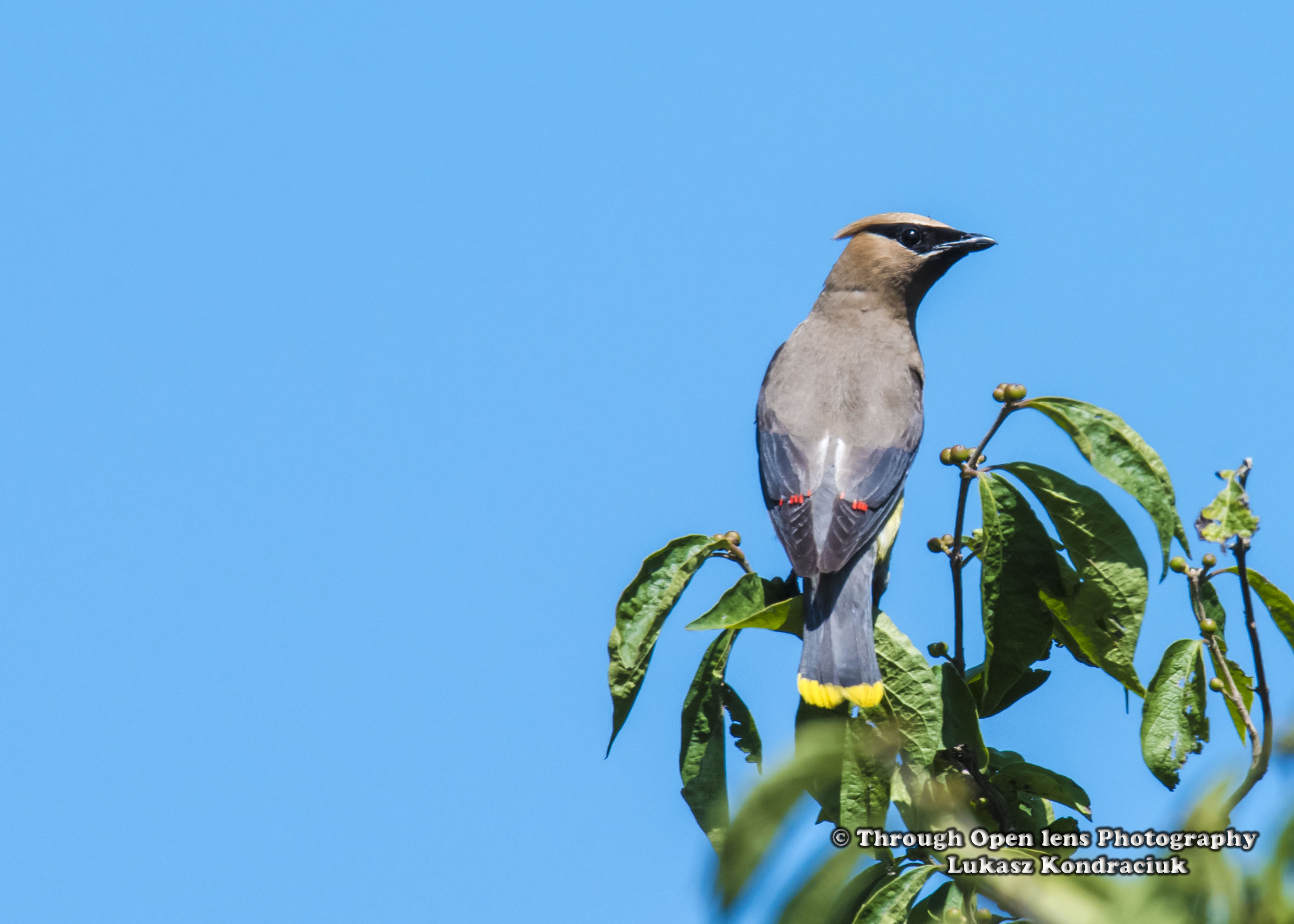
cedar-waxwing-1

F/ 11.0, 1/500, ISO 250.

Cedar Waxwing

What did the pencil sharpener say to the pencil?

Stop going in circles and get to the point! 

Interesting Fact: Cedar Waxwings with orange instead of yellow tail tips began appearing in the northeastern U.S. and southeastern Canada in the 1960s. The orange color is the result of a red pigment picked up from the berries of an introduced species of honeysuckle. If a waxwing eats enough of the berries while it is growing a tail feather, the tip of the feather will be orange. ( https://www.allaboutbirds.org/guide/Cedar_Waxwing/lifehistory )

Never Hide Your Wings!

Butterfly 1

F/ 5.6, 1/320, ISO 400.

Butterfly

My friend thinks he is smart.

He told me an onion is the only food that makes you cry, so I threw a coconut at his face.

Interesting Fact: Butterflies can eat anything that can dissolve in water. They mostly feed on nectar from flowers but also eat tree sap, dung, pollen, or rotting fruit. They are attracted to sodium found in salt and sweat. This is why they sometimes even land on people in Butterfly Parks. Sodium as well as many other minerals is vital for the butterflies reproduction. ( http://www.whatdobutterflieseat.info/ )


I Believe I Can Fly!

Franklin's Gull 1

F/14.0, 1/640, ISO 320.

Franklin’s Gull

What did the pig say at the beach on a hot summer’s day?

I’m bacon!

Interesting Fact: In breeding plumage, and sometimes in nonbreeding plumage as well, the Franklin’s Gull often shows a rosy pink cast (rarely salmon) on its chest and abdomen. This color is most apparent on the shafts and bases of its feathers. The color fades as the breeding season progresses as the pigment is broken down by sunlight.  ( https://www.allaboutbirds.org/guide/Franklins_Gull/lifehistory )


I’m Walking Here!

Common Grackle 2

F/6.3, 1/1600, ISO 250.

Common Grackle 

How do men exercise at the beach?

By sucking in their stomach every time they see a girl in a bikini.

Interesting Fact: Common Grackles are resourceful foragers. They sometimes follow plows to catch invertebrates and mice, wade into water to catch small fish, pick leeches off the legs of turtles, steal worms from American Robins, raid nests, and kill and eat adult birds. ( https://www.allaboutbirds.org/guide/Common_Grackle/lifehistory )

What Do You See In The Clouds ?

sky clouds

F/13.0, 1/640, ISO 160.

What is a clouds favorite drink?

Mountain Dew

Interesting Fact: Cloud types in the troposphere, the atmospheric layer closest to Earth’s surface, have Latin names due to the universal adaptation of Luke Howard‘s nomenclature. It was formally proposed in December 1802 and published for the first time the following year. It became the basis of a modern international system that classifies these tropospheric aerosols into five physical forms. These physical types include stratiform sheets, stratocumuliform rolls, ripples, and patches, cirriform wisps and patches, cumuliform heaps of variable size, and very large cumulonimbiform heaps that often show complex structure. Most of these forms can be found in the high, middle, and low altitude levels or étages of the troposphere. (  https://en.wikipedia.org/wiki/Cloud )

DUI Checkpoints

United States Coast Guard

F/11.0, 1/500, ISO 250.

Guy’s car is swerving all over the road so a cop pulls him over, “Step out of the car” says the cop, “I am going to need you to take a  breathalyzer test.” “I can’t”, Guy responds “You see I have very bad asthma, that can set off an attack.” “Alright,” says the cop, “then you’re going to have to take a blood test.” “Can’t do that either,” Guy responds, “I am a hemophiliac, if a wound is opened, I won’t stop bleeding, and I could bleed to death.” “Ok,” the cop answers “then I will need a urine sample.” “Sorry,” says Guy “I also have diabetes, that could push my sugar count really low.”

“Fine, so just come on out, and walk a straight line for me.” “Can’t do that either” responds Guy. “Why not?” Demanded the exasperated cop. “Well, because I’m drunk!”

Interesting Fact: The roots of the Coast Guard lie in the United States Revenue Cutter Service established by Alexander Hamilton under the Department of the Treasury on 4 August 1790. The first Coast Guard station was in Newburyport, Massachusetts. Until the re-establishment of the Navy in 1798, the Revenue Cutter Service was the only naval force of the early United States. It was established to collect taxes from a brand new nation of patriot smugglers. When the officers were out at sea, they were told to crack down on piracy; and to rescue any mariners in distress. ( https://en.wikipedia.org/wiki/United_States_Coast_Guard#History )