I Wanna Rock!

F/6.3, 1/100, ISO 500.

Chipping Sparrow

Why do fish live in salt water?

Because pepper makes them sneeze.

Interesting Fact: In summer, male Chipping Sparrows defend territories against other Chipping Sparrows, but often tolerate other species as long as they don’t go too near the nest. After the breeding season, Chipping Sparrows form flocks of several dozen, foraging together among grasses and at bird feeders. Their flight pattern is energetic, straight, and only slightly undulating. ( https://www.allaboutbirds.org/guide/Chipping_Sparrow/lifehistory )


When I Was Born I Was So Surprised I Didn’t Talk For A Year And Half

F/5.6, 1/800, ISO 250.

White-throated Sparrow

What do you call a fake noodle?

An Impasta

Interesting Fact:  White-throated Sparrows eat mainly the seeds of grasses and weeds, including ragweed and buckwheat, as well as fruits of sumac, grape, cranberry, mountain ash, rose, blueberry, blackberry, and dogwood. In summer they eat large numbers of insects that they catch on the forest floor or, occasionally on quick flights out from low vegetation. These include dragonflies, wasps, stinkbugs, beetles, flies, and caterpillars, as well as spiders, millipedes, centipedes, and snails. Parents feed their nestlings almost exclusively animal matter. During winter, White-throated Sparrows readily visit bird feeders for millet and black oil sunflower seeds. In spring they eat the tender buds, blossoms, and young seeds of oak, apple, maple, beech, and elm. ( https://www.allaboutbirds.org/guide/White-throated_Sparrow/lifehistory )


Cold Doesn’t Bother Me Anyway.

F/6.3, 1/160, ISO 320.

Dark-eyed Junco 

What do ghosts serve for dessert?

I Scream.

Interesting Fact: The female chooses the nest site, typically in a depression or niche on sloping ground, rock face, or amid the tangled roots of an upturned tree. Around people, juncos may nest in or underneath buildings. Occasionally, juncos nest above the ground on horizontal branches (rarely as high as 45 feet), window ledges, and in hanging flower pots or light fixtures. ( https://www.allaboutbirds.org/guide/Dark-eyed_Junco/lifehistory )


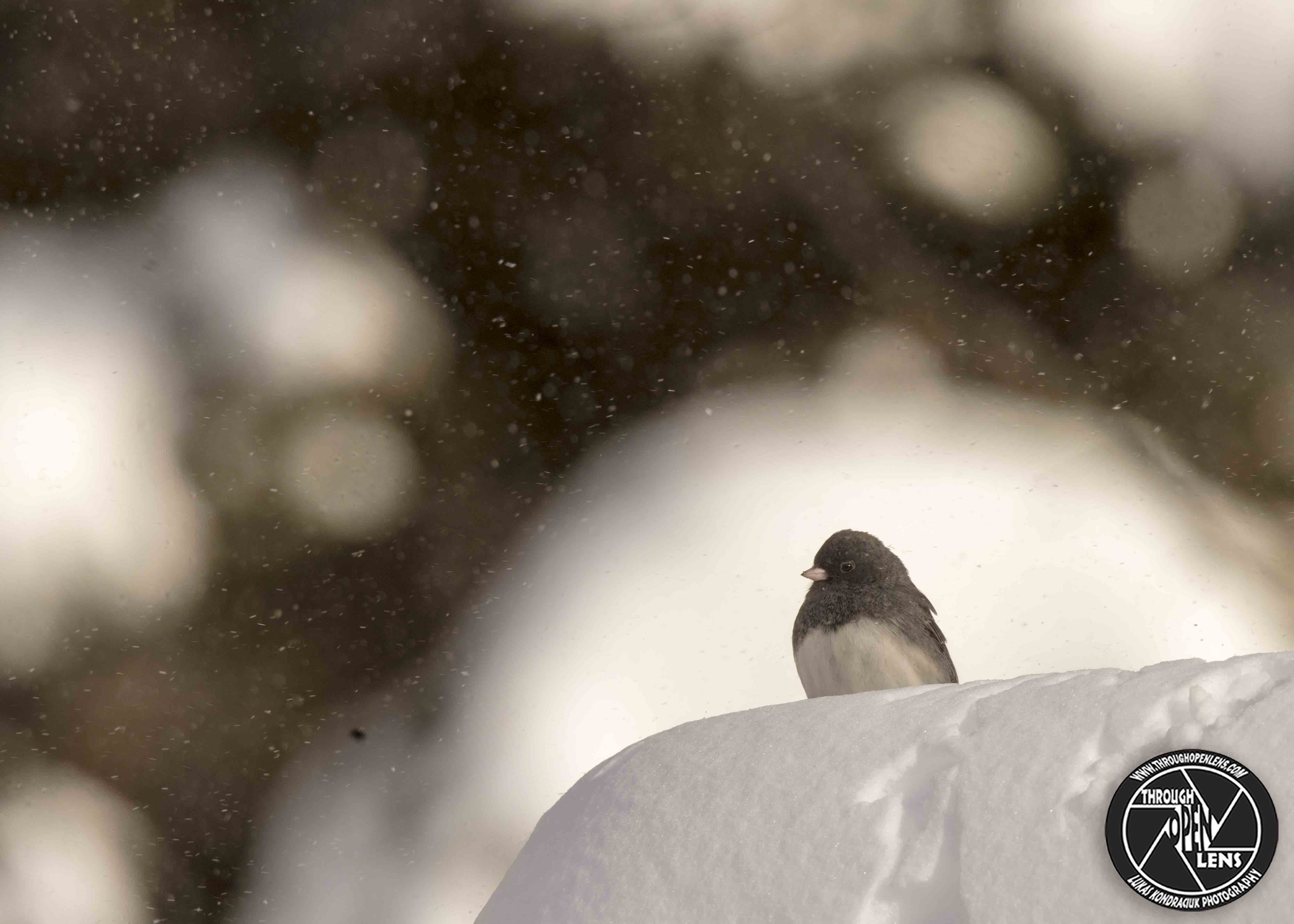
Let It Snow!

F/10.0, 1/800, ISO 250.

Dark-eyed Junco

What do you call an old snowman?

Water!

Interesting Fact: The oldest recorded Dark-eyed Junco was at least 11 years, 4 months old when it was recaptured and rereleased during banding operations in West Virginia in 2001. It had been banded in the same state in 1991. ( https://www.allaboutbirds.org/guide/Dark-eyed_Junco/lifehistory )

I Wanna Go Fast!

F/6.3, 1/60, ISO 400.

White-throated Sparrow

Two state officials are talking  “I don’t know what people have against us, We haven’t done anything.”

Interesting Fact:  Males are typically dominant over females, but whether an individual is white-striped or tan-striped seems to have no bearing on status. When pairing up, white-striped forms tend to choose tan-striped individuals, and vice versa. Pairs stay together for the summer, but birds often choose new partners the next year.  ( https://www.allaboutbirds.org/guide/White-throated_Sparrow/lifehistory )