Just CHILLING !

heineken

F/10.0, 1/640, ISO 400.

A bee goes into a bar,

It comes out 2 hours later buzzing

Interesting Fact: On 15 February 1864, Gerard Adriaan Heineken (1841–1893)[5][6] got his wealthy mother to buy De Hooiberg (The Haystack) brewery in Amsterdam, a popular working-class brand founded in 1592. In 1873 after hiring a Dr. Elion (student of Louis Pasteur) to develop Heineken-A Yeast for Bavarian bottom fermentation, the HBM (Heineken’s Bierbrouwerij Maatschappij) was established, and the first Heineken brand beer was brewed. In 1875 Heineken won the Medaille D’Or at the International Maritime Exposition in Paris, then began to be shipped there regularly, after which Heineken sales topped 64,000 hectolitres (1.7 million U.S. gallons), making them the biggest beer exporter to France. ( https://en.wikipedia.org/wiki/Heineken#History )

We Own The Night


new-york-city-manhattan-1

F/18.0, 26.0, ISO 80

New York City, Manhattan

A couple had lived together in the backwoods for over fifty years.

To celebrate their fiftieth anniversary, he took her to a large city and they checked into a plush hotel.

She said to the bellman, “We refuse to settle for such a small room. No windows, no bed, and no air conditioning.”

“But, madam!”, replied the bellman.

“Don’t ‘But madam’ me,” she continued. “You can’t treat us like we’re a couple of fools just because we don’t travel much, and we’ve never been to the big city, and never spent the night at a hotel. I’m going to complain to the manager.”

“Madam,” the bellman said, “this isn’t your room; this is the elevator!”

Interesting Fact: The name “Manhattan” derives from the word Manna-hata, as written in the 1609 logbook of Robert Juet, an officer on Henry Hudson‘s yacht Halve Maen (Half Moon).[35] A 1610 map depicts the name as Manna-hata, twice, on both the west and east sides of the Mauritius River (later named the Hudson River). The word “Manhattan” has been translated as “island of many hills” from the Lenape language.[36] The United States Postal Service prefers that mail addressed to Manhattan use “New York, NY” rather than “Manhattan, NY”.[

You Haven’t Seen The Last Of Me

butterfly-3

F/ 7.1, 1/200, ISO 160.

Why did summer catch autumn?

Because autumn is fall.

Interesting Fact: Butterflies have the typical four-stage insect life cycle. Winged adults lay eggs on the food plant on which their larvae, known as caterpillars, will feed. The caterpillars grow, sometimes very rapidly, and when fully developed, pupate in a chrysalis. When metamorphosis is complete, the pupal skin splits, the adult insect climbs out, and after its wings have expanded and dried, it flies off. Some butterflies, especially in the tropics, have several generations in a year, while others have a single generation, and a few in cold locations may take several years to pass through their whole life cycle. ( https://en.wikipedia.org/wiki/Butterfly )

I Get Knocked Down But I Get Up Again You Are Never Gonna Keep Me Down

mallard-duck

F/7.1, 1/200, ISO 250.

Mallard Duck

What did the duck say when he bought lipstick?

“Put it on my bill.”

Interesting Fact: Ducks are strong fliers; migrating flocks of Mallards have been estimated traveling at 55 miles per hour. ( https://www.allaboutbirds.org/guide/Mallard/lifehistory )

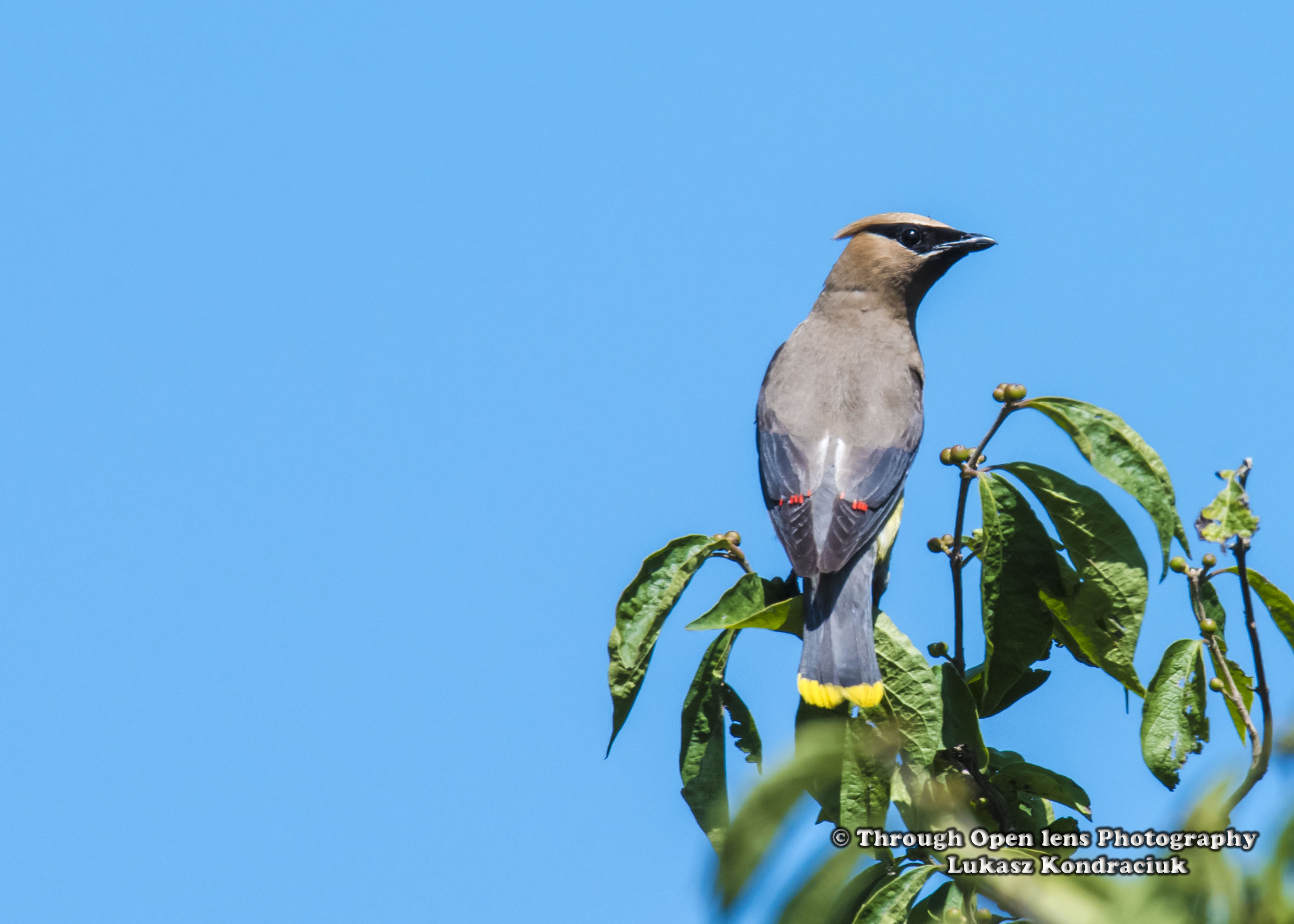
Don’t You Forget About Me

cedar-waxwing-1

F/ 11.0, 1/500, ISO 250.

Cedar Waxwing

What did the pencil sharpener say to the pencil?

Stop going in circles and get to the point! 

Interesting Fact: Cedar Waxwings with orange instead of yellow tail tips began appearing in the northeastern U.S. and southeastern Canada in the 1960s. The orange color is the result of a red pigment picked up from the berries of an introduced species of honeysuckle. If a waxwing eats enough of the berries while it is growing a tail feather, the tip of the feather will be orange. ( https://www.allaboutbirds.org/guide/Cedar_Waxwing/lifehistory )

Never Hide Your Wings!

Butterfly 1

F/ 5.6, 1/320, ISO 400.

Butterfly

My friend thinks he is smart.

He told me an onion is the only food that makes you cry, so I threw a coconut at his face.

Interesting Fact: Butterflies can eat anything that can dissolve in water. They mostly feed on nectar from flowers but also eat tree sap, dung, pollen, or rotting fruit. They are attracted to sodium found in salt and sweat. This is why they sometimes even land on people in Butterfly Parks. Sodium as well as many other minerals is vital for the butterflies reproduction. ( http://www.whatdobutterflieseat.info/ )


I Believe I Can Fly!

Franklin's Gull 1

F/14.0, 1/640, ISO 320.

Franklin’s Gull

What did the pig say at the beach on a hot summer’s day?

I’m bacon!

Interesting Fact: In breeding plumage, and sometimes in nonbreeding plumage as well, the Franklin’s Gull often shows a rosy pink cast (rarely salmon) on its chest and abdomen. This color is most apparent on the shafts and bases of its feathers. The color fades as the breeding season progresses as the pigment is broken down by sunlight.  ( https://www.allaboutbirds.org/guide/Franklins_Gull/lifehistory )


I’m Walking Here!

Common Grackle 2

F/6.3, 1/1600, ISO 250.

Common Grackle 

How do men exercise at the beach?

By sucking in their stomach every time they see a girl in a bikini.

Interesting Fact: Common Grackles are resourceful foragers. They sometimes follow plows to catch invertebrates and mice, wade into water to catch small fish, pick leeches off the legs of turtles, steal worms from American Robins, raid nests, and kill and eat adult birds. ( https://www.allaboutbirds.org/guide/Common_Grackle/lifehistory )

What Do You See In The Clouds ?

sky clouds

F/13.0, 1/640, ISO 160.

What is a clouds favorite drink?

Mountain Dew

Interesting Fact: Cloud types in the troposphere, the atmospheric layer closest to Earth’s surface, have Latin names due to the universal adaptation of Luke Howard‘s nomenclature. It was formally proposed in December 1802 and published for the first time the following year. It became the basis of a modern international system that classifies these tropospheric aerosols into five physical forms. These physical types include stratiform sheets, stratocumuliform rolls, ripples, and patches, cirriform wisps and patches, cumuliform heaps of variable size, and very large cumulonimbiform heaps that often show complex structure. Most of these forms can be found in the high, middle, and low altitude levels or étages of the troposphere. (  https://en.wikipedia.org/wiki/Cloud )

Let’s Get Little Bit Closer

flower

F/5.6, 1/500, ISO 200.

Why can’t you iron four-leaf clover?

Because you shouldn’t press your luck!!

Interesting Fact: Many flowers have important symbolic meanings in Western culture.[28] The practice of assigning meanings to flowers is known as floriography. Some of the more common examples include:

  • Red roses are given as a symbol of love, beauty, and passion.[29]
  • Poppies are a symbol of consolation in time of death. In the United Kingdom, New Zealand, Australia and Canada, red poppies are worn to commemorate soldiers who have died in times of war.
  • Irises/Lily are used in burials as a symbol referring to “resurrection/life”. It is also associated with stars (sun) and its petals blooming/shining.
  • Daisies are a symbol of innocence.

( https://en.wikipedia.org/wiki/Flower#Symbolism )