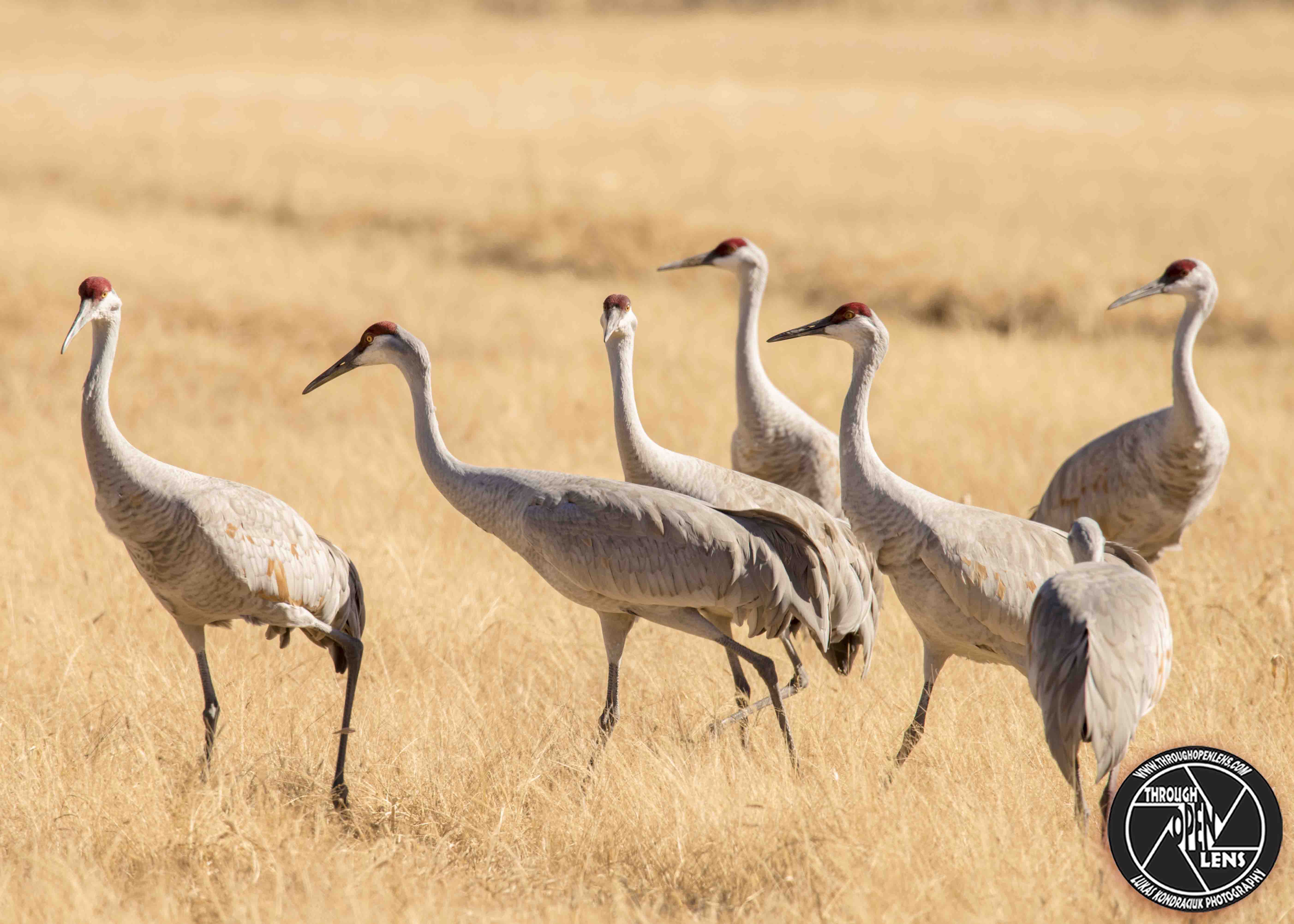
Crane Operators

F/9.0, 1/320, ISO 160.

Sandhill Crane

What bird can lift the most?

A crane.

Interesting Fact:  The Sandhill Crane’s call is a loud, rolling, trumpeting sound whose unique tone is a product of anatomy: Sandhill Cranes have long tracheas (windpipes) that coil into the sternum and help the sound develop a lower pitch and harmonics that add richness. (  https://www.allaboutbirds.org/guide/Sandhill_Crane/lifehistory )

I Woke Up Early, There Was No Worm!

F/10.0, 1/400, ISO 250.

Sandhill Crane

Where do fortune tellers dance?

At the crystal ball.

Interesting Fact: The earliest Sandhill Crane fossil, estimated to be 2.5 million years old, was unearthed in the Macasphalt Shell Pit in Florida. ( https://www.allaboutbirds.org/guide/Sandhill_Crane/ )

Have You Hugged A Tree Today?

F/8.0, 1/250, ISO 320.

Brown Creeper

How do you make a tissue dance?

Put a little boogie in it.

Interesting Fact: The Brown Creeper builds a hammock-like nest behind a loosened flap of bark on a dead or dying tree. It wasn’t until 1879 that naturalists discovered this unique nesting strategy. ( https://www.allaboutbirds.org/guide/Brown_Creeper/lifehistory )

Keep Calm And Hop On!

F/8.0, 1/250, ISO 250.

Desert Cottontail Rabbit

What do rabbits say before they eat?

Lettuce pray.

Interesting Fact: Due to the variable temperature of living conditions, desert cottontails must be adequate thermoregulators to minimize water loss during the hotter seasons and require shaded areas of their environment to conduct evaporative water loss through thermal heat transfer. In open-desert areas, they can withstand for a short period with extremely high temperatures of around 45 °C and have a large evaporative water loss capacity of around 1.5% body mass/hour, though cottontails can withstand longer in an ideal environment with shaded areas. To cope with evaporative heat loss, they do panting and undergo changes in production of their basal metabolic rate in relation to the ambient temperature of the environment. Ears of desert cottontails make up 14% of their body size and may help with thermoregulation. ( https://en.wikipedia.org/wiki/Desert_cottontail )

Down The Rabbit Hole!

F/8.0, 1/250, ISO 250.

Desert Cottontail Rabbit 

What is a tree’s favorite drink?

Root beer!

Interesting Fact: The lifespan of a cottontail that reaches adulthood averages less than two years, depending on the location.[6] Unfortunately for the cottontail, almost every local carnivore larger or faster than the lagomorph is its predator. Some predators, like snakes for example, are familiar with the area inhabited by the cottontails, and can catch and eat the young at will; the mother is unable to defend the litter. Although cottontails are highly active sexually, and mated pairs have multiple litters throughout the year, few young survive to adulthood. Those that survive grow quickly and are full grown at three months. ( https://en.wikipedia.org/wiki/Desert_cottontail )


It May Look Like I’m Doing Nothing. But In My Head, I’m Quite Busy.

F/9.0, 1/320, ISO 160.

Sandhill Cranes 

Why are baseball players so cool?

They always have their fans there!

Interesting Fact: During migration and winter the family units group together with other families and nonbreeders, forming loose roosting and feeding flocks—in some places numbering in the tens of thousands. Eggs, nestlings, and injured or sick adults may be hunted by foxes, raccoons, coyotes, wolves, bobcats, crows, ravens, eagles, and owls. Cranes attack aerial predators by leaping into the air and kicking their feet forward. They threaten terrestrial predators by spreading their wings and hissing, eventually resorting to kicking. ( https://www.allaboutbirds.org/guide/Sandhill_Crane/lifehistory )


There Have Been Many Times In 2017, When I Have Annoyed You, Distubed You, Irritated You, And Bugged The Hell Out Of You….Today I Just Wanna Tell You I Plan To Continue In 2018!

F/9.0, 1/320, ISO 320.

Curve-billed Thrasher

How does one snowman greet another snowman?….

Ice to meet you

Interesting Fact: Forages on ground, pokes and probes in plant litter, and digs holes in the soil with its long, down-curved bill. (  https://www.allaboutbirds.org/guide/Curve-billed_Thrasher/lifehistory )