A Bird Does Not Sing Becauces It Has An Answer. It Sings Because It Has A Song.

F/6.3, 1/100, ISO 320.

Tufted Titmouse

What is the snowman’s breakfast?…

Frosted flakes!

Interesting Fact: The Black-crested Titmouse of Texas and Mexico has at times been considered just a form of the Tufted Titmouse. The two species hybridize where they meet, but the hybrid zone is narrow and stable over time. They differ slightly in the quality of their calls, and show genetic differences as well. ( https://www.allaboutbirds.org/guide/Tufted_Titmouse/lifehistory )

Stay With Me, Sway With Me!

F/6.3, 1/60, ISO 640.

American Black Bear

What do you call a knight who lets people borrow his stuff?

Sir lends a lot

Interesting Facts: When winter arrives, black bears spend the season dormant in their dens, feeding on body fat they have built up by eating ravenously all summer and fall. They make their dens in caves, burrows, brush piles, or other sheltered spots—sometimes even in tree holes high above the ground. Black bears den for various lengths of time governed by the diverse climates in which they live, from Canada to northern Mexico. ( https://www.nationalgeographic.com/animals/mammals/a/american-black-bear/ )


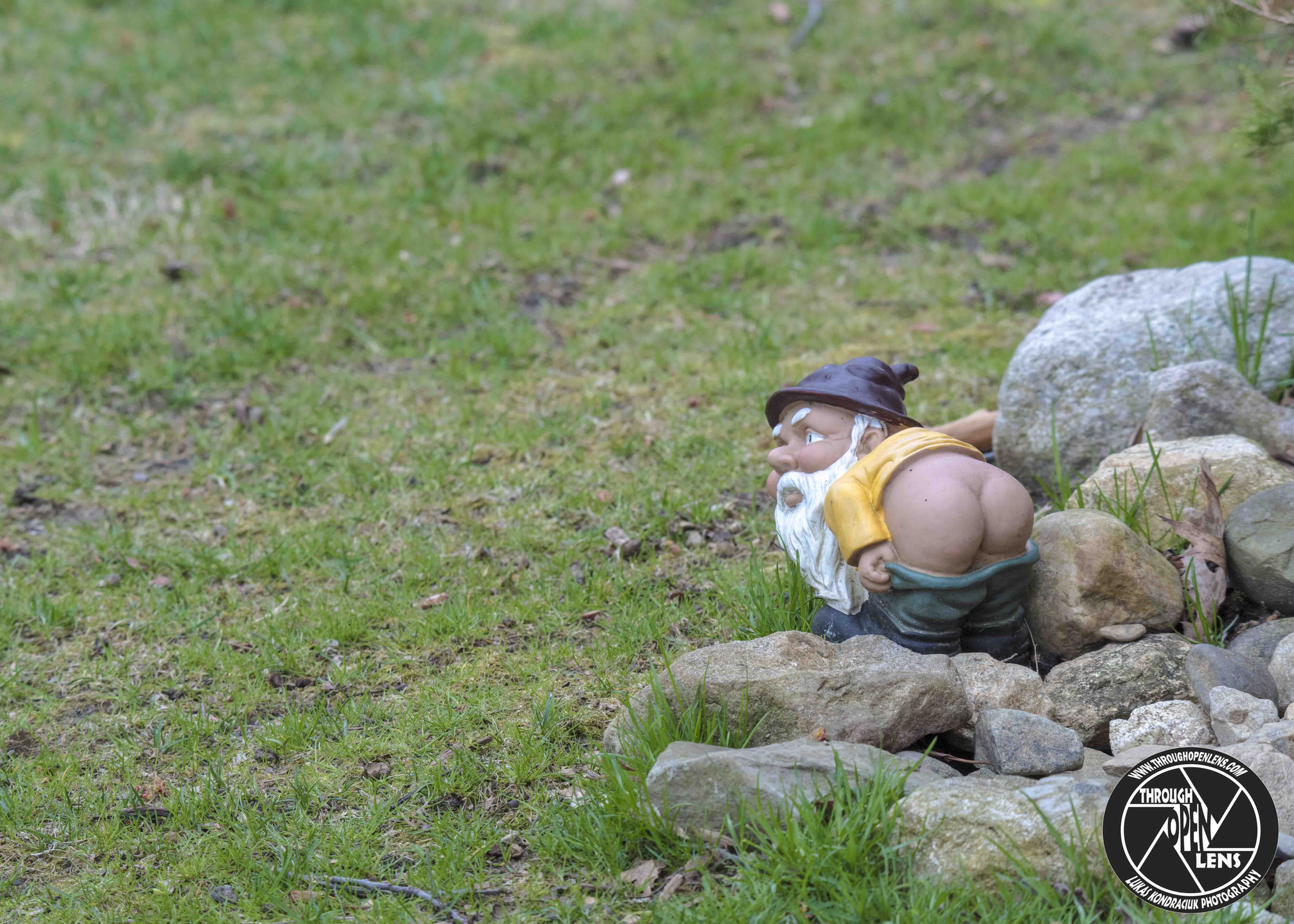
Goodmooning!

F/7.1, 1/200, ISO 640.

Garden Gnome

One time a man was driving on the road when he got stopped by a gnome with red clothes.

The gnome said” I’m a red gnome and I want a strawberry”. The man gave him a strawberry and went on his business.

Later he got stopped by a gnome with yellow clothes.

The gnome said:” I’m a yellow gnome and I want a banana”. The man, slightly annoyed, gave him a banana and continued to drive.

He then got stopped by a gnome with blue clothes.

The man, now pissed, said to him:” Let me guess, you’re a blue gnome and you want a blueberry”

The blue gnome then said:” sir, please step out of the car”

Interesting Fact: In ancient Rome, small stone statues depicting the Greco-Roman fertility god Priapus, also the protector of floors, were frequently placed in Roman gardens.[1][2][3] Gnomes as magical creatures were first described during the Renaissance period by Swiss alchemist Paracelsus as “diminutive figures two spans in height who did not like to mix with humans”.[4] During this period, stone “grotesques“, which were typically garishly painted, 1-metre-tall (3.3 ft) figurines, were commonly placed in the gardens of the wealthy.[5] Among the figures depicted were gobbi (Italian for hunchbacks). In particular, Jacques Callot produced 21 versions of gobbi, which he engraved and printed in 1616.  ( https://en.wikipedia.org/wiki/Garden_gnome#History )

Call Me A Teddy Bear Again!

F/6.3, 1/50, ISO 2000.

American Black Bear

Why don’t bears like fast food?

Because they can’t catch it!

Interesting Fact: Solitary animals, black bears roam large territories, though they do not protect them from other bears. Males might wander a 15- to 80-square-mile home range. ( https://www.nationalgeographic.com/animals/mammals/a/american-black-bear/ )

I Wanna Go Fast!

F/6.3, 1/60, ISO 400.

White-throated Sparrow

Two state officials are talking  “I don’t know what people have against us, We haven’t done anything.”

Interesting Fact:  Males are typically dominant over females, but whether an individual is white-striped or tan-striped seems to have no bearing on status. When pairing up, white-striped forms tend to choose tan-striped individuals, and vice versa. Pairs stay together for the summer, but birds often choose new partners the next year.  ( https://www.allaboutbirds.org/guide/White-throated_Sparrow/lifehistory )

I Just Did A Weeks Worth Of Cardio After Walking Into A Spider’s Web.

F/8.0, 1/250, ISO 320.

Spider

How do spiders communicate?

Through the World Wide Web.

Interesting Fact: Spiders (order Araneae) are air-breathing arthropods that have eight legs and chelicerae with fangs that inject venom. They are the largest order of arachnids and rank seventh in total species diversity among all other orders of organisms.[2] Spiders are found worldwide on every continent except for Antarctica, and have become established in nearly every habitat with the exceptions of air and sea colonization. As of November 2015[update], at least 45,700 spider species, and 113 families have been recorded by taxonomists.[1] However, there has been dissension within the scientific community as to how all these families should be classified, as evidenced by the over 20 different classifications that have been proposed since 1900. ( https://en.wikipedia.org/wiki/Spider )

Behind Every Good Kid Is A Great MOM! ( Happy Mother’s Day )

Happy Mother’s Day to all mom’s out there!

F/3.5, 1/150, ISO 325.

Son: “Mom can I get twenty bucks”
Mom: Does it look like I am made of money
Son: “Well isn’t that what M.O.M stands for?”

Interesting Fact: In the United States, celebration of Mother’s Day began in the early 20th century. It is not related to the many celebrations of mothers and motherhood that have occurred throughout the world over thousands of years, such as the Greek cult to Cybele, the Roman festival of Hilaria, or the Christian Mothering Sunday celebration (originally a commemoration of Mother Church, not motherhood).[1][2][3][4] However, in some countries, Mother’s Day has become synonymous with these older traditions. ( https://en.wikipedia.org/wiki/Mother’s_Day )

If A Turtle Loses It’s Shell Is It Naked Or Homeless?

F/7.1, 1/200, ISO 200.

Common Snapping Turtle

What kind of photos does a turtle take?

Shellfies.

Interesting Fact: In their environment, they are at the top of the food chain, causing them to feel less fear or aggression in some cases. When they encounter a species unfamiliar to them such as humans, in rare instances, they will become curious and survey the situation and even more rarely may bump their nose on a leg of the person standing in the water. Although snapping turtles have fierce dispositions,[16] when they are encountered in the water or a swimmer approaches, they will slip quietly away from any disturbance or may seek shelter under mud or grass nearby.[17] Common snapping turtles are very aggressive if caught, and have a strong enough bite to easily amputate human fingers. ( https://en.wikipedia.org/wiki/Common_snapping_turtle#Behavior )