At The Quack Of Dawn

F/6.3, 1/160, ISO 250.

Wood Duck

What do you get when a duck bends over?

Buttquack

Interesting Fact: Wood Ducks feed by dabbling or short, shallow dives. They are strong fliers and can reach speeds of 30 mph. Wood Ducks are not territorial, with the exception that a male may fight off other males that approach his mate too closely. ( https://www.allaboutbirds.org/guide/Wood_Duck/lifehistory )


If A Turtle Loses It’s Shell Is It Naked Or Homeless?

F/7.1, 1/200, ISO 200.

Common Snapping Turtle

What kind of photos does a turtle take?

Shellfies.

Interesting Fact: In their environment, they are at the top of the food chain, causing them to feel less fear or aggression in some cases. When they encounter a species unfamiliar to them such as humans, in rare instances, they will become curious and survey the situation and even more rarely may bump their nose on a leg of the person standing in the water. Although snapping turtles have fierce dispositions,[16] when they are encountered in the water or a swimmer approaches, they will slip quietly away from any disturbance or may seek shelter under mud or grass nearby.[17] Common snapping turtles are very aggressive if caught, and have a strong enough bite to easily amputate human fingers. ( https://en.wikipedia.org/wiki/Common_snapping_turtle#Behavior )

Dancing In The Street

dancing-in-the-street

F/4.0, 1/60, ISO 800.

Why don’t dogs make good dancers?

Because they have two left feet!

Interesting Fact: Archeological evidence for early dance includes 9,000-year-old paintings in India at the Rock Shelters of Bhimbetka, and Egyptian tomb paintings depicting dancing figures, dated c. 3300 BC. It has been proposed that before the invention of written languages, dance was an important part of the oral and performance methods of passing stories down from generation to generation.[5] The use of dance in ecstatic trance states and healing rituals (as observed today in many contemporary “primitive” cultures, from the Brazilian rainforest to the Kalahari Desert) is thought to have been another early factor in the social development of dance. ( https://en.wikipedia.org/wiki/Dance#Origins )

Go Away! I’m Really Focused Here

Great Blue Heron 3

F/7.1, 1/800, ISO 200.

Great Blue Heron

Two neighbors are talking to each other.
First neighbor: Do you know that my dog is so smart, he waits for the newspaper to drop at the doorstep and then delivers it to me?
Second neighbor: Of course, I know that very well.
First neighbor: Really, well then, how?
Second neighbor: My dog came and told me.

Interesting Fact: Great Blue Herons congregate at fish hatcheries, creating potential problems for the fish farmers. A study found that herons ate mostly diseased fish that would have died shortly anyway. Sick fish spent more time near the surface of the water where they were more vulnerable to the herons.  ( https://www.allaboutbirds.org/guide/Great_Blue_Heron/lifehistory )

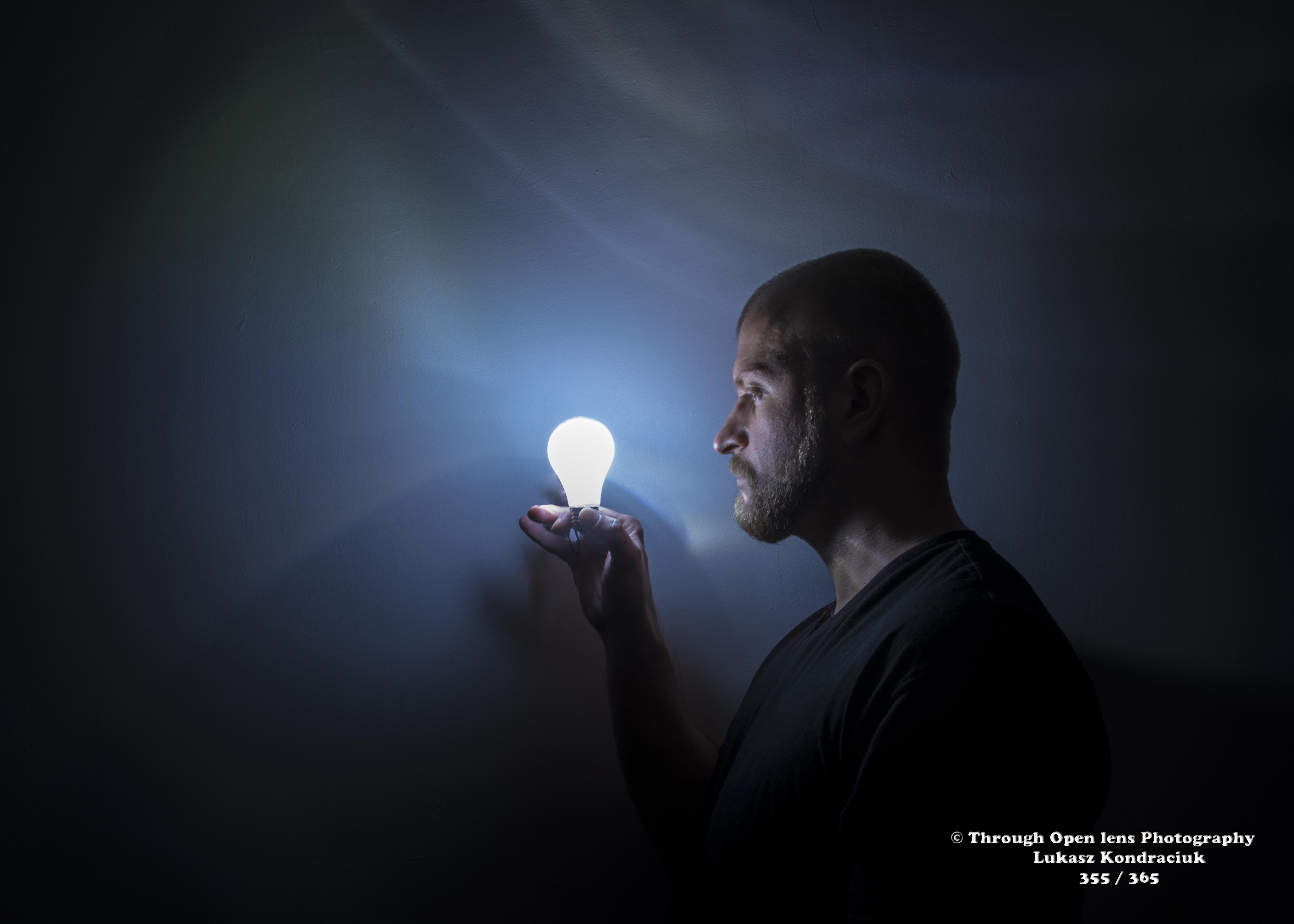
Ideas Just Come To Me

idea

F/ 10.0, 4.0, ISO 320.

Day 355 / 365

When the inventor of the drawing board messed things up, what did he go back to?

Interesting Fact: In addressing the question of who invented the incandescent lamp, historians Robert Friedel and Paul Israel[9] list 22 inventors of incandescent lamps prior to Joseph Swan and Thomas Edison. They conclude that Edison’s version was able to outstrip the others because of a combination of three factors: an effective incandescent material, a higher vacuum than others were able to achieve (by use of the Sprengel pump) and a high resistance that made power distribution from a centralized source economically viable. ( https://en.wikipedia.org/wiki/Incandescent_light_bulb#Early_pre-commercial_research )

Time Is Precious, Waste It Wisely!

paint

F/ 13.0, 1/60, ISO 200, Photoshop CS6.

Day 351 / 365

A man was given the job of painting the white lines down the middle of a highway. On his first day he painted six miles; the next day three miles; the following day less than a mile. When the foreman asked the man why he kept painting less each day.

He replied “I just can’t do any better. Each day I keep getting further away from the paint can”.

Interesting Fact:  Ancient colored walls at Dendera, Egypt, which were exposed for years to the elements, still possess their brilliant color, as vivid as when they were painted about 2,000 years ago. The Egyptians mixed their colors with a gummy substance, and applied them separately from each other without any blending or mixture. They appear to have used six colors: white, black, blue, red, yellow, and green. They first covered the area entirely with white, then traced the design in black, leaving out the lights of the ground color. They used minium for red, and generally of a dark tinge. ( https://en.wikipedia.org/wiki/Paint#History )

Don’t Get Erased

don't be erased

F/9.0, 1/60, ISO 320, Photoshop CS6.

Day 349 / 365

Mother: “why are you home from school so early?” son: “i was the only one who could answer a question.” mother: “oh, really?
What was the question?” son: “who threw the eraser at the principal?”

source: http://www.jokebuddha.com/Eraser#ixzz3uRglUMj4

Interesting Fact: Before rubber erasers, tablets of rubber or wax were used to erase lead or charcoal marks from paper. Bits of rough stone such as sandstone or pumice were used to remove small errors from parchment or papyrus documents written in ink. Crustless bread was used as an eraser in the past; a Meiji-era (1868-1912) Tokyo student said: “Bread erasers were used in place of rubber erasers, and so they would give them to us with no restriction on amount. So we thought nothing of taking these and eating a firm part to at least slightly satisfy our hunger.” ( https://en.wikipedia.org/wiki/Eraser#History )

Happy Halloween!! Don’t Look Under The Bed!!

halloween

F/4.5, 1/60, ISO 64.

Day 304 / 365

What’s it like to be kissed by a vampire?

It’s a pain in the neck.

Interesting Fact: The wearing of costumes at Halloween may come from the belief that supernatural beings, or the souls of the dead, roamed the earth at this time. The practice may have originated in a Celtic festival, held on 31 October–1 November, to mark the beginning of winter. It was called Samhain in Ireland, Scotland and the Isle of Man, and Calan Gaeaf in Wales, Cornwall and Brittany. The festival is believed to have pre-Christian roots. After the Christianization of Ireland in the 5th century, some of these customs may have been retained in the Christian observance of All Hallows’ Eve in that region—which continued to be called Samhain/Calan Gaeaf—blending the traditions of their ancestors with Christian ones.[2][3] It was seen as a liminal time, when the spirits or fairies (the Aos Sí), and the souls of the dead, could more easily come into our world.[4] It was believed that the Aos Sí needed to be propitiated to ensure that the people and their livestock survived the winter. ( https://en.wikipedia.org/wiki/Halloween_costume )

Style Is Away To Say Who You Are Without Having To Speak

the walk

F/ 5.3, 1/60, ISO 320.

Day 296 / 365

I’ve never understood the fashion industry, those people are so clothes minded.

Interesting Fact:  The first official Fashion Week started in 1943 in New York. Its main purpose was to distract the attention away from French fashion during World War II and kickstart the way for American designers. ( http://www.younghollywood.com/scene/15-amazing-fashion-facts.html )

Ha Ha Ha Ha Ha Ha Ha!!! Are You Scared Yet?!

halloween mask

F/5.3, 1/13, ISO 64.

Day 294 / 365

A woman whose husband often came home drunk decided to cure him of the habit. One Halloween night, she put on a devil suit and hid behind a tree to intercept him on the way home.
When her husband came by, she jumped out and stood before him with her red horns, long tail, and pitchfork.
“Who are you?” he asked.
“I’m the Devil!” she responded.
“Well, come on home with me,” he said, “I married your sister!”

Interesting Fact:  Halloween costumes are costumes worn on or around Halloween, a festival which falls on October 31. An early reference to wearing costumes at Halloween comes from Scotland in 1585, but they may pre-date this. There are many references to the custom during the 18th and 19th centuries in the Celtic countries of Scotland, Ireland, Mann and Wales. It has been suggested that the custom comes from the Celtic festivals of Samhain and Calan Gaeaf, or from the practise of “souling” at Hallowtide. Wearing costumes and mumming has long been associated with festivals at other times of the year, such as on Christmas.[1] Halloween costumes are traditionally based on frightening supernatural or folkloric beings. However, by the 1930s costumes based on characters in mass media such as film, literature, and radio were popular. Halloween costumes have tended to be worn mainly by young people, but since the mid-20th century they have been increasingly worn by adults also. ( https://en.wikipedia.org/wiki/Halloween_costume )