I Am Not Crazy… Well, Maybe I Am But You Got To Love Me.

Eastern Towhee 1

F/8.0, 1/250, ISO 250.

Eastern Towhee

Why was the math textbook so sad?

He had a lot of problems!

Interesting Fact: The Eastern Towhee and the very similar Spotted Towhee of western North America used to be considered the same species, the Rufous-sided Towhee. The two forms still occur together in the Great Plains, where they sometimes interbreed. This is a common evolutionary pattern in North American birds – a holdover from when the great ice sheets split the continent down the middle, isolating birds into eastern and western populations that eventually became new species. ( https://www.allaboutbirds.org/guide/Eastern_Towhee/lifehistory )

So What Are We Staring At?!

Great Black-backed Gull

F/13.0, 1/640, ISO 320.

Great Black-backed Gull  

What do you call a seagull when it flies over the bay?

A bagel.

Interesting Fact: This is the largest gull in the world. Its broad wings and powerful appearance give it a regal look that have impressed naturalists for years. In the words of one early observer: “It surely seemed to be a king among the gulls, a merciless tyrant over its fellows, the largest and strongest of its tribe. No weaker gull dared to intrude upon its feudal domain.” ( https://www.allaboutbirds.org/guide/Great_Black-backed_Gull/lifehistory )

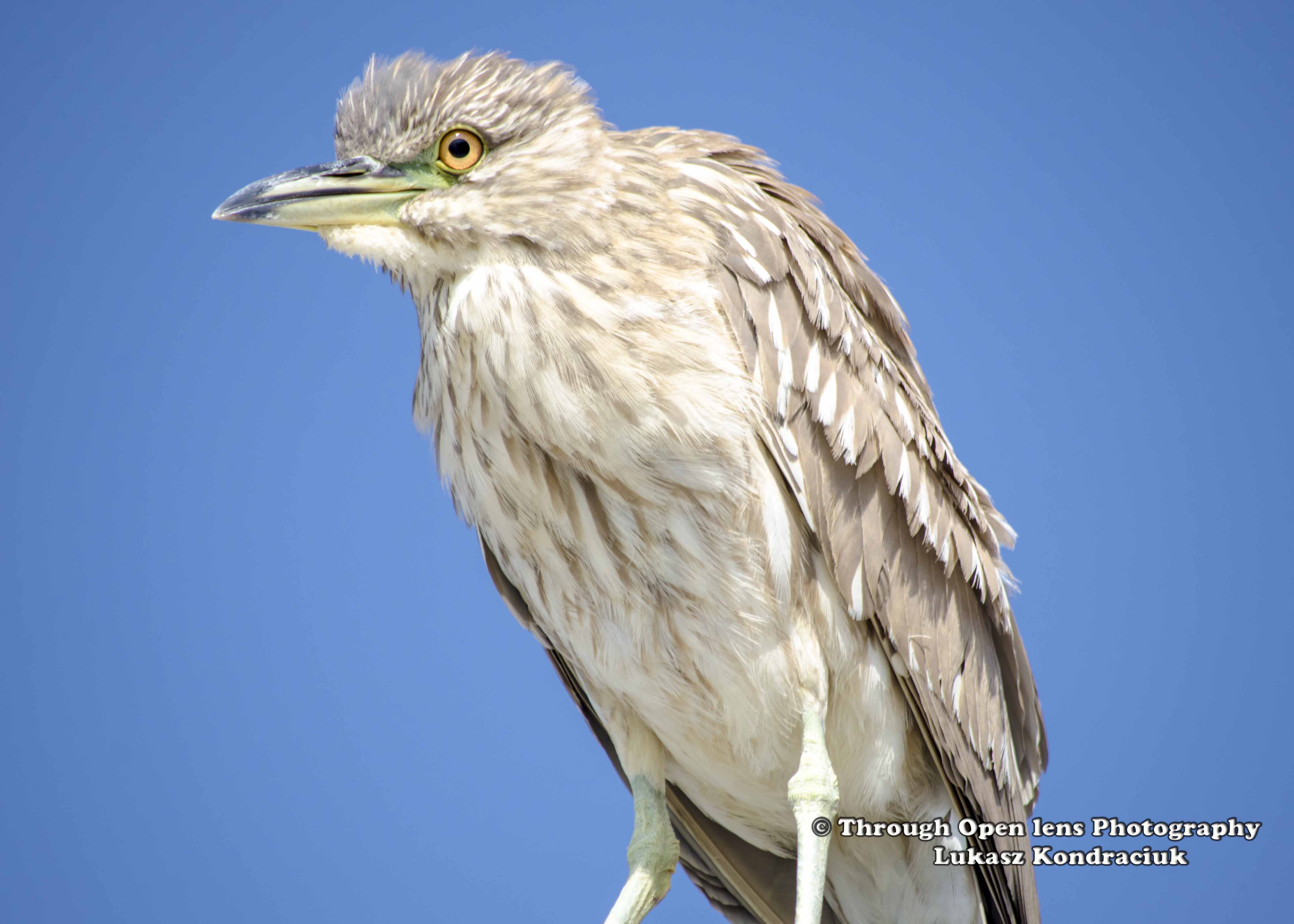
Look Into My Eyes, You Are Getting Sleepy!

Black-crowned Night-Heron 1

F/ 6.3, 1/640, ISO 200.

Black-Crowned Night-Heron ( Juvenile )

How do you wake up Lady gaga?

Poke her face.

Interesting Fact: The familiar evening sight and sound of the Black-crowned Night-Heron was captured in this description from Arthur Bent’s Life Histories of North American Marsh Birds: “How often, in the gathering dusk of evening, have we heard its loud, choking squawk and, looking up, have seen its stocky form, dimly outlined against the gray sky and propelled by steady wing beats, as it wings its way high in the air toward its evening feeding place in some distant pond or marsh!” ( https://www.allaboutbirds.org/guide/Black-crowned_Night-Heron/lifehistory )

Can’t Touch Me!

Black-crowned Night-Heron

F/6.3, 1/250 ISO 100.

Black-crowned Night-Heron

Why was the math textbook so sad?

He had a lot of problems!

Interesting Fact: Young Black-crowned Night-Herons leave the nest at the age of 1 month but cannot fly until they are 6 weeks old. They move through the vegetation on foot, joining up in foraging flocks at night. ( https://www.allaboutbirds.org/guide/Black-crowned_Night-Heron/lifehistory )

Feed Me!

Heermann's Gull

F/7.1, 1/800, ISO 200.

Heermann’s Gull

If someone ever says, “What are you staring at?”

Say “I don’t know, give me a minute.”

Interesting Fact: The Heermann’s Gull, like many other gulls, frequently steals food from other birds. The Brown Pelican is a frequent victim. An adult Heermann’s Gull is most likely to try to steal food from an adult pelican, and an immature gull is more likely to steal from an immature pelican. ( https://www.allaboutbirds.org/guide/Heermanns_Gull/lifehistory )

And I Ran, I Ran So Far Away!

Sanderling

F/7.1, 1/800, ISO 200.

Sanderling

Did you hear about the race between the lettuce and the tomato?

The lettuce was a “head” and the tomato was trying to “ketchup”!

Interesting Fact: The Sanderling’s mating system varies from area to area and possibly from year to year. Sanderlings are usually monogamous, but in some cases the female breeds with multiple males in a row within a single breeding season. ( https://www.allaboutbirds.org/guide/Sanderling/lifehistory )

I Need A Hug!

Common Tern 1

F/7.1, 1/800, ISO 200.

Common Tern

Knock! Knock!

Who’s there?

Lettuce.

Lettuce who?

Lettuce in already!

Interesting Fact: Common Terns living along the coast drink salt water. They do not seek fresh water even when it is available nearby. Like many seabirds, they have nasal glands that excrete the excess salt. ( https://www.allaboutbirds.org/guide/Common_Tern/lifehistory )

Hi I’m Steven, Steven SeaGull

Franklin's Gull

F/7.1, 1/800, ISO 200.

Franklin’s Gull

Why do sea-gulls fly over the sea?

Because if they flew over the bay they would be bagels!

Interesting Fact: The floating nest of the Franklin’s Gull gradually sinks as the material below the water surface decays, and it requires continual maintenance. Both parents add new nest material daily until one or two weeks before departing the colony. Older chicks also add nest material from the immediate vicinity of the nest. ( https://www.allaboutbirds.org/guide/Franklins_Gull/lifehistory )

Reverse Mohawk Is In!

Elegant Tern

F/5.6, 1/500, ISO 220.

Elegant Tern

California Week Two 

A sailor trying to sneak back to his ship about 3 o’clock in the morning was spotted by a chief petty officer who ordered him to explain his tardiness. The lame explanation didn’t work. “Take this broom and sweep every link on this anchor chain by morning or it’s the brig for you,” the chief said. The sailor began to sweep, but a tern landed on the broom handle and he couldn’t continue. He yelled at the bird, but it didn’t budge. He finally plucked it off the broom and gave it a toss. But the bird came right back and again landed on the handle. Over and over, the same routine was repeated. A toss, one sweep, and the bird was back. When morning came, the chief also was back. “What have you been doing all night? This chain is no cleaner than when you started!” “Honest, chief,” said the sailor, “I tossed a tern all night and couldn’t sweep a link.”

Interesting Fact: Unlike some of the smaller white terns, it is not very aggressive toward potential predators, relying on the sheer density of the nests and nesting close to other more aggressive species such as Heermann’s Gulls to avoid predation. ( http://identify.whatbird.com/obj/467/_/Elegant_Tern.aspx )


New York, Concrete Jungle Where Dreams Are Made Of There’s Nothin’ You Can’t Do Now You’re In New York

Empire State Building

F/16.0, 57.0, ISO 64.

Day 310 / 365

Two men are sitting drinking at a bar at the top of the Empire State
Building when the first man turns to the other and says, “You know,
last week I discovered that if you jump from the top of this building,
by the time you fall to the 10th floor, the winds around the building
are so intense that they carry you around the building and back into
the window.”

The bartender just shakes his head in disapproval while wiping the
bar.

The second guy says, “What are you a nut? There is no way that could
happen.” “No, it’s true,” said the first man, let me prove it to you.”
He gets up from the bar, jumps over the balcony, and plummets to the
street below. When he passes the 10th floor, the high wind whips him
around the building and back into the 10th floor window and he takes
the elevator back up to the bar. He met the second man, who looked
quite astonished. “You know, I saw that with my own eyes, but that
must have been a one time fluke.”

“No, I’ll prove it again,” says the first man as he jumps. Again just
as he is hurling toward the street, the 10th floor wind gently carries
him around the building and into the window.

Once upstairs he urges his fellow drinker to try it. “Well, what the
hey,” the second guy says, “it works, I’ll try it!” He jumps over the
balcony plunges downward, passes the 11th, 10th, 9th, 8th floors
…and hits the sidewalk with a ‘splat.’ Back upstairs the Bartender
turns to the other drinker, saying “You know, Superman, sometimes you
can be a real jerk.”

Interesting Fact: On July 28, 1945, a B-25 bomber that was lost in fog slammed into Empire State Building north wall of the 78th and 79th floors. Fourteen people were killed (it was a Saturday, so many offices were empty). Elevator operator Betty Lou Oliver survived a plunge of 75 stories inside an elevator, the Guinness World Record for the longest survived elevator fall recorded. There was no important structural damage to the building, which opened for business on the following Monday. ( https://www.walksofnewyork.com/blog/empire-state-building-facts )