I Used To Think I Was Indecisive, But Now I’m Not Too Sure.

F/8.0, 1/250, ISO 250.

Loggerhead Shrike

At a local coffee bar, a young woman was expounding on her idea of the perfect mate to some of her friends. “The man I marry must be a shining light amongst company. He must be musical. Tell jokes. Sing. And stay home at night!” An old granny overheard and spoke up, “Honey, if that’s all you want, get a TV!”

Interesting Fact: The upper cutting edge (tomium) of the Loggerhead Shrike’s hooked bill features a pair of built-in pointy projections, aptly named “tomial teeth.” Like a falcon, the shrike tackles vertebrate prey with a precise attack to the nape, probably using these tomial “teeth” to paralyze the animal with a jab to the spinal cord. ( https://www.allaboutbirds.org/guide/Loggerhead_Shrike )



I’m On Top Of The World!

F/11.0, 1/500, ISO 320.

Mount San Jacinto State Park ( Desert View Trail )

Why did the snowman call his dog Frost?

Because frost bites!

Interesting Fact: Mount San Jacinto State Park is in the San Jacinto Mountains, of the Peninsular Ranges system, in Riverside County, California, United States. A majority of the park is within the Santa Rosa and San Jacinto Mountains National Monument.[1] The park is near the Greater Los Angeles and San Diego metropolitan areas.  ( https://en.wikipedia.org/wiki/Mount_San_Jacinto_State_Park )

I Am Not Liable If You Falling Asleep Count Sheep!

F/8.0, 1/250, ISO 320.

Sheep

What do you call a sheep that is always quiet?

A shhhheep!

Interesting Fact: The exact line of descent between domestic sheep and their wild ancestors is unclear.[1] The most common hypothesis states that Ovis aries is descended from the Asiatic (O. orientalis) species of mouflon.[2]:5 Sheep were among the first animals to be domesticated by humankind (although the domestication of dogs may be over 20,000 years earlier); the domestication date is estimated to fall between 11,000 and 9,000 B.C in Mesopotamia.[2]:4[3]:11–14[4]:2[5] The rearing of sheep for secondary products, and the resulting breed development, began in either southwest Asia or western Europe.[6] Initially, sheep were kept solely for meat, milk and skins. Archaeological evidence from statuary found at sites in Iran suggests that selection for woolly sheep may have begun around 6000 BC,[2]:5[3]:11 and the earliest woven wool garments have been dated to two to three thousand years later. ( https://en.wikipedia.org/wiki/Sheep#History )

Car Is In Garage We Will Poop On The Roof Then!

Brown Pelicans 1

F/5.6, 1/500, ISO 250.

Brown Pelicans

Do you know what the white stuff in bird poop is?

That’s bird poop, too!

Interesting Fact: Pelicans incubate their eggs with the skin of their feet, essentially standing on the eggs to keep them warm. In the mid-twentieth century the pesticide DDT caused pelicans to lay thinner eggs that cracked under the weight of incubating parents. After nearly disappearing from North America in the 1960s and 1970s, Brown Pelicans made a full comeback thanks to pesticide regulations. ( https://www.allaboutbirds.org/guide/Brown_Pelican/lifehistory )


The Water Is Fine Come On In!

American Coot

F/5.6, 1/500, ISO 360.

American Coots

Father: Why did you get such a low score in that exam?

Son: Absence!

Father: You were absent on the day of the exam?

Son: No but the boy who sits next to me was!

Interesting Fact: Although it swims like a duck, the American Coot does not have webbed feet like a duck. Instead, each one of the coot’s long toes has broad lobes of skin that help it kick through the water. The broad lobes fold back each time the bird lifts its foot, so it doesn’t impede walking on dry land, though it supports the bird’s weight on mucky ground. ( https://www.allaboutbirds.org/guide/American_Coot/lifehistory )

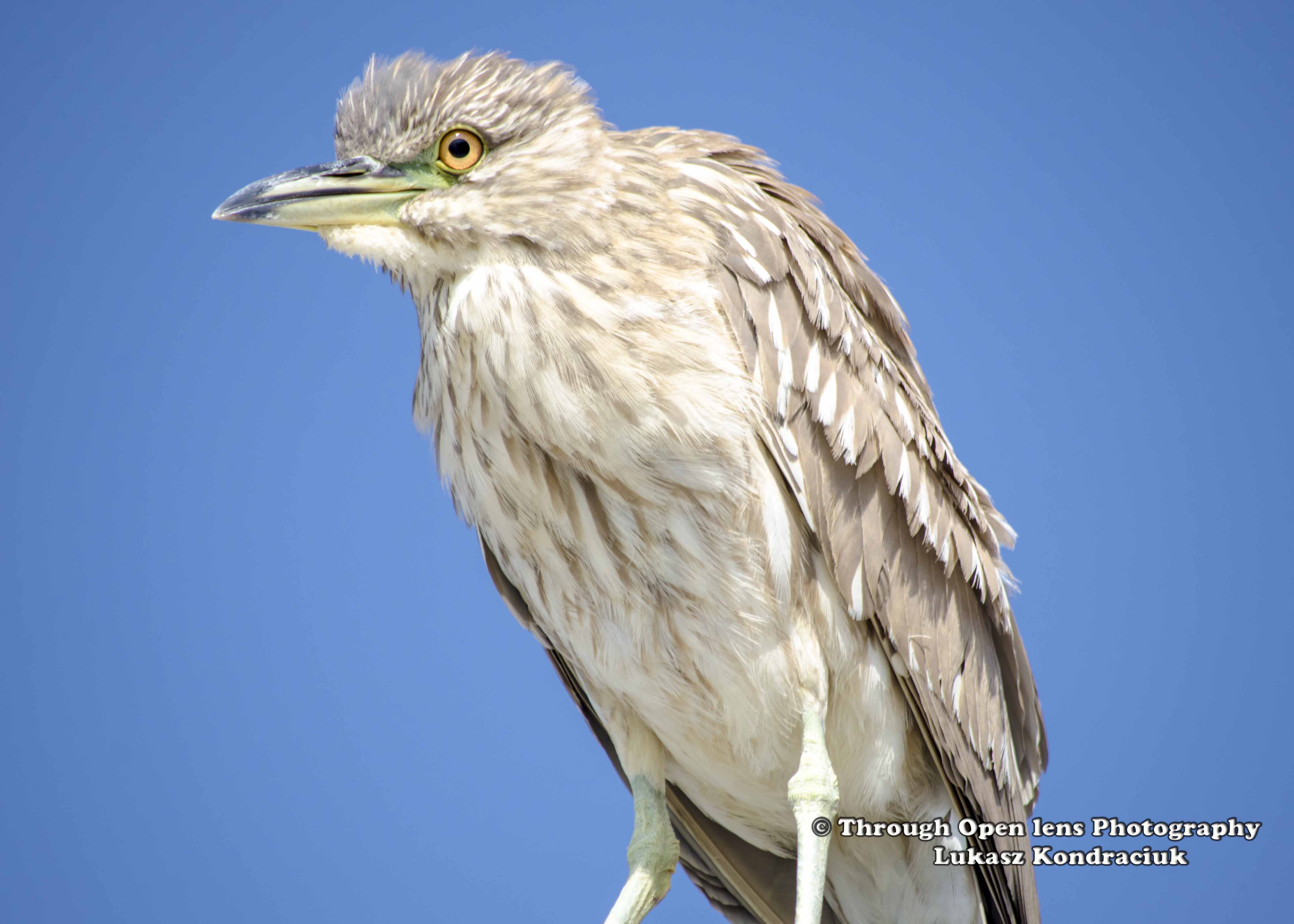
Look Into My Eyes, You Are Getting Sleepy!

Black-crowned Night-Heron 1

F/ 6.3, 1/640, ISO 200.

Black-Crowned Night-Heron ( Juvenile )

How do you wake up Lady gaga?

Poke her face.

Interesting Fact: The familiar evening sight and sound of the Black-crowned Night-Heron was captured in this description from Arthur Bent’s Life Histories of North American Marsh Birds: “How often, in the gathering dusk of evening, have we heard its loud, choking squawk and, looking up, have seen its stocky form, dimly outlined against the gray sky and propelled by steady wing beats, as it wings its way high in the air toward its evening feeding place in some distant pond or marsh!” ( https://www.allaboutbirds.org/guide/Black-crowned_Night-Heron/lifehistory )

Go Away! I’m Really Focused Here

Great Blue Heron 3

F/7.1, 1/800, ISO 200.

Great Blue Heron

Two neighbors are talking to each other.
First neighbor: Do you know that my dog is so smart, he waits for the newspaper to drop at the doorstep and then delivers it to me?
Second neighbor: Of course, I know that very well.
First neighbor: Really, well then, how?
Second neighbor: My dog came and told me.

Interesting Fact: Great Blue Herons congregate at fish hatcheries, creating potential problems for the fish farmers. A study found that herons ate mostly diseased fish that would have died shortly anyway. Sick fish spent more time near the surface of the water where they were more vulnerable to the herons.  ( https://www.allaboutbirds.org/guide/Great_Blue_Heron/lifehistory )

Can’t Touch Me!

Black-crowned Night-Heron

F/6.3, 1/250 ISO 100.

Black-crowned Night-Heron

Why was the math textbook so sad?

He had a lot of problems!

Interesting Fact: Young Black-crowned Night-Herons leave the nest at the age of 1 month but cannot fly until they are 6 weeks old. They move through the vegetation on foot, joining up in foraging flocks at night. ( https://www.allaboutbirds.org/guide/Black-crowned_Night-Heron/lifehistory )

Feed Me!

Heermann's Gull

F/7.1, 1/800, ISO 200.

Heermann’s Gull

If someone ever says, “What are you staring at?”

Say “I don’t know, give me a minute.”

Interesting Fact: The Heermann’s Gull, like many other gulls, frequently steals food from other birds. The Brown Pelican is a frequent victim. An adult Heermann’s Gull is most likely to try to steal food from an adult pelican, and an immature gull is more likely to steal from an immature pelican. ( https://www.allaboutbirds.org/guide/Heermanns_Gull/lifehistory )