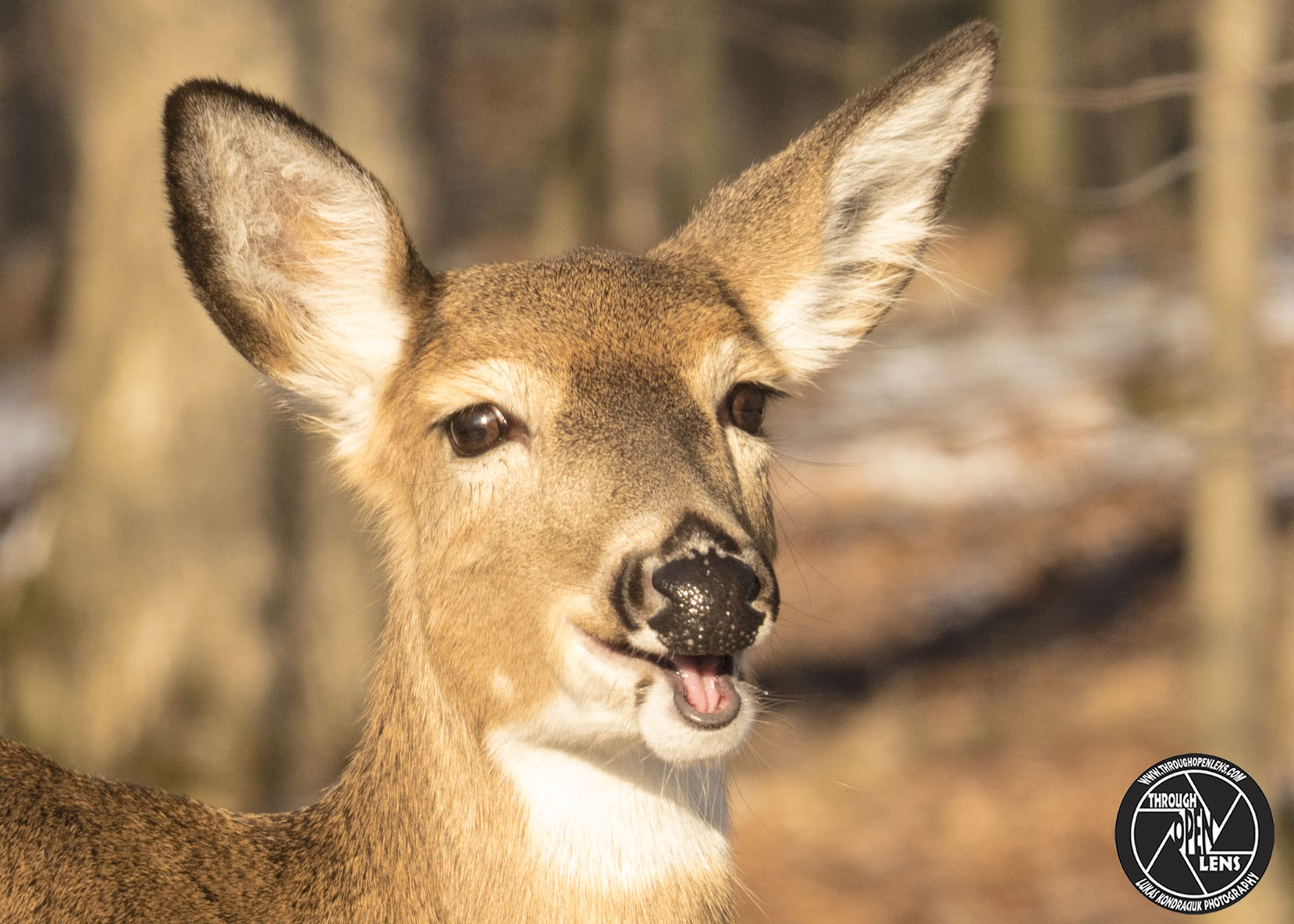
Peck Me If You Can!

F/9.0, 1/1250, ISO 800.

Red-Bellied Woodpecker

Why did the owl, owl?

Because the woodpecker would peck ‘er!

Interesting Fact: A Red-bellied Woodpecker can stick out its tongue nearly 2 inches past the end of its beak. The tip is barbed and the bird’s spit is sticky, making it easier to snatch prey from deep crevices. Males have longer, wider-tipped tongues than females, possibly allowing a breeding pair to forage in slightly different places on their territory and maximize their use of available food. ( https://www.allaboutbirds.org/guide/Red-bellied_Woodpecker/lifehistory )


Dear Life, When I Said ” Can My Day Get Any Worst” It Was A Rhetorical Question Not A Challenge.

F/6.3, 1/250, ISO 800.

White-Tailed Deer ( Fawn )

Which branch of the military do babies join?

The infantry!

Interesting Fact: White tailed deer can run as fast as 36 mph, jump as high as 8 1/2 feet, and leap as far as 30 feet. They are also very good swimmers. ( https://www.brighthub.com/environment/science-environmental/articles/48142.aspx )


I See You Watching Me!

brown-thrasher

F/6.3, 1/160, ISO 320.

Brown Thrasher

A bird was flying south for Winter, but he had left it too late and was frozen solid in a storm. He dropped down into a pasture of cows. The biggest, fattest cow was doing a crap there, and the bird landed in it.

At first he was disgusted, until he realised the poo was thawing him out! He started crying out for joy as the ice melted. A cat that was nearby heard the cries, walked over, saw the bird and ate it

There are three morals to this story:

1. Not everyone who gets you into sh*t is your enemy

2. Not everyone who gets you out of sh*t is your friend

3. If you are in s#!t, keep your mouth shut

Interesting Fact: Brown Thrashers are accomplished songsters that may sing more than 1,100 different song types and include imitations of other birds, including Chuck-will’s-widows, Wood Thrushes, and Northern Flickers. ( https://www.allaboutbirds.org/guide/Brown_Thrasher/lifehistory )

Keep On Knockin!

F/8.0, 1/800, ISO 800.

Red-Bellied Woodpecker 

What did one traffic light say to the other?

Don’t look at me while I’m changing!

Interesting Fact: These birds often stick to main branches and trunks of trees, where they hitch in classic woodpecker fashion, leaning away from the trunk and onto their stiff tail feathers as they search for food hiding in bark crevices. ( https://www.allaboutbirds.org/guide/Red-bellied_Woodpecker/lifehistory )


All Good Things Are Wild And Free

white-tailed-deer-buck

F/6.3, 1/100, ISO 200.

White-Tailed Deer

What is the difference between beer nuts and deer nuts?

Beer nuts cost a buck twenty-five. Deer nuts are under a buck!

Interesting Fact: The male white tailed deer, buck, normally weighs about 130-300 pounds. The female, doe, weighs about 90-200 pounds. The average height is 3 feet. ( http://www.brighthub.com/environment/science-environmental/articles/48142.aspx )


Hey Handsome!

F/9.0, 1/320, ISO 250.

White-Tailed Deer

Did you hear the joke about the butter?

I do not think I should tell you because you might spread it around…

Interesting Fact: Males compete for the opportunity of breeding females. Sparring among males determines a dominance hierarchy.[61] Bucks attempt to copulate with as many females as possible, losing physical condition, since they rarely eat or rest during the rut. The general geographical trend is for the rut to be shorter in duration at increased latitude. Many factors determine how intense the “rutting season” will be; air temperature is a major one. Any time the temperature rises above 40 °F (4 °C), the males do much less traveling looking for females, else they will be subject to overheating or dehydrating. Another factor for the strength in rutting activity is competition. If numerous males are in a particular area, then they compete more for the females. If fewer males or more females are present, then the selection process will not need to be as competitive. ( https://en.wikipedia.org/wiki/White-tailed_deer )

And Since I Have No Place To Go Let It Snow, Let It Snow, Let It Snow.

F/7.1, 1/200, ISO 320.

Northern Cardinal Female

Why did the baseball coach throw Cinderella off the team?

Because she ran away from the ball.

Interesting Fact: A week or two before the female starts building, she starts to visit possible nest sites with the male following along. The pair call back and forth and hold nesting material in their bills as they assess each site. Nests tend to be wedged into a fork of small branches in a sapling, shrub, or vine tangle, 1-15 feet high and hidden in dense foliage. ( https://www.allaboutbirds.org/guide/Northern_Cardinal/lifehistory )


Snow Fun

Snow Fun

F/8.0, 1/250, ISO 100.

How do you know if there’s a snowman in your bed?

You wake up wet!

Interesting Fact: Snow forms when  water vapor in the atmosphere freezes into ice crystals.


Well I Hope The Neighbors Like This Song

black-capped-chickadee-branch

F/9.0, 1/320, ISO 320, Photoshop CS6.

Black-capped Chickadee

What kind of music are balloons afraid of?

Pop Music.

Interesting Fact: Winter flocks with chickadees serving as the nucleus contain mated chickadee pairs and nonbreeders, but generally not the offspring of the adult pairs within that flock. Other species that associate with chickadee flocks include nuthatches, woodpeckers, kinglets, creepers, warblers and vireos. ( https://www.allaboutbirds.org/guide/Black-capped_Chickadee/lifehistory )


I Always Have To Deal With Paparazzis

White-Tailed Deer 1

F/5.6, 1/50, ISO 100.

White-Tailed Deer

Who did Bambi invite to his birthday party?

His nearest and deer-est friends.

Interesting Fact: White-tailed deer, the smallest members of the North American deer family, are found from southern Canada to South America. In the heat of summer they typically inhabit fields and meadows using clumps of broad-leaved and coniferous forests for shade. During the winter they generally keep to forests, preferring coniferous stands that provide shelter from the harsh elements. ( http://animals.nationalgeographic.com/animals/mammals/white-tailed-deer/ )