Let Me Tell You A Secret.

F/10.0, 1/400, ISO 640.

White-Tailed Deer

Who did Bambi invite to his birthday party?

His nearest and deer-est friends.

Interesting Fact: Although most often thought of as forest animals depending on relatively small openings and edges, white-tailed deer can equally adapt themselves to life in more open prairie, savanna woodlands, and sage communities as in the Southwestern United States and northern Mexico. These savanna-adapted deer have relatively large antlers in proportion to their body size and large tails. Also, a noticeable difference exists in size between male and female deer of the savannas. The Texas white-tailed deer (O. v. texanus), of the prairies and oak savannas of Texas and parts of Mexico, are the largest savanna-adapted deer in the Southwest, with impressive antlers that might rival deer found in Canada and the northern United States. Populations of Arizona (O. v. couesi) and Carmen Mountains (O. v. carminis) white-tailed deer inhabit montane mixed oak and pine woodland communities.[21] The Arizona and Carmen Mountains deer are smaller, but may also have impressive antlers, considering their size. The white-tailed deer of the Llanos region of Colombia and Venezuela (O. v. apurensis and O. v. gymnotis) have antler dimensions similar to the Arizona white-tailed deer.  ( https://en.wikipedia.org/wiki/White-tailed_deer )

Deer Me To Jump?!

F/13.0, 1/640, ISO1600.

White-Tailed Deer

What is the cheapest kind of meat?

Deer Balls, two for under a Buck!

Interesting Fact: White-tailed deer are generalists and can adapt to a wide variety of habitats.[20] The largest deer occur in the temperate regions of Canada and United States. The northern white-tailed deer (O. v. borealis), Dakota white-tailed deer (O. v. dacotensis), and northwest white-tailed deer (O. v. ochrourus) are some of the largest animals, with large antlers. The smallest deer occur in the Florida Keys and in partially wooded lowlands in the neotropics. ( https://en.wikipedia.org/wiki/White-tailed_deer )


What Drives You Nuts?!

F/6.3, 1/100, ISO 320.

American Red Squirrel

Why do squirrels swim on there back?

To keep their nuts dry!

Interesting Fact: Red squirrels can be easily distinguished from other North American tree squirrels by their smaller size, 28–35 cm (11–14 in) total length (including tail), territorial behavior, and reddish fur with a white venter (underbelly).[6] Red squirrels are somewhat larger than chipmunks. The Douglas squirrel is morphologically similar to the American red squirrels, but has a rust-colored venter and is restricted to the southwestern coast of British Columbia and in the Pacific Northwest of the United States. These species’ ranges do not overlap.  ( https://en.wikipedia.org/wiki/American_red_squirrel )

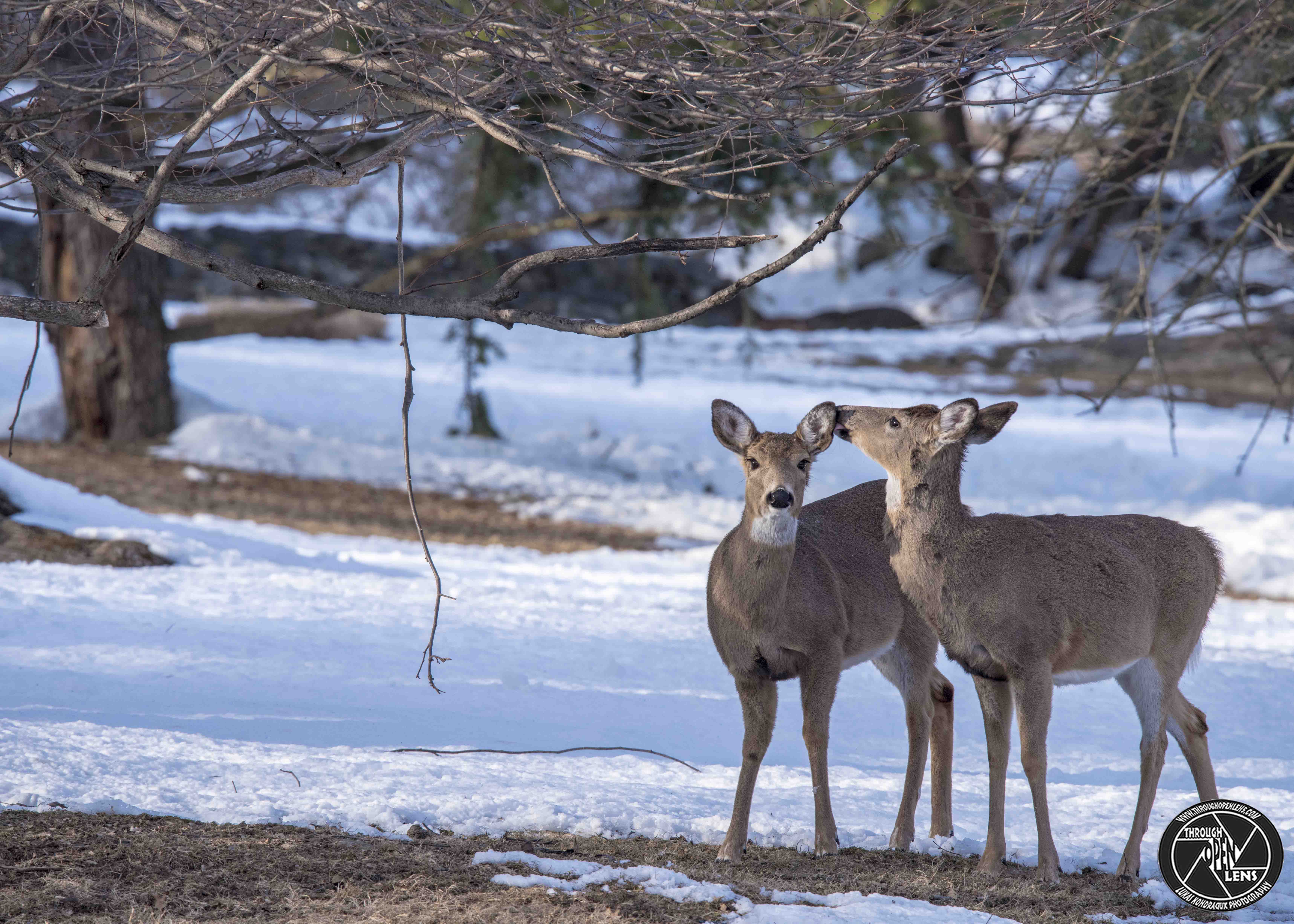
Oh My Deer…

F/5.6, 1/250, ISO 400

White-Tailed Deer

What is it called when a tree takes time off from work in autumn?

Paid leaf.

Interesting Fact: Deer have a great sense of hearing and can even move their ears in any direction, without moving the head. Deer have an excellent sense of smell and can detect predators from a long distance away.

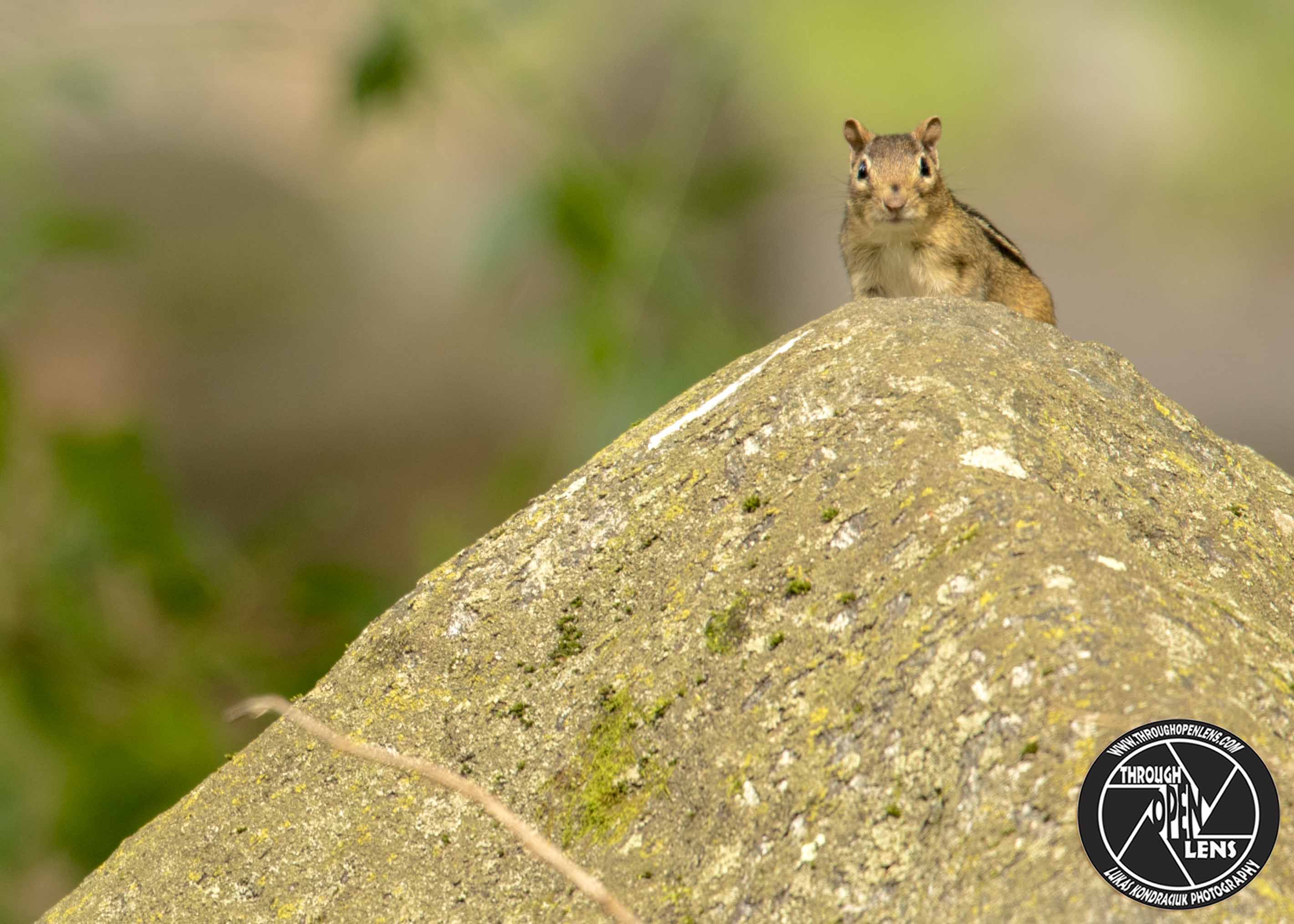
Im On Top Of The World!

F/6.3, 1/100, ISO 250.

Chipmunk

Why was the chipmunk late for work?

Traffic was NUTS.

Interesting Fact: Their shrill, repeated, birdlike chirp is usually made upon sensing a threat but is also thought to be used as a mating call by females. Chipmunks are solitary creatures and normally ignore one another except during the spring, when mating takes place. After a 30-day gestation, a litter of two to eight is born. The young stay with their parents for two months before they begin to gather their own provisions for the winter ahead. ( https://www.nationalgeographic.com/animals/mammals/group/chipmunks/ )

Keep Calm And Hop On!

F/8.0, 1/250, ISO 250.

Desert Cottontail Rabbit

What do rabbits say before they eat?

Lettuce pray.

Interesting Fact: Due to the variable temperature of living conditions, desert cottontails must be adequate thermoregulators to minimize water loss during the hotter seasons and require shaded areas of their environment to conduct evaporative water loss through thermal heat transfer. In open-desert areas, they can withstand for a short period with extremely high temperatures of around 45 °C and have a large evaporative water loss capacity of around 1.5% body mass/hour, though cottontails can withstand longer in an ideal environment with shaded areas. To cope with evaporative heat loss, they do panting and undergo changes in production of their basal metabolic rate in relation to the ambient temperature of the environment. Ears of desert cottontails make up 14% of their body size and may help with thermoregulation. ( https://en.wikipedia.org/wiki/Desert_cottontail )

I Am Too Busy Working On My Own Grass To Notice If Yours Is Greener

F/6.3, 1/250, ISO 640.

Muskrat

Why is sex like math?

You add a bed, subtract the clothes, divide the legs, and pray there’s no multiplying!

Interesting Fact: Muskrats provide an important food resource for many other animals, including minkfoxescoyoteswolveslynxbobcatsbearseaglessnakesalligators, and large owls and hawksOtterssnapping turtles, and large fish such as pike prey on baby muskrats. Caribou and elk sometimes feed on the vegetation which makes up muskrat push-ups during the winter when other food is scarce for them.[24] In their introduced range in the former Soviet Union, the muskrat’s greatest predator is the golden jackal. They can be completely eradicated in shallow water bodies, and during the winter of 1948–49 in the Amu Darya (river in central Asia), muskrats constituted 12.3% of jackal faeces contents, and 71% of muskrat houses were destroyed by jackals, 16% of which froze and became unsuitable for muskrat occupation. Jackals also harm the muskrat industry by eating muskrats caught in traps or taking skins left out to dry. ( https://en.wikipedia.org/wiki/Muskrat#Behavior )

What Am I Going To Do Today?

F/9.0, 1/320, ISO 320.

Eastern Chipmunk

Why did the tiny ghost join the football team?

He heard they needed a little team spirit.

Interesting Fact: It has several bird-like or chattering calls; one is a trill at the rate of 130 vibrations per minute and another is a lower-pitched, clicking sound. ( https://en.wikipedia.org/wiki/Eastern_chipmunk )

HEY GIRL! NO, I Meant ” HAY GIRL”. That Is Your Job, Right?

F/5.6, 1/200, ISO 100.

HORSE

Which state has the smallest drinks?

Mini-soda.

Interesting Fact: Horses are prey animals with a strong fight-or-flight response. Their first reaction to a threat is to startle and usually flee, although they will stand their ground and defend themselves when flight is impossible or if their young are threatened.[88] They also tend to be curious; when startled, they will often hesitate an instant to ascertain the cause of their fright, and may not always flee from something that they perceive as non-threatening. Most light horse riding breeds were developed for speed, agility, alertness and endurance; natural qualities that extend from their wild ancestors. However, through selective breeding, some breeds of horses are quite docile, particularly certain draft horses. ( https://en.wikipedia.org/wiki/Horse )


Not Fair You Are Peeking!

F/8.0, 1/250, ISO 200.

White-Tailed Deer 

How does NASA organize a birthday party?

They planet!

Interesting Fact: Males compete for the opportunity of breeding females. Sparring among males determines a dominance hierarchy.[63] Bucks attempt to copulate with as many females as possible, losing physical condition, since they rarely eat or rest during the rut. The general geographical trend is for the rut to be shorter in duration at increased latitude. Many factors determine how intense the “rutting season” will be; air temperature is a major one. Any time the temperature rises above 40 °F (4 °C), the males do much less traveling looking for females, else they will be subject to overheating or dehydrating. Another factor for the strength in rutting activity is competition. If numerous males are in a particular area, then they compete more for the females. If fewer males or more females are present, then the selection process will not need to be as competitive. ( https://en.wikipedia.org/wiki/White-tailed_deer )