Don’t Be Afraid To Rock The Boat

F/13.0, 1/640, ISO 200.

Jersey City Hudson River

What does a cheetah say when someone looks at it?

I’ve been spotted!

Interesting Fact: The land comprising what is now Jersey City was inhabited by the Lenape, a collection of tribes (later called Delaware Indian). In 1609, Henry Hudson, seeking an alternate route to East Asia, anchored his small vessel Halve Maen (English: Half Moon) at Sandy Hook, Harsimus Cove and Weehawken Cove, and elsewhere along what was later named the North River. After spending nine days surveying the area and meeting its inhabitants, he sailed as far north as Albany. By 1621, the Dutch West India Company was organized to manage this new territory and in June 1623, New Netherland became a Dutch province, with headquarters in New Amsterdam. Michael Reyniersz Pauw received a land grant as patroon on the condition that he would establish a settlement of not fewer than fifty persons within four years. He chose the west bank of the North River (Hudson River) and purchased the land from the Lenape. This grant is dated November 22, 1630 and is the earliest known conveyance for what are now Hoboken and Jersey City. Pauw, however, was an absentee landlord who neglected to populate the area and was obliged to sell his holdings back to the Company in 1633.[39] That year, a house was built at Communipaw for Jan Evertsen Bout, superintendent of the colony, which had been named Pavonia (the Latinized form of Pauw’s name, which means peacock).[40] Shortly after, another house was built at Harsimus Cove and became the home of Cornelius Van Vorst, who had succeeded Bout as superintendent, and whose family would become influential in the development of the city. Relations with the Lenape deteriorated, in part because of the colonialist’s mismanagement and misunderstanding of the indigenous people, and led to series of raids and reprisals and the virtual destruction of the settlement on the west bank. During Kieft’s War, approximately eighty Lenapes were killed by the Dutch in a massacre at Pavonia on the night of February 25, 1643. ( https://en.wikipedia.org/wiki/Jersey_City,_New_Jersey#History )

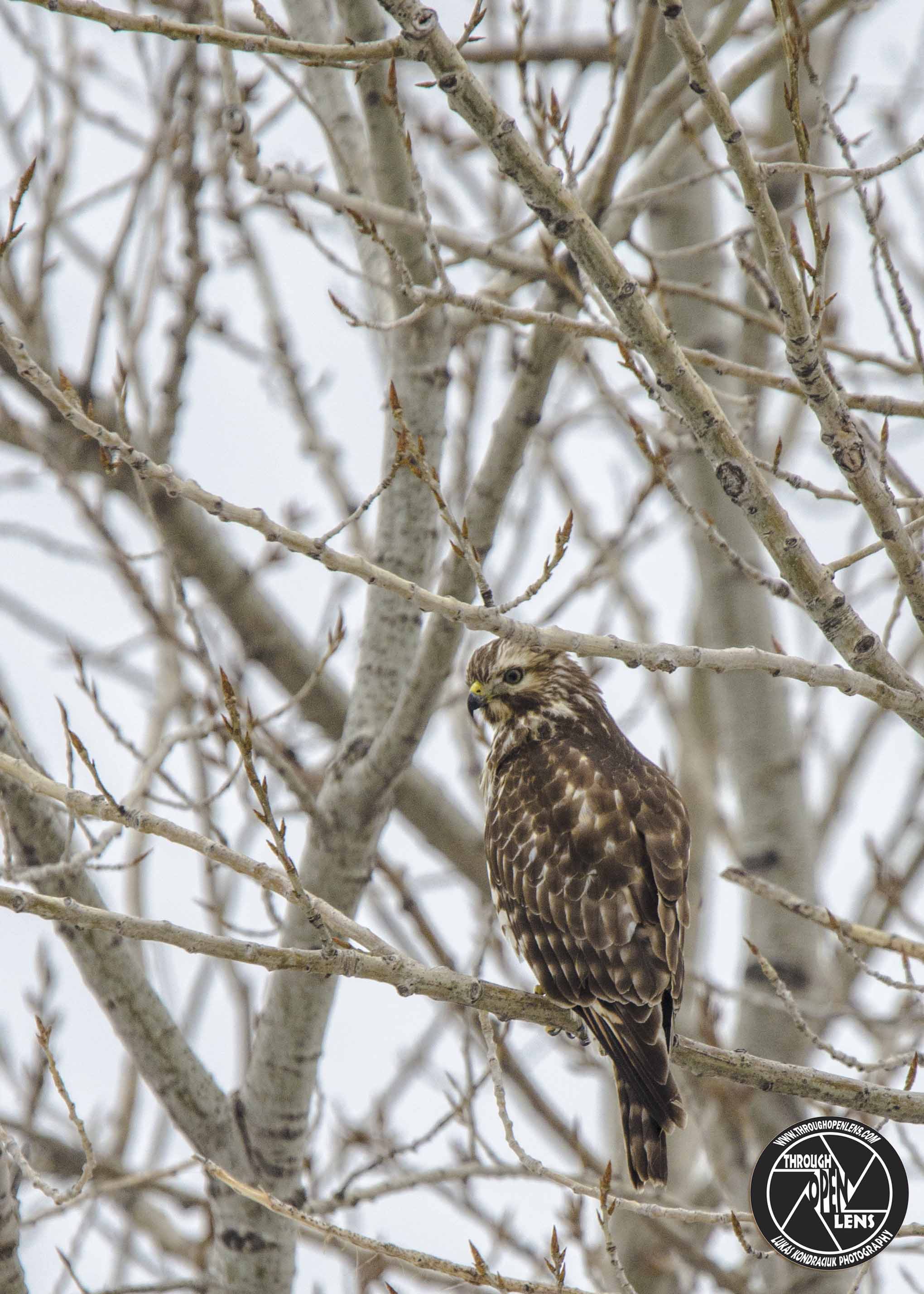
Life Always Offers You A Second Chance. It’s Called Tomorrow.

F/10.0, 1/400, ISO 250.

Tree Swallow

What did one wall say to the other wall?

Meet you at the corner!

Interesting Fact:  Tree Swallows are highly social, forming large migratory and wintering flocks; and pairs often nest close together, particularly where nest boxes are numerous. Agile fliers, Tree Swallows tend to glide more than any other swallow species. They bathe by flying low over the water and skimming their bodies against the surface, then rising quickly while shaking off droplets. ( https://www.allaboutbirds.org/guide/Tree_Swallow/lifehistory )

Admit It. You’re Waiting For Something You Know Won’t Happen.

F/6.3, 1/500, ISO 800.

Merlin

What do you get if you cross LSD with birth control?

A trip without the kids!

Interesting Fact: The name “Merlin” comes from esmerillon, the old French name for the species. Merlins used to be called “pigeon hawks” because in flight they look somewhat pigeon-like. Their species name, columbarius, is also a reference to pigeons.  ( https://www.allaboutbirds.org/guide/Merlin )


The Sky Speaks In A Thousand Colours.

F/4.5, 1/60, ISO 400.

Did you hear about the astronaut that stepped on the chewing gum?

He got stuck in orbit !

Interesting Fact: As a ray of white sunlight travels through the atmosphere to an observer, some of the colors are scattered out of the beam by air molecules and airborne particles, changing the final color of the beam the viewer sees. Because the shorter wavelength components, such as blue and green, scatter more strongly, these colors are preferentially removed from the beam. ( https://en.wikipedia.org/wiki/Sunset#Historically )


It’s Not What’s Under The Tree That Matters It’s Who’s Gathered Around It.

F/11.0, 1/500, ISO 400.

Merry Christmas And Happy Holidays To You All!

Why is Santa so jolly?

Because he knows where all the naughty girls live.

Interesting Fact: Modern Christmas trees originated during the Renaissance of early modern Germany. Its 16th-century origins are sometimes associated with Protestant Christian reformer Martin Luther, who is said to have first added lighted candles to an evergreen tree. ( https://en.wikipedia.org/wiki/Christmas_tree )

All Bridges Can Be Crossed, So Don’t Give Up!

F/10.0, 1/640, ISO 160.

Verrazano-Narrows Bridge

Why was the big cat disqualified from the race?

Because it was a cheetah.

Interesting Fact: A bridge across the Narrows had been proposed as early as 1927, when structural engineer David B. Steinman brought up the possibility of such a crossing.[3] At the time, Staten Island was isolated from the rest of New York City, and its only direct connection to the other four boroughs was via the Staten Island Ferry to South Ferry in Manhattan, or 39th and 69th Streets in Brooklyn.[4] In 1928, when the chambers of commerce in Brooklyn, Queens, Long Island, and Staten Island announced that the Interboro Bridge Company had proposed the future construction of the “Liberty Bridge” to United States Department of War. The bridge’s towers would be 800 feet (240 m) high and it would cost $60 million in 1928 dollars.[5] In November 1929, engineers released plans for the 4,500-foot (1,400 m) Liberty Bridge spanning the Narrows,[6] with 800-foot-tall towers.[7] It was hoped that the new construction would spur development on Staten Island, along with the Outerbridge Crossing and the Bayonne Bridge, which were under construction at the time. ( https://en.wikipedia.org/wiki/Verrazano-Narrows_Bridge#History

BON VOYAGE! The Rest Of Us Will Envying You While We Work.

F/11.0, 1/500, ISO 320.

New York City Skyline & Norwegian Cruise Line Ship

A very nervous first time crew member says to the skipper, “Do ships like this sink very often?”

“Not too often,” replied the skipper. “Usually it’s only once.”

Interesting Fact: The cruise line was founded as Norwegian Caribbean Line in 1966 by Knut Kloster and Ted Arison, with the 8,666-ton, 140m cruise ship/car ferry, Sunward,[5] which in 1966 operated as a car-ferry between Southampton UK and Gibraltar, for that one, short season only. Arison soon left to form Carnival Cruise Lines, while Kloster acquired additional ships for Caribbean service. Norwegian pioneered many firsts in the cruise industry like: the first Out Island Cruise, the first combined air-sea program (marketed as “Cloud 9 Cruises”) which combined low cost air fares with the cruise, first shipline to develop new ports in the Caribbean, like Ocho Rios in Jamaica. Like the original Sunward of 1966, Norwegians’s second ship, the Starward had the capability to carry automobiles through a well concealed stern door. Later, this area was turned into cabins and a two deck movie theater, which is now a casino. Norwegian was responsible for many of the cruise innovations that have now become standard throughout the industry. ( https://en.wikipedia.org/wiki/Norwegian_Cruise_Line )

I Get Knocked Down But I Get Up Again You Are Never Gonna Keep Me Down

mallard-duck

F/7.1, 1/200, ISO 250.

Mallard Duck

What did the duck say when he bought lipstick?

“Put it on my bill.”

Interesting Fact: Ducks are strong fliers; migrating flocks of Mallards have been estimated traveling at 55 miles per hour. ( https://www.allaboutbirds.org/guide/Mallard/lifehistory )

Baby Let’s Fly Away

sunset flight

F/9.0, 1/1250, ISO 100.

A day without sunshine is like, well, night.

Interesting Fact: Neglecting atmospheric refraction and the Sun’s non-zero size, whenever and wherever sunset occurs, it is always in the northwest quadrant from the March equinox to the September equinox, and in the southwest quadrant from the September equinox to the March equinox. Sunsets occur almost exactly due west on the equinoxes for all viewers on Earth. Exact calculations of the azimuths of sunset on other dates are complex, but they can be estimated with reasonable accuracy by using the analemma. ( https://en.wikipedia.org/wiki/Sunset#Historically )

Oops I Pierce The Sky!

Pierce The Sky

F/ 11.0, 1/500, ISO 100.

How much do pirates pay to get their ears pierced?

A Buccaneer!

Interesting Fact: In the field of astronomy, the sky is also called the celestial sphere. This is viewed from Earth’s surface as an imaginary dome where the sun, stars, planets, and the moon are seen to be traveling. The celestial sphere is conventionally divided into regions called constellations. Usually, the term sky is used informally as the point of view from the Earth’s surface; however, the meaning and usage can vary. In some cases, such as in discussing the weather, the sky refers to only the lower, more dense portions of the atmosphere. ( https://en.wikipedia.org/wiki/Sky )