
F/9.0, 1/320, ISO 250.
Carolina Wren
How do you drown a Hipster?
In the mainstream.
Interesting Fact: They are known to build multiple nests to confuse predators. ( http://identify.whatbird.com/obj/677/overview/Carolina_Wren.aspx )

F/9.0, 1/320, ISO 250.
Carolina Wren
How do you drown a Hipster?
In the mainstream.
Interesting Fact: They are known to build multiple nests to confuse predators. ( http://identify.whatbird.com/obj/677/overview/Carolina_Wren.aspx )
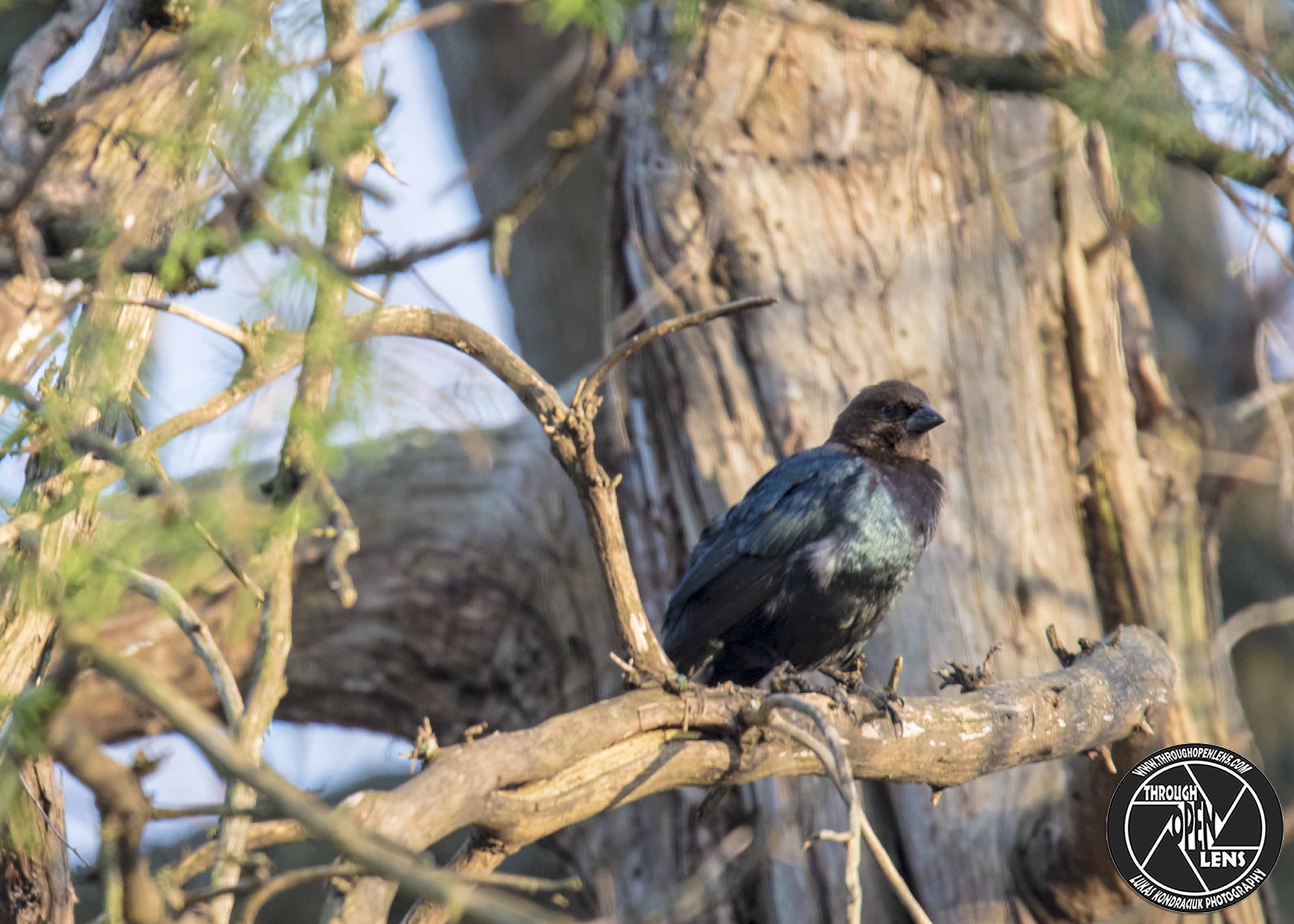
F/6.3, 1/80, ISO 500.
Brown-headed Cowbird
I’ve just opened a new restaurant called Karma.
There’s no menu, we just give you what you deserve.
Interesting Fact: The Brown-headed Cowbird is North America’s most common “brood parasite.” A female cowbird makes no nest of her own, but instead lays her eggs in the nests of other bird species, who then raise the young cowbirds. ( https://www.allaboutbirds.org/guide/Brown-headed_Cowbird )

F/6.3, 1/50, ISO 500.
Wild Turkey Male
What happened then the Turkey got into a fight?
He got the stuffing knocked out of him.
Interesting Fact: They display for females by strutting with their tails fanned, wings lowered, while making nonvocal hums and chump sounds. Males breed with multiple mates and form all-male flocks outside of the breeding season, leaving the chick-rearing to the females, The chicks travel in a family group with their mother, often combining with other family groups to form large flocks of young turkeys accompanied by two or more adult females. ( https://www.allaboutbirds.org/guide/Wild_Turkey/lifehistory )
 F/10.0, 1/400, ISO 160.
Black-capped Chickadee
What do you call a gorilla wearing ear-muffs?
Anything you like! He can’t hear you!
Interesting Fact: There is a dominance hierarchy within flocks. Some birds are “winter floaters” that don’t belong to a single flock—these individuals may have a different rank within each flock they spend time in. ( https://www.allaboutbirds.org/guide/Black-capped_Chickadee/lifehistory )

F/6.3, 1/100, ISO 500.
Wild Turkeys ( Male )
A blonde driving a car became lost in a snowstorm.
She didn’t panic however, because she remembered what her dad had once told her. “If you ever get stuck in a snowstorm, just wait for a snow plow to come by and follow it.”
Sure enough, pretty soon a snow plow came by, and she started to follow it.
She followed the plow for about forty-five minutes. Finally the driver of the truck got out and asked her what she was doing.
And she explained that her dad had told her if she ever got stuck in a snow storm, to follow a plow.
The driver nodded and said, “Well, I’m done with the Wal-Mart parking lot, do you want to follow me over to Best Buy now?”
Interesting Fact: Wild Turkeys nest on the ground in dead leaves at the bases of trees, under brush piles or thick shrubbery, or occasionally in open hayfields. ( https://www.allaboutbirds.org/guide/Wild_Turkey/lifehistory )

F/9.0, 1/320, ISO 250.
Tufted Titmouse
A husband and a wife purchased an old home in Northern New York State from two elderly sisters. Winter was fast approaching and the years first snow came early and they were concerned about the house’s lack of insulation.
“If they could live here all those years, so can we!” a husband confidently declared.
One November night the temperature plunged to below zero, and they woke up to find interior walls covered with frost.
A husband called the sisters to ask how they had kept the house warm.
After a rather brief conversation, he hung up.
“For the past 30 years,” he muttered,
“they’ve gone to Florida for the winter.”
Interesting Fact: Titmice build cup-shaped nests inside the nest cavity using damp leaves, moss and grasses, and bark strips. They line this cup with soft materials such as hair, fur, wool, and cotton, sometimes plucking hairs directly from living mammals. Naturalists examining old nests have identified raccoon, opossum, dog, fox squirrel, red squirrel, rabbit, horse, cow, cat, mouse, woodchuck, and even human hair in titmouse nests. Nest construction takes 6 to 11 days. ( https://www.allaboutbirds.org/guide/Tufted_Titmouse/lifehistory )
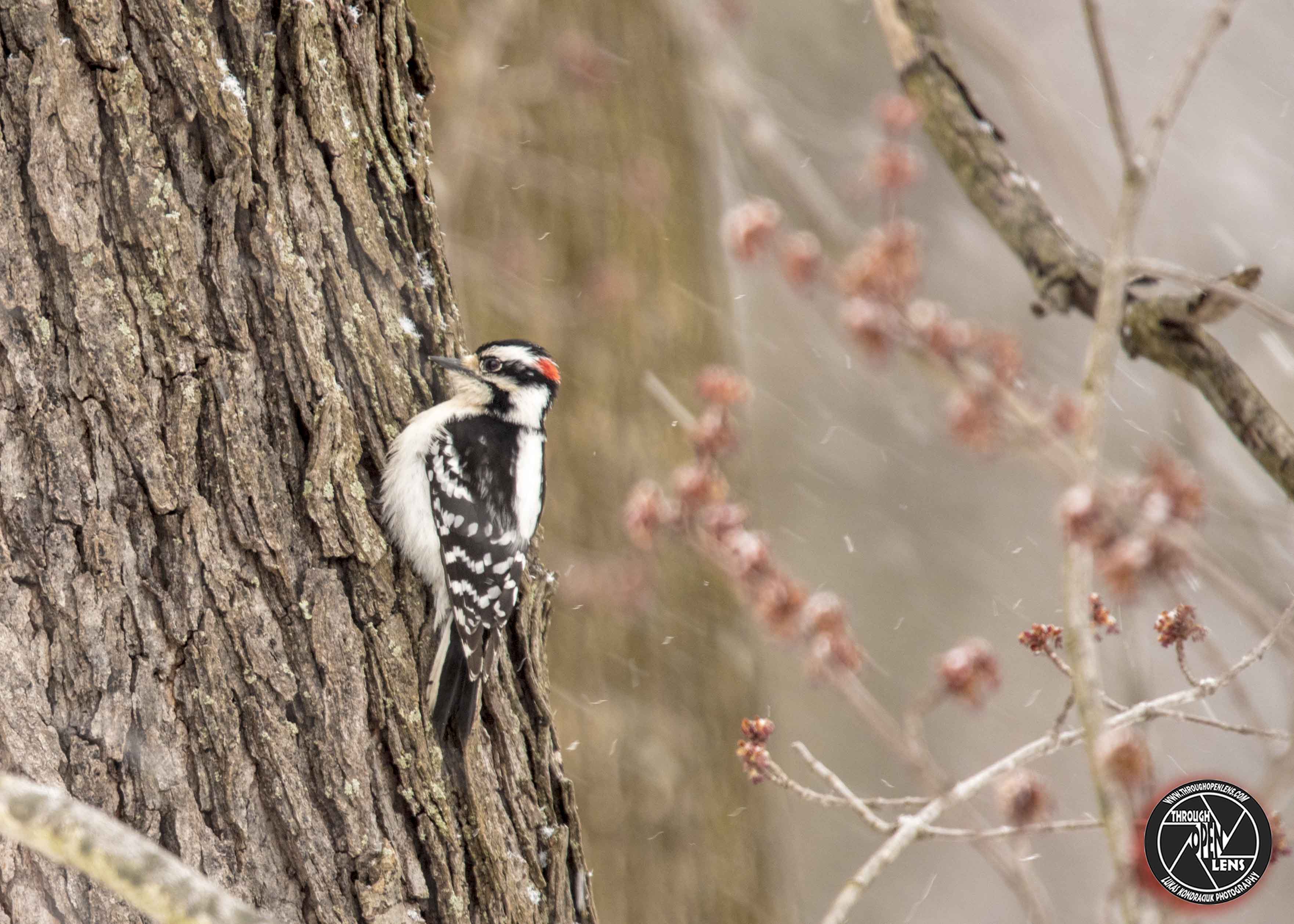
F/6.3, 1/60, 500.
Downy Woodpecker
What do snowmen eat for breakfast?
Frosted Flakes.
Interesting Fact: An active woodpecker that moves quickly over tree trunks, branches, and stems of grasses and wildflowers, characteristically leaning against its stiffened tail feathers for support. Downy Woodpeckers move horizontally and downwards on trees much more readily than most other woodpeckers. You may also see them perched atop tall weeds such as goldenrod in late summer, hammering away at a plant gall to get at the larva inside. Occasionally hops on the ground for food. ( https://www.allaboutbirds.org/guide/Downy_Woodpecker/lifehistory )

F/7.1, 1/200, ISO 250.
Blue Jay
Why is your foot more special than your other body parts?
Because they have their own soul.
Interesting Fact: Blue Jays are found in all kinds of forests but especially near oak trees; they’re more abundant near forest edges than in deep forest. They’re common in urban and suburban areas, especially where oaks or bird feeders are found. ( https://www.allaboutbirds.org/guide/Blue_Jay/lifehistory )

F/9.0, 1/320, ISO 250.
Black-capped Chickadee
“How do you shoot a killer bee?”
“With a bee bee gun.”
Interesting Fact: Adult chickadees don’t migrate. In years when chickadee reproduction is high, young birds sometimes move large distances, but these movements are irregular and are more accurately called “irruptions.”( https://www.allaboutbirds.org/guide/Black-capped_Chickadee )

F/8.0, 1/250, ISO 320.
Tufted Titmouse
Why are hairdressers never late for work?
Because they know all the short cuts!
Interesting Fact: Tufted Titmice live in deciduous woods or mixed evergreen-deciduous woods, typically in areas with a dense canopy and many tree species. They are also common in orchards, parks, and suburban areas. Generally found at low elevations, Tufted Titmice are rarely reported at elevations above 2,000 feet. ( https://www.allaboutbirds.org/guide/Tufted_Titmouse/lifehistory )
 Through Open Lens