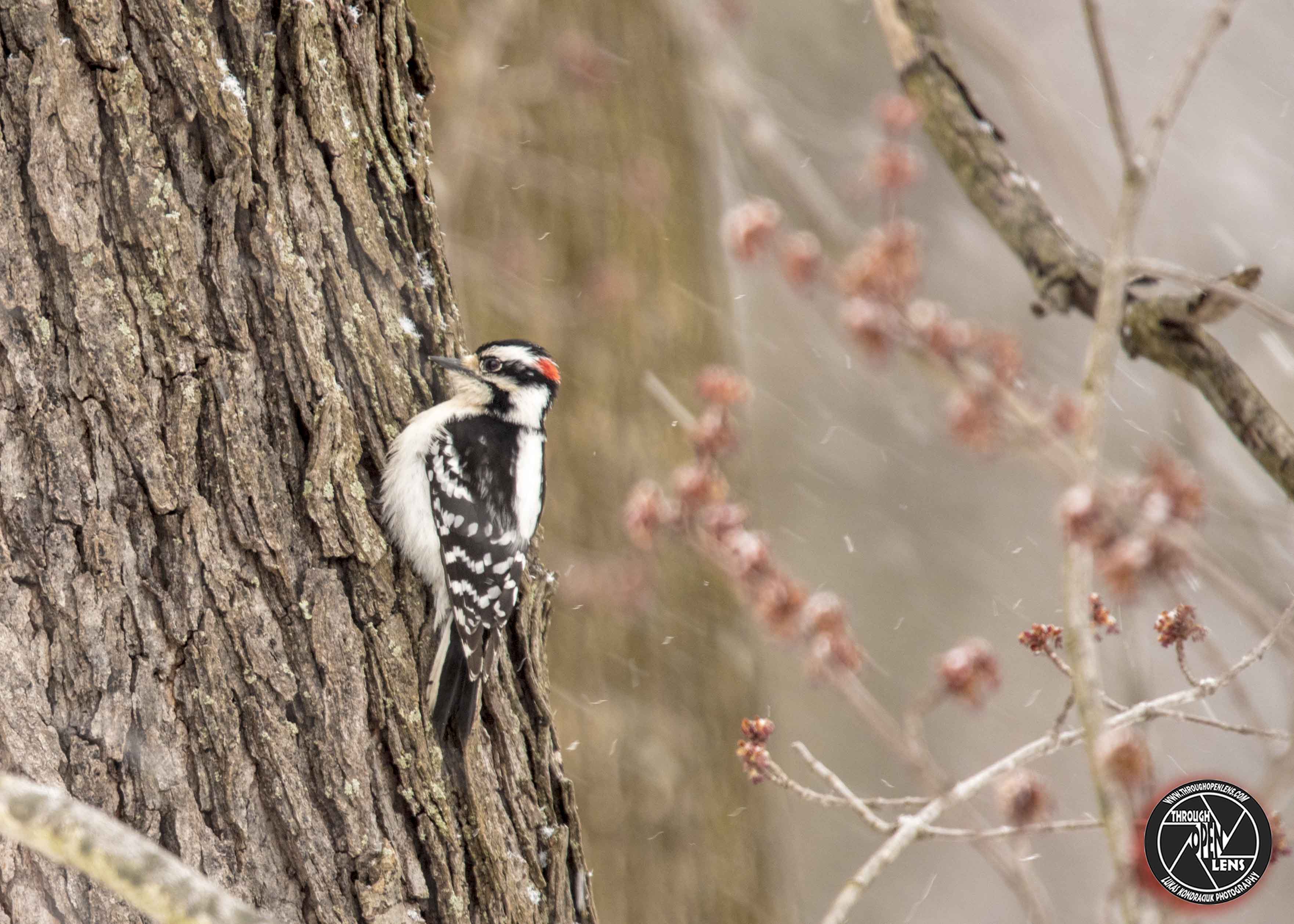
Dont Mess With Me, I Can Peck You Up!

F/9.0, 1/1250, ISO 400.

Downy Woodpecker

Teacher: Bob please point to America on the map.

Bob: This is it.

Teacher: Well done. Now class, who found America?

Class: Bob did.

Interesting Fact: Woodpeckers don’t sing songs, but they drum loudly against pieces of wood or metal to achieve the same effect. People sometimes think this drumming is part of the birds’ feeding habits, but it isn’t. In fact, feeding birds make surprisingly little noise even when they’re digging vigorously into wood. ( http://www.allaboutbirds.org/guide/downy_woodpecker/lifehistory )

Red Mean Stop And Admire!

F/6.3, 1/125, ISO 1000.

Northern Cardinal ( Male )

Did you hear the joke about the roof?

Never mind, it’s over your head!

Interesting Fact: Males sometimes bring nest material to the female, who does most of the building. She crushes twigs with her beak until they’re pliable, then turns in the nest to bend the twigs around her body and push them into a cup shape with her feet. The cup has four layers: coarse twigs (and sometimes bits of trash) covered in a leafy mat, then lined with grapevine bark and finally grasses, stems, rootlets, and pine needles. ( https://www.allaboutbirds.org/guide/Northern_Cardinal/lifehistory )

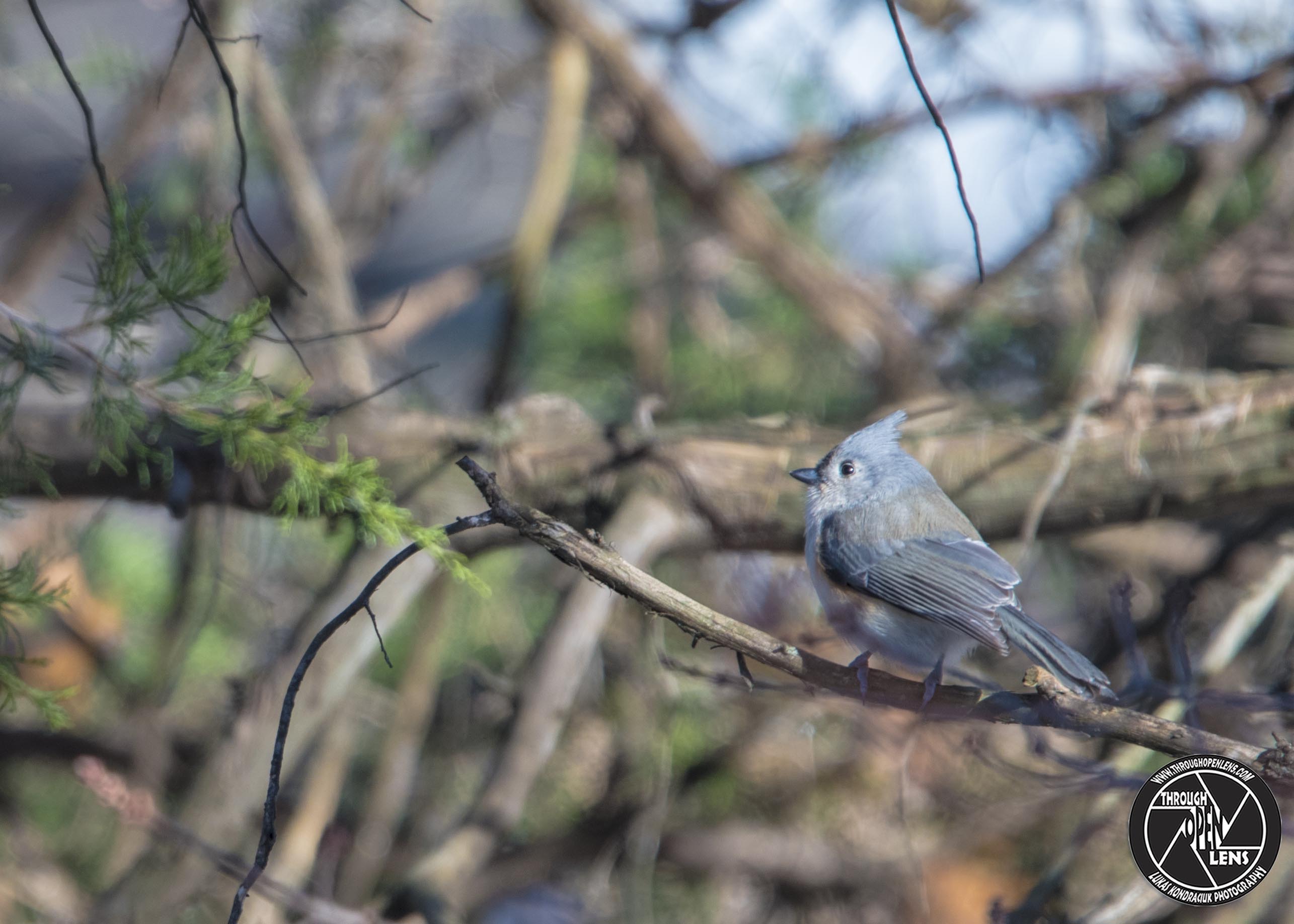
Yeah, Thats Right I Can Dunk!

F/9.0, 1/320, ISO 250.

Tufted Titmouse 

A husband and a wife purchased an old home in Northern New York State from two elderly sisters. Winter was fast approaching and the years first snow came early and they were concerned about the house’s lack of insulation.

“If they could live here all those years, so can we!” a husband confidently declared.

One November night the temperature plunged to below zero, and they woke up to find interior walls covered with frost.

A husband called the sisters to ask how they had kept the house warm.

After a rather brief conversation, he hung up.

“For the past 30 years,” he muttered,

“they’ve gone to Florida for the winter.”

Interesting Fact: Titmice build cup-shaped nests inside the nest cavity using damp leaves, moss and grasses, and bark strips. They line this cup with soft materials such as hair, fur, wool, and cotton, sometimes plucking hairs directly from living mammals. Naturalists examining old nests have identified raccoon, opossum, dog, fox squirrel, red squirrel, rabbit, horse, cow, cat, mouse, woodchuck, and even human hair in titmouse nests. Nest construction takes 6 to 11 days. (  https://www.allaboutbirds.org/guide/Tufted_Titmouse/lifehistory )

Stop Knocking And Come In Its Snowing Out There

F/6.3, 1/60, 500.

Downy Woodpecker

What do snowmen eat for breakfast?

Frosted Flakes.

Interesting Fact: An active woodpecker that moves quickly over tree trunks, branches, and stems of grasses and wildflowers, characteristically leaning against its stiffened tail feathers for support. Downy Woodpeckers move horizontally and downwards on trees much more readily than most other woodpeckers. You may also see them perched atop tall weeds such as goldenrod in late summer, hammering away at a plant gall to get at the larva inside. Occasionally hops on the ground for food.  ( https://www.allaboutbirds.org/guide/Downy_Woodpecker/lifehistory )


Wait, What Did You Said?

F/7.1, 1/200, ISO 250.

Blue Jay

Why is your foot more special than your other body parts?

Because they have their own soul.

Interesting Fact: Blue Jays are found in all kinds of forests but especially near oak trees; they’re more abundant near forest edges than in deep forest. They’re common in urban and suburban areas, especially where oaks or bird feeders are found. ( https://www.allaboutbirds.org/guide/Blue_Jay/lifehistory )

So, You Are The Quiet Type, I Like That.

F/9.0, 1/320, ISO 250.

Black-capped Chickadee 

“How do you shoot a killer bee?”

“With a bee bee gun.”

Interesting Fact: Adult chickadees don’t migrate. In years when chickadee reproduction is high, young birds sometimes move large distances, but these movements are irregular and are more accurately called “irruptions.”( https://www.allaboutbirds.org/guide/Black-capped_Chickadee )


Say What?!

F/8.0, 1/250, ISO 320.

Tufted Titmouse

Why are hairdressers never late for work?

Because they know all the short cuts!

Interesting Fact: Tufted Titmice live in deciduous woods or mixed evergreen-deciduous woods, typically in areas with a dense canopy and many tree species. They are also common in orchards, parks, and suburban areas. Generally found at low elevations, Tufted Titmice are rarely reported at elevations above 2,000 feet. ( https://www.allaboutbirds.org/guide/Tufted_Titmouse/lifehistory )


He Can Be A Real Pecker !

red-bellied-woodpecker-1

F/ 6.3, 1/125, ISO 1100.

Red-Bellied Woodpecker

An New York woodpecker and a Florida woodpecker were in New York arguing about which state had the toughest trees to peck. The New Yorker

woodpecker said that they had a tree there that no woodpecker can peck.

The Florida woodpecker challenged him and was able to peck a hole in the tree with no problem. The New Yorker woodpecker was in awe!

The Florida woodpeck then challenged the New Yorker woodpecker to come to Florida and try to peck this certain tree there that no woodpecker had

ever been able to peck successfully.

The NewYorker woodpecker said he was sure he would be able to do it. So, after flying down to Florida, he successfully pecked the tree!

The two woodpeckers then had a discussion about why they were each unable to peck those trees in their own states. After thinking about this problem

for some time, they both came to the same conclusion: “Your pecker is always harder when you’re away from home…”


Interesting Fact: You may sometimes see Red-bellied Woodpeckers wedge large nuts into bark crevices, then whack them into manageable pieces using their beaks. They also use cracks in trees and fence posts to store food for later in the year, a habit it shares with other woodpeckers in its genus. ( https://www.allaboutbirds.org/guide/Red-bellied_Woodpecker/lifehistory )


I Had A Dream I Was A Muffler And I Woke Up Exhausted.

F/7.1, 1/200, ISO 250.

Tufted Titmouse

Want to hear a dirty joke?

A kid jumped into a mud puddle.

Want to hear a clean joke?

A kid jumped into the bath.

Interesting Fact:  Tufted Titmice nest in cavities but aren’t able to excavate them on their own. They use natural holes and old nest holes made by several woodpecker species, including large species such as Pileated Woodpecker and Northern Flicker. Additionally, Tufted Titmice also nest in artificial structures including nest boxes, fenceposts, and metal pipes. ( https://www.allaboutbirds.org/guide/Tufted_Titmouse/lifehistory )

Point Of View

white-breasted-nuthatch

F/8.0, 1/250, ISO 320.

White-breasted Nuthatch

How do you keep from getting cold feet?

Don’t go around BRRfooted!

Interesting Fact:  If you see a White-breasted Nuthatch making lots of quick trips to and from your feeder – too many for it to be eating them all – it may be storing the seeds for later in the winter, by wedging them into furrows in the bark of nearby trees. ( https://www.allaboutbirds.org/guide/White-breasted_Nuthatch/lifehistory )