
F/8.0, 1/250, ISO 100.
How do you know if there’s a snowman in your bed?
You wake up wet!
Interesting Fact: Snow forms when water vapor in the atmosphere freezes into ice crystals.

F/8.0, 1/250, ISO 100.
How do you know if there’s a snowman in your bed?
You wake up wet!
Interesting Fact: Snow forms when water vapor in the atmosphere freezes into ice crystals.

F/9.0, 1/320, ISO 400.
Black-Capped Chickadee
Did you hear about the actor who fell through the floorboards?
He was just going through a stage.
Interesting Fact: Every autumn Black-capped Chickadees allow brain neurons containing old information to die, replacing them with new neurons so they can adapt to changes in their social flocks and environment even with their tiny brains. ( https://www.allaboutbirds.org/guide/Black-capped_Chickadee/lifehistory )

F/13.0, 6.0, ISO 100.

F/5.6, 1/500, ISO 200.
Greater Yellowlegs
What did the pig say on a hot summer day?
I’m bacon!
Interesting Fact: Greater Yellowlegs eats small aquatic and terrestrial invertebrates, small fish, frogs, and occasionally seeds and berries. ( https://www.allaboutbirds.org/guide/Greater_Yellowlegs/lifehistory )

F/5.6, 1/500, ISO 100.
Mallard Ducks
What season is it when you are on a trampoline?
Spring time.
Interesting Fact: Mallards are generalist foragers and will eat a wide variety of food. They don’t dive, but dabble to feed, tipping forward in the water to eat seeds and aquatic vegetation. They also roam around on the shore and pick at vegetation and prey on the ground. During the breeding season, they eat mainly animal matter including aquatic insect larvae, earthworms, snails and freshwater shrimp. During migration, many Mallards consume largely agricultural seed and grain. In city parks, they readily accept handouts from parkgoers. ( https://www.allaboutbirds.org/guide/Mallard/lifehistory )

F/4.0, 1/60, ISO 800.
Why don’t dogs make good dancers?
Because they have two left feet!
Interesting Fact: Archeological evidence for early dance includes 9,000-year-old paintings in India at the Rock Shelters of Bhimbetka, and Egyptian tomb paintings depicting dancing figures, dated c. 3300 BC. It has been proposed that before the invention of written languages, dance was an important part of the oral and performance methods of passing stories down from generation to generation.[5] The use of dance in ecstatic trance states and healing rituals (as observed today in many contemporary “primitive” cultures, from the Brazilian rainforest to the Kalahari Desert) is thought to have been another early factor in the social development of dance. ( https://en.wikipedia.org/wiki/Dance#Origins )
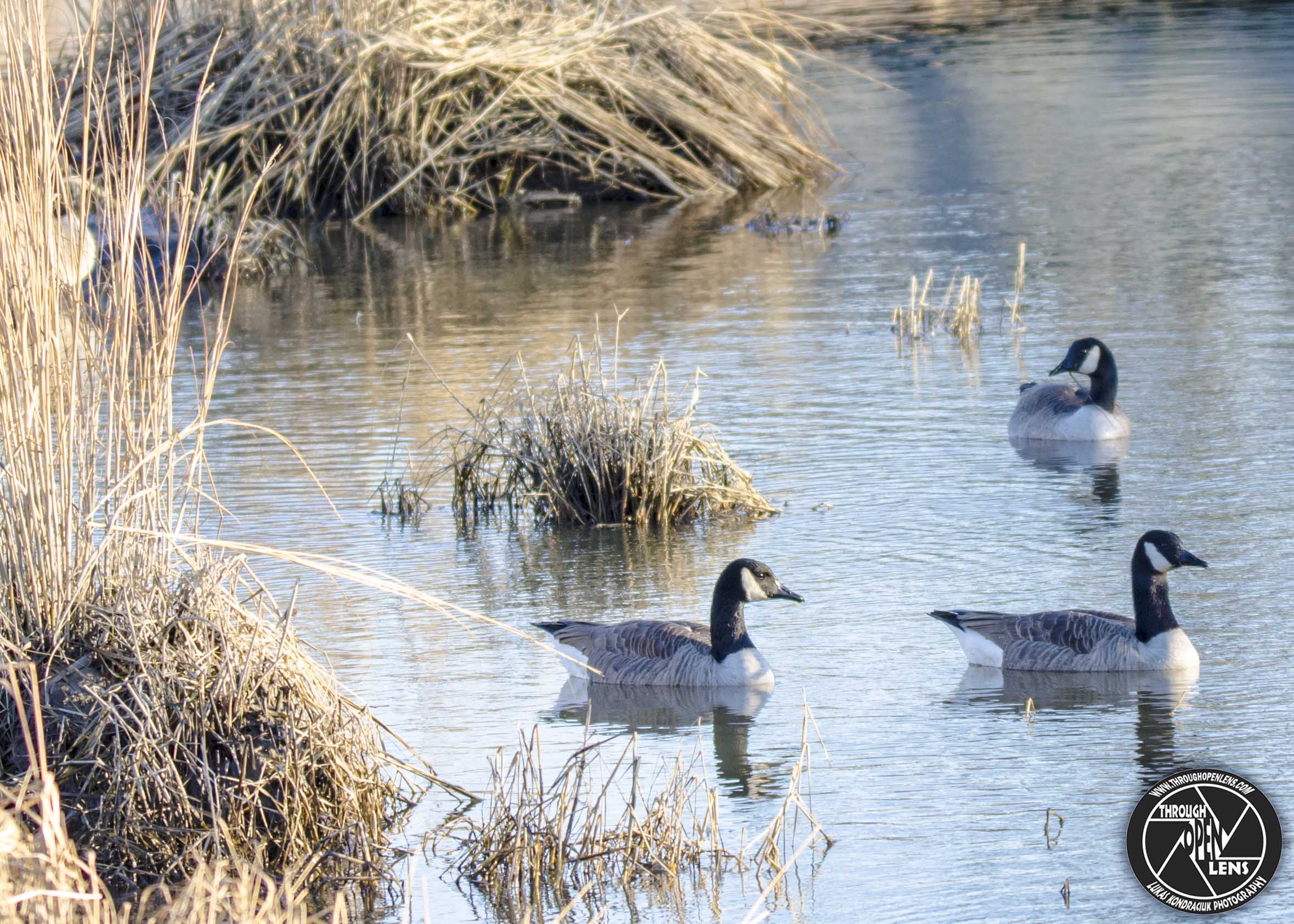
F/5.0, 1/400, ISO 400.
Cackling Goose
What did the 30 degree angle say to the 90 degree angle?
“You think you’re always right!”
Interesting Fact: The Cackling Goose was long considered just a small race of the Canada Goose. The smallest four of the eleven recognized races were recently determined to be distinct enough to be their own species. Cackling Goose includes the races known as Taverner’s, Richardson’s, Aleutian, and Cackling geese. Confusingly, the “Lesser Canada Goose” is still a race of the Canada Goose. ( https://www.allaboutbirds.org/guide/Cackling_Goose/lifehistory )
Happy Valentine’s Day!

F/9.0, 1/320, ISO 100.
Mallard
Girl: “I can’t be your valentine for medical reasons.”
Boy: “Really?”
Girl: “Yeah, you make me sick!”
Interesting Fact: Numerous early Christian martyrs were named Valentine.[11] The Valentines honored on February 14 are Valentine of Rome (Valentinus presb. m. Romae) and Valentine of Terni (Valentinus ep. Interamnensis m. Romae).[12] Valentine of Rome was a priest in Rome who was martyred in 269 and was added to the calendar of saints by Pope Galesius in 496 and was buried on the Via Flaminia. The relics of Saint Valentine were kept in the Church and Catacombs of San Valentino in Rome, which “remained an important pilgrim site throughout the Middle Ages until the relics of St. Valentine were transferred to the church of Santa Prassede during the pontificate of Nicholas IV“.[13][14] The flower-crowned skull of Saint Valentine is exhibited in the Basilica of Santa Maria in Cosmedin, Rome. Other relics are found at Whitefriar Street Carmelite Church in Dublin, Ireland. ( https://en.wikipedia.org/wiki/Valentine%27s_Day#History )

F/16.0, 30, ISO 100, Photoshop CS6.
On New Year’s Eve, Jenny stood up in the local pub and said that it was time to get ready.
At the stroke of midnight, she wanted every husband to be standing next to the one person who made his life worth living.
Well, it was kind of embarrassing. As the clock struck – the bartender was almost crushed to death.
Interesting Fact: During the Roman Republic and the Roman Empire years began on the date on which each consul first entered office. This was probably 1 May before 222 BC, 15 March from 222 BC to 154 BC,[7] and 1 January from 153 BC.[8] In 45 BC, when Julius Caesar‘s new Julian calendar took effect, the Senate fixed 1 January as the first day of the year. At that time, this was the date on which those who were to hold civil office assumed their official position, and it was also the traditional annual date for the convening of the Roman Senate. This civil new year remained in effect throughout the Roman Empire, east and west, during its lifetime and well after, wherever the Julian calendar continued in use. ( https://en.wikipedia.org/wiki/New_Year#Historical_European_new_year_dates )

 Through Open Lens