Oh Stop, You Making Me Blush!

F/6.3, 1/160, ISO 500.

House Finch

What did one hat say to another? 

You stay here, I’ll go on a head.

Interesting Fact: House Finches nest in a variety of deciduous and coniferous trees as well as on cactus and rock ledges. They also nest in or on buildings, using sites like vents, ledges, street lamps, ivy, and hanging planters. Occasionally House Finches use the abandoned nests of other birds. ( https://www.allaboutbirds.org/guide/House_Finch/lifehistory )

Holy Smokes Batman Your Zipper Is Down!

F/9.0, 1/320, ISO 250.

American Robin

What happens when Batman and Robin fight a steamroller?

They become Flatman and Ribbon.

Interesting Fact: Although robins are considered harbingers of spring, many American Robins spend the whole winter in their breeding range. But because they spend more time roosting in trees and less time in your yard, you’re much less likely to see them. The number of robins present in the northern parts of the range varies each year with the local conditions. ( https://www.allaboutbirds.org/guide/American_Robin/lifehistory )

You looking at me? Owl Do Something About It!

F/6.3, 1/50, ISO 400.

Great Horned Owlets

What do you call an owl get together?

A HOO-tenanny

Interesting Fact: When clenched, a Great Horned Owl’s strong talons require a force of 28 pounds to open. The owls use this deadly grip to sever the spine of large prey. ( https://www.allaboutbirds.org/guide/Great_Horned_Owl/lifehistory )


It’s Monday Don’t Forget To Be Awesome!

F/ 7.1, 1/200, ISO 250.

Northern Cardinal ( Female )

My neighbor is really into music.

Even his driveway is hard rock.

Interesting Fact: Many people are perplexed each spring by the sight of a cardinal attacking its reflection in a window, car mirror, or shiny bumper. Both males and females do this, and most often in spring and early summer when they are obsessed with defending their territory against any intruders. Birds may spend hours fighting these intruders without giving up. A few weeks later, as levels of aggressive hormones subside, these attacks should end (though one female kept up this behavior every day or so for six months without stopping).  ( http://www.allaboutbirds.org/guide/Northern_Cardinal/lifehistory )

I Had A Very Unhappy Egghood…

F/5.6, 1/125, ISO 200.

Helmeted guineafowl

Why was the man running around his bed?

He wanted to catch up on his sleep.

Interesting Fact: The helmeted guineafowl (Numida meleagris) is the best known of the guineafowl bird family, Numididae, and the only member of the genus Numida. It is native to Africa, mainly south of the Sahara, and has been widely introduced into the West Indies, Brazil, Australia and Europe (e.g. southern France).  ( https://en.wikipedia.org/wiki/Helmeted_guineafowl )

I Am Looking Up To You!

F/5.6, 1/500, ISO 320.

Elegant Tern

How do you organize an outer space party?

You planet.

Interesting Fact: The oldest recorded Elegant Tern was at least 20 years, 11 months old when it was found in California in 2010, the same state where it had been banded in 1989. ( https://www.allaboutbirds.org/guide/Elegant_Tern )

His Feathers Didn’t Go Up, But They Have A Pill For That.

F/5.6, 1/60, ISO 320.

Peafowl

Did you hear the story about the peacock?

It’s a beautiful tail.

Interesting Fact: Peafowl are forest birds that nest on the ground, but roost in trees. They are terrestrial feeders. All species of peafowl are believed to be polygamous. In common with other members of the Galliformes, the males possess metatarsal spurs or “thorns” on their legs used during intraspecific territorial fights with other members of their kind. ( https://en.wikipedia.org/wiki/Peafowl#Behaviour )

If People Are Talking About You Behind Your Back, Then Just Fart!

F/6.3, 1/60, ISO 500.

Ovenbird

Why did the apple run away?

Because the banana split!

Interesting Fact: The Ovenbird gets its name from its covered nest. The dome and side entrance make it resemble a Dutch oven. ( https://www.allaboutbirds.org/guide/Ovenbird/overview )

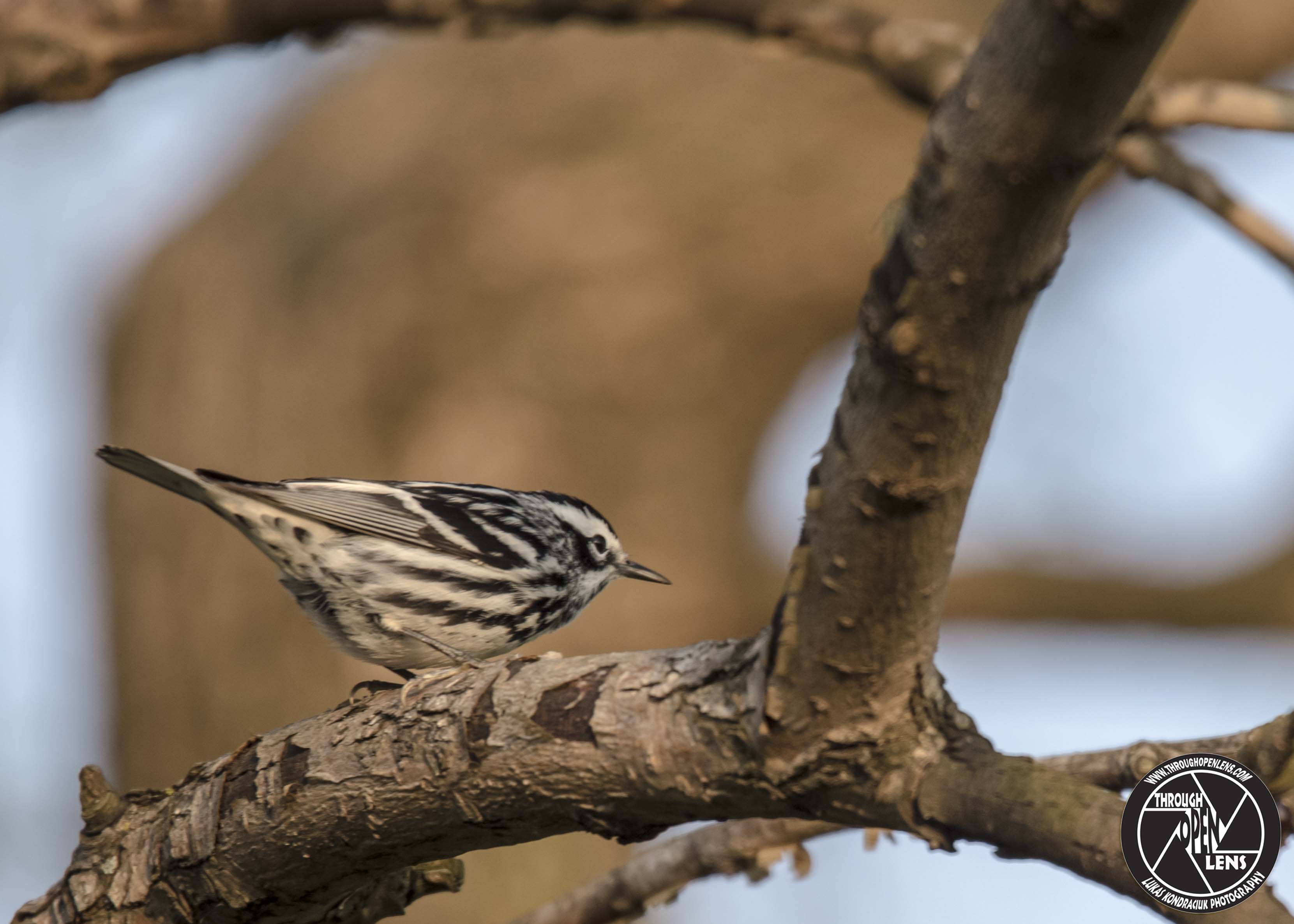
I Have A Audition For A Zebra.

F/7.1, 1/200, ISO 320.

Black-and-white Warbler 

Why are ghosts such good cheerleaders?

Because they have a lot of spirit!

Interesting Fact: The female Black-and-white Warbler selects a well-hidden nesting location at the base of a tree, rock, stump, or fallen log, or under a bush or shrub. Nests are usually built on the ground but occasionally are placed in a cavity atop a tree stump, in a rock crevice, or on a mossy bank up to six feet high. ( https://www.allaboutbirds.org/guide/Black-and-white_Warbler/lifehistory )

The Deeper You Look The Better The Treasure.

F/7.1, 1/200, ISO 500.

Yellow Warbler

What did the judge say when a skunk walked into the courtroom?

“Odor in the court!”

Interesting Fact: Yellow Warblers build their nests in the vertical fork of a bush or small tree such as willow, hawthorn, raspberry, white cedar, dogwood, and honeysuckle. The nest is typically within about 10 feet of the ground but occasionally up to about 40 feet.  ( https://www.allaboutbirds.org/guide/Yellow_Warbler/lifehistory )