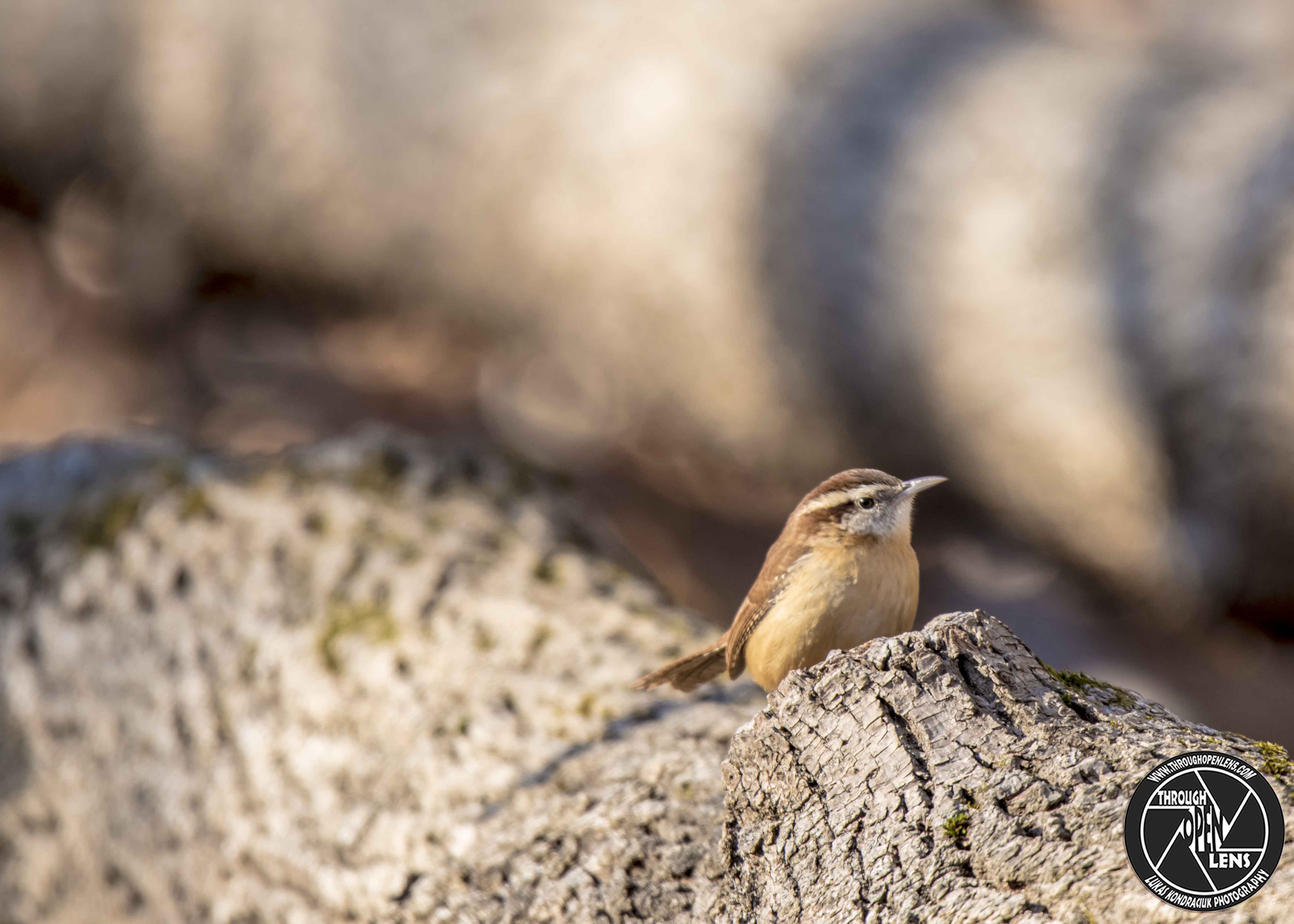
Here I Am Rock You Like A Hurricane!

F/8.0, 1/125, ISO 400.

Carolina Wren

What did one autumn leaf say to the other?

I’m falling for you.

Interesting Fact: They climb up vines, trunks, and branches, poking into squirrel nests and probing nooks and crannies in search of insects. Carolina Wrens use their curved bills to turn over decaying vegetation and to hammer and shake apart large bugs. They roost in bird boxes, abandoned hornet nests, hanging plants, garages, barns, old nests, and other shelters. A weak flyer, this wren makes brief, quick aerial forays over short distances. Pairs stay bonded year-round, with no vacation from singing or defending territory. ( https://www.allaboutbirds.org/guide/Carolina_Wren/lifehistory )

Don’t Look Back With Regret, Look Foward With Hope.

F/10.0, 1/400, ISO 160.

Black-capped Chickadee

What do you call a gorilla wearing ear-muffs?

Anything you like! He can’t hear you!

Interesting Fact: There is a dominance hierarchy within flocks. Some birds are “winter floaters” that don’t belong to a single flock—these individuals may have a different rank within each flock they spend time in. ( https://www.allaboutbirds.org/guide/Black-capped_Chickadee/lifehistory

Music Helps Me Escape From The Reality I Live In

F/6.3, 1/320, ISO 400.

Song Sparrow

What did the Mummy movie director say when the final scene was done?

Ok, that’s a wrap.

Interesting Fact:  Some scientists think that Song Sparrows of wet, coastal areas have darker plumage as a defense against feather mites and other decay agents that thrive in humid climates. The darker plumage contains more of a pigment called melanin, which makes feathers tougher and harder to degrade than lighter, unpigmented feathers. ( https://www.allaboutbirds.org/guide/Song_Sparrow/lifehistory )

You’ll Never Find A Rainbow If You’re Looking Down.

F/8.0, 1/125, ISO 125.

White-breasted Nuthatch

What do bulls do when they go shopping?

They CHARGE!

Interesting Fact:  White-breasted Nuthatches typically build their nests in natural tree cavities or abandoned woodpecker holes. They sometimes enlarge these holes but rarely excavate them entirely on their own (as Red-breasted Nuthatches often do). Nuthatches are smaller than woodpeckers, and White-breasted Nuthatches don’t seem bothered by nest holes considerably larger than they are. Despite their association with deciduous woods, they nest in both coniferous and deciduous trees. White-breasted Nuthatches sometimes use nest boxes. ( https://www.allaboutbirds.org/guide/White-breasted_Nuthatch/lifehistory

If Money Is Made Out Of Paper, Doesn’t That mean money Grows on Trees?

F/9.0, 1/320, ISO 320.

Brown Creeper

What do you do when two snails have a fight?

Leave them to slug it out!

Interesting Fact: Sometimes creepers build nests in unusual places, such as behind window shutters, in or under roofs, inside fenceposts, or inside concrete blocks. One brought up a family in a specially constructed box made of pieces of Douglas-fir bark. ( https://www.allaboutbirds.org/guide/Brown_Creeper/lifehistory )

Don’t Be A Creep!

F/8.0, 1/250, ISO 320.

Brown Creeper

Past, present and future walk into a bar.

It was tense!

Interesting Fact: The Brown Creeper spends most of its time spiraling up tree trunks in search of insects. It holds its short legs on either side of its body, with the long, curved claws hooking into the bark, and braces itself with its long, stiff tail. Both feet hop at the same time, making the bird’s head duck after each hop. Because of its specialized anatomy, the Brown Creeper rarely climbs downward: once high in a tree, it flies down to begin a new ascent at the base of a nearby tree. ( https://www.allaboutbirds.org/guide/Brown_Creeper/lifehistory )

Red Mean Stop And Admire!

F/6.3, 1/125, ISO 1000.

Northern Cardinal ( Male )

Did you hear the joke about the roof?

Never mind, it’s over your head!

Interesting Fact: Males sometimes bring nest material to the female, who does most of the building. She crushes twigs with her beak until they’re pliable, then turns in the nest to bend the twigs around her body and push them into a cup shape with her feet. The cup has four layers: coarse twigs (and sometimes bits of trash) covered in a leafy mat, then lined with grapevine bark and finally grasses, stems, rootlets, and pine needles. ( https://www.allaboutbirds.org/guide/Northern_Cardinal/lifehistory )

Yeah, Thats Right I Can Dunk!

F/9.0, 1/320, ISO 250.

Tufted Titmouse 

A husband and a wife purchased an old home in Northern New York State from two elderly sisters. Winter was fast approaching and the years first snow came early and they were concerned about the house’s lack of insulation.

“If they could live here all those years, so can we!” a husband confidently declared.

One November night the temperature plunged to below zero, and they woke up to find interior walls covered with frost.

A husband called the sisters to ask how they had kept the house warm.

After a rather brief conversation, he hung up.

“For the past 30 years,” he muttered,

“they’ve gone to Florida for the winter.”

Interesting Fact: Titmice build cup-shaped nests inside the nest cavity using damp leaves, moss and grasses, and bark strips. They line this cup with soft materials such as hair, fur, wool, and cotton, sometimes plucking hairs directly from living mammals. Naturalists examining old nests have identified raccoon, opossum, dog, fox squirrel, red squirrel, rabbit, horse, cow, cat, mouse, woodchuck, and even human hair in titmouse nests. Nest construction takes 6 to 11 days. (  https://www.allaboutbirds.org/guide/Tufted_Titmouse/lifehistory )

Wait, What Did You Said?

F/7.1, 1/200, ISO 250.

Blue Jay

Why is your foot more special than your other body parts?

Because they have their own soul.

Interesting Fact: Blue Jays are found in all kinds of forests but especially near oak trees; they’re more abundant near forest edges than in deep forest. They’re common in urban and suburban areas, especially where oaks or bird feeders are found. ( https://www.allaboutbirds.org/guide/Blue_Jay/lifehistory )

So, You Are The Quiet Type, I Like That.

F/9.0, 1/320, ISO 250.

Black-capped Chickadee 

“How do you shoot a killer bee?”

“With a bee bee gun.”

Interesting Fact: Adult chickadees don’t migrate. In years when chickadee reproduction is high, young birds sometimes move large distances, but these movements are irregular and are more accurately called “irruptions.”( https://www.allaboutbirds.org/guide/Black-capped_Chickadee )