Double Check!

F/5.6, 1/1600, ISO 400.

Mute Swan

What did the digital clock say to his mother?

Look ma, no hands!

Interesting Fact: All of the Mute Swans in North America descended from swans imported from Europe from the mid 1800s through early 1900s to adorn large estates, city parks, and zoos. Escapees established breeding populations and are now established in the Northeast, Midatlantic, Great Lakes, and Pacific Northwest of the U.S. ( https://www.allaboutbirds.org/guide/Mute_Swan )

Just Be Free!

F/10.0, 1/400, ISO 250.

Wild Turkeys 

What animal should you never play cards with?

A cheetah.

Interesting Fact: Because of their large size, compact bones, and long-standing popularity as a dinner item, turkeys have a better known fossil record than most other birds. Turkey fossils have been unearthed across the southern United States and Mexico, some of them dating from more than 5 million years ago. ( https://www.allaboutbirds.org/guide/Wild_Turkey/lifehistory )


I Just Love The Way I Feel, Hmmm.

F/11.0, 1/500, ISO 200.

Mute Swan

What do clouds do when they become rich?

They make it rain!

Interesting Fact: Mute Swans form long-lasting pair bonds. Their reputation for monogamy along with their elegant white plumage has helped establish them as a symbol of love in many cultures. ( https://www.allaboutbirds.org/guide/Mute_Swan/lifehistory )

When I Was Born I Was So Surprised I Didn’t Talk For A Year And Half

F/5.6, 1/800, ISO 250.

White-throated Sparrow

What do you call a fake noodle?

An Impasta

Interesting Fact:  White-throated Sparrows eat mainly the seeds of grasses and weeds, including ragweed and buckwheat, as well as fruits of sumac, grape, cranberry, mountain ash, rose, blueberry, blackberry, and dogwood. In summer they eat large numbers of insects that they catch on the forest floor or, occasionally on quick flights out from low vegetation. These include dragonflies, wasps, stinkbugs, beetles, flies, and caterpillars, as well as spiders, millipedes, centipedes, and snails. Parents feed their nestlings almost exclusively animal matter. During winter, White-throated Sparrows readily visit bird feeders for millet and black oil sunflower seeds. In spring they eat the tender buds, blossoms, and young seeds of oak, apple, maple, beech, and elm. ( https://www.allaboutbirds.org/guide/White-throated_Sparrow/lifehistory )


Life Is Better When You’re Laughing

F/11.0, 1/500, ISO 320.

Laughing Gull  

Why do hamburgers go to the gym?

To get better buns

Interesting Fact: The Laughing Gull is normally diurnal, or active during the day. During the breeding season it forages at night as well. It usually looks for food along the beach at night, but will also hover to catch insects around lights. ( https://www.allaboutbirds.org/guide/Laughing_Gull/lifehistory )


I See You Watching Me!

brown-thrasher

F/6.3, 1/160, ISO 320.

Brown Thrasher

A bird was flying south for Winter, but he had left it too late and was frozen solid in a storm. He dropped down into a pasture of cows. The biggest, fattest cow was doing a crap there, and the bird landed in it.

At first he was disgusted, until he realised the poo was thawing him out! He started crying out for joy as the ice melted. A cat that was nearby heard the cries, walked over, saw the bird and ate it

There are three morals to this story:

1. Not everyone who gets you into sh*t is your enemy

2. Not everyone who gets you out of sh*t is your friend

3. If you are in s#!t, keep your mouth shut

Interesting Fact: Brown Thrashers are accomplished songsters that may sing more than 1,100 different song types and include imitations of other birds, including Chuck-will’s-widows, Wood Thrushes, and Northern Flickers. ( https://www.allaboutbirds.org/guide/Brown_Thrasher/lifehistory )

I Was Going To Give You A Nesty Look… But I See You Already Have One…

osprey-1

F/7.1, 1/800, ISO 200.

Osprey

Why doesn’t Dracula have any friends?

Because he is a pain in the neck.

Interesting Fact: An Osprey may log more than 160,000 migration miles during its 15-to-20-year lifetime. Scientists track Ospreys by strapping lightweight satellite transmitters to the birds’ backs. The devices pinpoint an Osprey’s location to within a few hundred yards and last for 2-3 years. During 13 days in 2008, one Osprey flew 2,700 miles—from Martha’s Vineyard, Massachusetts, to French Guiana, South America.  ( https://www.allaboutbirds.org/guide/Osprey/lifehistory )

Will You Be My Valentine?!

F/6.3, 1/1000, ISO 450.

Mute Swan

What do you call a funny chicken?

A comedi-hen

Interesting Fact: Mute Swans form long-lasting pair bonds. Their reputation for monogamy along with their elegant white plumage has helped establish them as a symbol of love in many cultures. ( https://www.allaboutbirds.org/guide/Mute_Swan/lifehistory )

Bonus Valentine Facts:  Feb. 14 was officially designated St. Valentine’s Day in 1537 by King Henry VII of England. ( http://www.ibtimes.com/valentines-day-facts-history-fun-ideas-free-burritos-singles-awareness-other-things-1813226 )

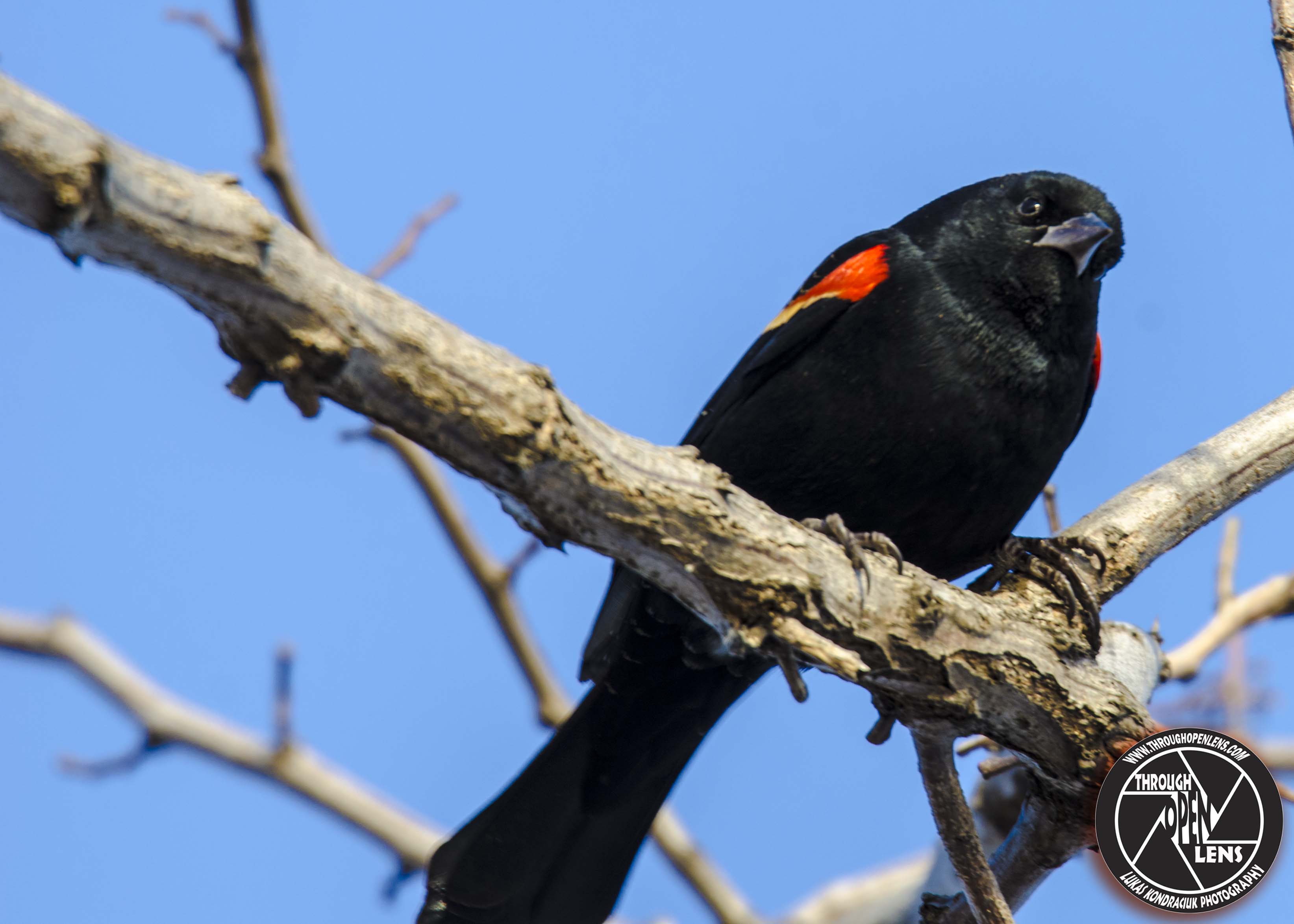
Sometimes What You Looking For Comes When You’re Not Looking At All.

red-winged-blackbird

F/8.0, 1/125, ISO 180.

Red-winged Blackbird

Why can’t you tell an egg a joke?

Because it will crack up

Interesting Fact: Male Red-winged Blackbirds fiercely defend their territories during the breeding season, spending more than a quarter of daylight hours in territory defense. He chases other males out of the territory and attacks nest predators, sometimes going after much larger animals, including horses and people. ( https://www.allaboutbirds.org/guide/Red-winged_Blackbird/lifehistory )

Which Way Did He Go, George? Which Way Did He Go?

european-starlings

F/10.0, 1/400, ISO 320.

European Starlings

What’s a good snowing tip?

Never catch snowflakes with your tongue until all the birds have gone south for the winter.

Interesting Fact: All the European Starlings in North America descended from 100 birds set loose in New York’s Central Park in the early 1890s. The birds were intentionally released by a group who wanted America to have all the birds that Shakespeare ever mentioned. It took several tries, but eventually the population took off. Today, more than 200 million European Starlings range from Alaska to Mexico, and many people consider them pests.  ( https://www.allaboutbirds.org/guide/European_Starling/lifehistory )