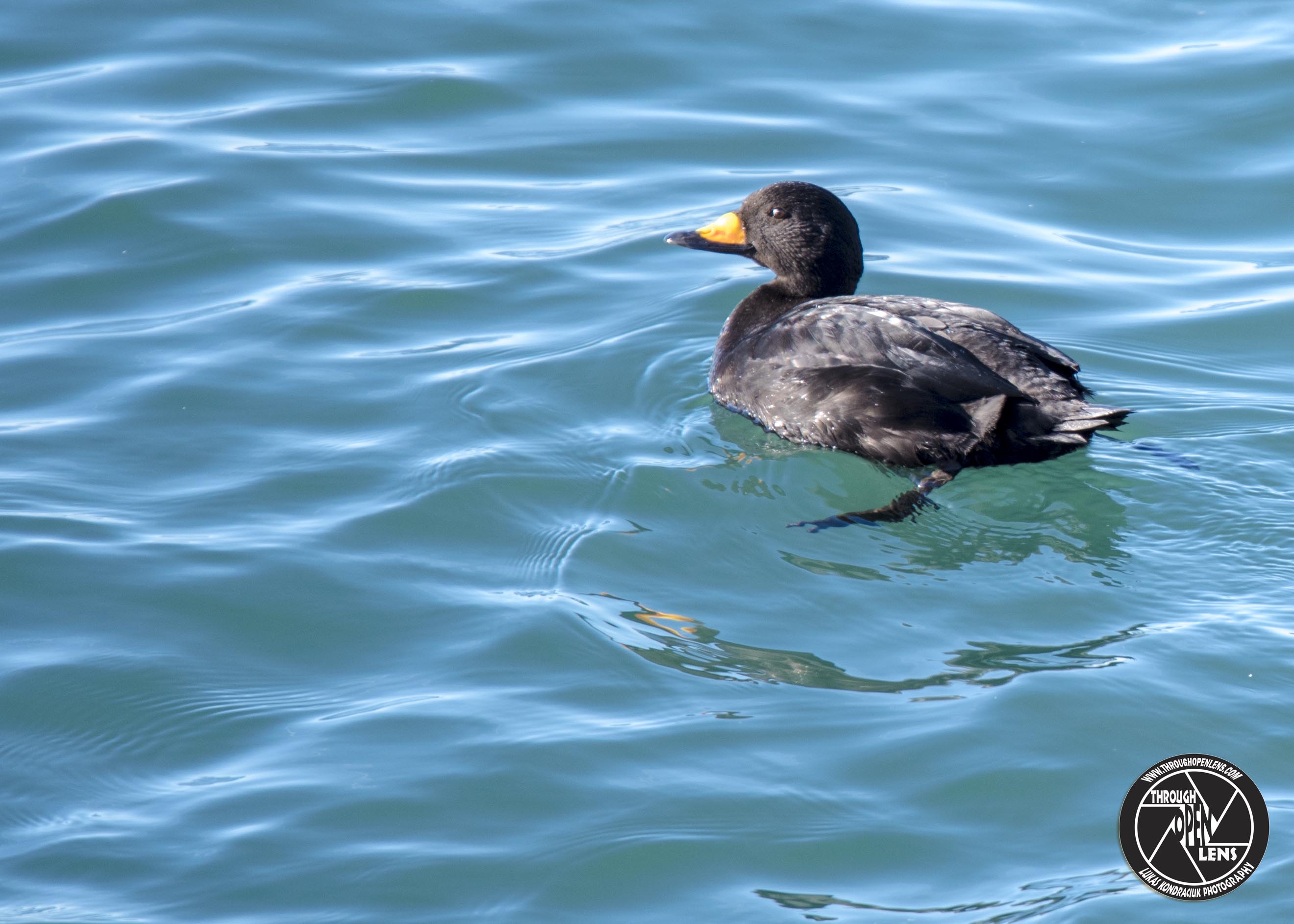
Eat Pasta Swim Fasta!

F/7.1, 1/200, ISO 200.

Black Scoter Duck

Want to hear a construction joke?

Oh never mind, I’m still working on that one.

Interesting Fact: The lined nest is built on the ground close to the sea, lakes or rivers, in woodland or tundra. 5–7 eggs are laid. Each eggs weighs from 60–74 g (2.1–2.6 oz), or 8% of the females body weight. The incubation period may range from 27 to 31 days. Females brood their young extensively for about 3 weeks, after which the still flightless young must fend for themselves. ( https://en.wikipedia.org/wiki/Black_scoter )

Waiting Here For You

F/13.0, 1/640, ISO 320.

Great Black-backed Gull

Four high school boys afflicted with spring fever skipped morning classes. After lunch they reported to the teacher that they had a flat tire.

Much to their relief she smiled and said, “Well, you missed a test today so take seats apart from one another and take out a piece of paper.”

Still smiling, she waited for them to sit down. Then she said: “First Question: Which tire was flat?”

Interesting Fact: The Great Black-backed Gull is one of many bird species whose feathers were used for fashionable clothing in the 1800s. After the demise of the feather trade in the early 1900s, Great Black-backed Gull populations increased and spread farther south. Garbage dumps and other sources of human refuse have contributed to their range expansion. ( https://www.allaboutbirds.org/guide/Great_Black-backed_Gull/lifehistory )

I Just Love The Way I Feel, Hmmm.

F/11.0, 1/500, ISO 200.

Mute Swan

What do clouds do when they become rich?

They make it rain!

Interesting Fact: Mute Swans form long-lasting pair bonds. Their reputation for monogamy along with their elegant white plumage has helped establish them as a symbol of love in many cultures. ( https://www.allaboutbirds.org/guide/Mute_Swan/lifehistory )

Life Is Better When You’re Laughing

F/11.0, 1/500, ISO 320.

Laughing Gull  

Why do hamburgers go to the gym?

To get better buns

Interesting Fact: The Laughing Gull is normally diurnal, or active during the day. During the breeding season it forages at night as well. It usually looks for food along the beach at night, but will also hover to catch insects around lights. ( https://www.allaboutbirds.org/guide/Laughing_Gull/lifehistory )


Be Like A Duck. Remain Calm On The Surface And Paddle Like Hell Underneath.

F/7.1, 1/200, ISO 200.

Black Scoter

What did the blanket say when it fell off the bed?

Oh sheet.

Interesting Facts: This species dives for crustaceans and molluscs while migrating or wintering on the sea-coasts, and feeds on insects and their larvae, especially caddisflies, fish eggs and, more rarely, vegetation such as duck weed while nesting on freshwater. It forms large flocks on suitable coastal waters in winter quarters. These are tightly packed, and the birds tend to take off together; in the breeding season they are less social. It has been suggested that in coastal waters this species prefers sheltered embayments, and possibly waters that include some mixed depths. ( https://en.wikipedia.org/wiki/Black_scoter )


Don’t Be Jealous Of My Beak.

F/9.0, 1/320, ISO 640.

Common Loon 

Why is sex like math?

You add a bed, subtract the clothes, divide the legs, and pray there’s no multiplying!

Interesting Fact: A hungry loon family can put away a lot of fish. Biologists estimate that loon parents and their 2 chicks can eat about a half-ton of fish over a 15-week period.  ( https://www.allaboutbirds.org/guide/Common_Loon )

Why You All Up In My Business!

osprey

F/5.6, 1/500, ISO200.

Osprey

What does the man in the moon do when his hair gets too long?

Eclipse it!

Interesting Fact: Ospreys hunt by diving to the water’s surface from some 30 to 100 feet (9 to 30 meters) up. They have gripping pads on their feet to help them pluck fish from the water with their curved claws and carry them for great distances. In flight, ospreys will orient the fish headfirst to ease wind resistance. ( https://www.nationalgeographic.com/animals/birds/o/osprey/ )