Hey There Ace!

F/6.3, 1/500, ISO 220.

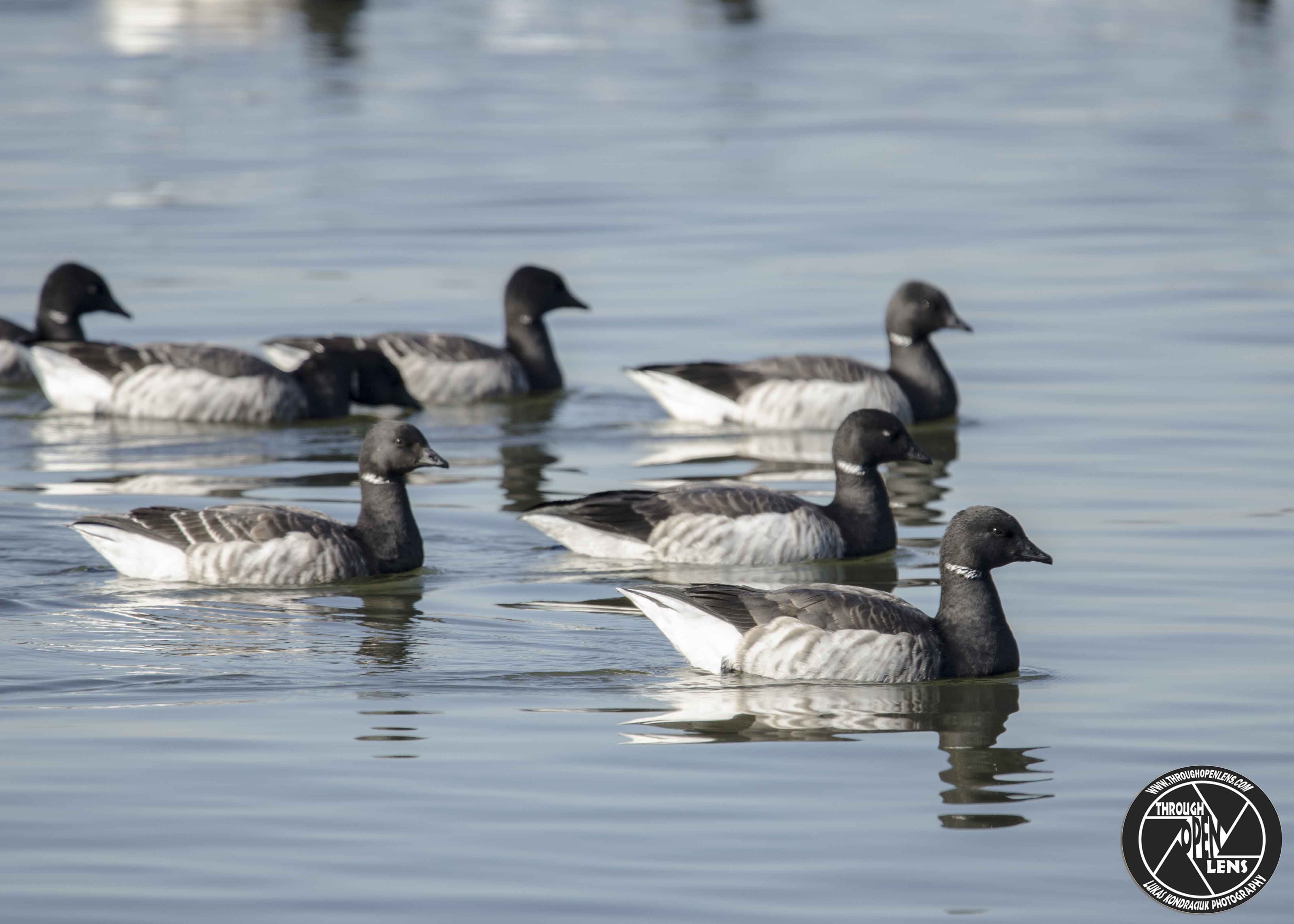
Brant Goose

What did the big flower say to the little one?

You’re really growing, bud!

Interesting Fact: The oldest recorded Brant was a female, and was over 27 years, 6 months old. It had been banded in Alaska and was found in Washington. ( https://www.allaboutbirds.org/guide/Brant )

That’s Not A Wild Goose Chase. That’s Bingo.

F/7.1, 1/200, ISO 400.

Domestic Geese in Wild

Which two letters in the alphabet are always jealous?

NV.

Interesting Fact: In Europe, northern Africa, and western Asia, the original domesticated geese are derived from the greylag goose Anser anser. In eastern Asia, the original domesticated geese are derived from the swan goose Anser cygnoides; these are commonly known as Chinese geese. Both have been widely introduced in more recent times, and modern flocks in both areas (and elsewhere, such as Australia and North America) may consist of either species, and/or hybrids between them. Chinese geese may be readily distinguished from European geese by the large knob at the base of the bill, though hybrids may exhibit every degree of variation between them. ( https://en.m.wikipedia.org/wiki/Domestic_goose )

Family Are Like Fudge… Mostly Sweet With A Few Nuts.

F/6.3, 1/160, ISO 100.

Canada Goose and Goslings 

What did the baby corn say to the mama corn?

Where’s POP corn?

Interesting Fact: During spring, pairs break out from flocks and begin defending territories. Spacing of these pairs is variable and depends on availability of nest sites and population density; where population is large, even after a great many fights birds may end up nesting in view of one another, and some populations are semi-colonial. ( https://www.allaboutbirds.org/guide/Canada_Goose/lifehistory )

DON’T PANIC!

F/5.6, 1/500, ISO 360.

Canada Goose 

A man goes to his doctor because he’s been feeling very ill for days. The doctor gives him several sets of pills.

The doctor instructs; “Take the green pill with two big glasses of water when you get up. An hour later, take the white pill with another glass of water. Take the blue pill with a big glass of water after lunch. Mid afternoon, take the orange pill with plenty of water, and repeat that at dinner. Then, just before going to bed, take the red pill with several big glasses of water.”

The man is alarmed at huge volume of medicine he has been given to take, and nervously asks, “What’s the diagnosis? What’s wrong with me?”

The doctor says, “You’re dehydrated.”

Interesting Fact: The “giant” Canada Goose, Branta canadensis maxima, bred from central Manitoba to Kentucky but was nearly driven extinct in the early 1900s. Programs to reestablish the subspecies to its original range were in many places so successful that the geese have become a nuisance in many urban and suburban areas.  ( https://www.allaboutbirds.org/guide/Canada_Goose/lifehistory )

If You Can’t Convince Them, Confuse Them.

F/6.3, 1/500, ISO 200.

Brant

What kind of shoes do you make with banana skins?

Slippers!

Interesting Fact: The Brant is also known as the Brent Goose. The spelling “Brant” is the original one, with “Brent” being a later folk-etymological idea that it was derived from a classical Greek water bird name brenthos. It actually came from the guttural call note of the species. ( http://identify.whatbird.com/obj/290/overview/Brant.aspx )


That’s Despicable!

F/10.0, 1/1600, ISO 800.

Canada Goose 

How do we know that insects are so clever?

Because they always know when your eating outside!

Interesting Fact: They mate for life with very low “divorce rates,” and pairs remain together throughout the year. Geese mate “assortatively,” larger birds choosing larger mates and smaller ones choosing smaller mates; in a given pair, the male is usually larger than the female. ( https://www.allaboutbirds.org/guide/Canada_Goose/lifehistory )


I Trying To Get My Duck In The Row But I Got Geese Instead!

F/7.1, 1/200, ISO 250.

Canada Goose and Goslings

What did the triangle say to the circle?

Your pointless!

Interesting Fact:  In spring and summer, geese concentrate their feeding on grasses and sedges, including skunk cabbage leaves and eelgrass. During fall and winter, they rely more on berries and seeds, including agricultural grains, and seem especially fond of blueberries. They’re very efficient at removing kernels from dry corn cobs. Two subspecies have adapted to urban environments and graze on domesticated grasses year round. ( https://www.allaboutbirds.org/guide/Canada_Goose/lifehistory )

Happy Mother’s Day To Every Mom Out There! 

Happy Mother’s Day!

Canada Goose 3
F/4.8, 1/800, ISO 100.

Canada Goose

Son asked his mom a question about computers

Son: Why is a computer so smart mom?

Mom: It listens to its motherboard.

Interesting Fact: The modern holiday of Mother’s Day was first celebrated in 1908, when Anna Jarvis held a memorial for her mother at St Andrew’s Methodist Church in Grafton, West Virginia. Today St Andrew’s Methodist Church now holds the International Mother’s Day Shrine.[6] Her campaign to make “Mother’s Day” a recognized holiday in the United States began in 1905, the year her mother, Ann Reeves Jarvis, died. Ann Jarvis had been a peace activist who cared for wounded soldiers on both sides of the American Civil War, and created Mother’s Day Work Clubs to address public health issues. Anna Jarvis wanted to honor her mother by continuing the work she started and to set aside a day to honor all mothers, because she believed that they were “the person who has done more for you than anyone in the world”. ( https://en.m.wikipedia.org/wiki/Mother%27s_Day )

Lifeguard Is On Duty!

Canada Goose And Goslings

F/5.6, 1/500, ISO 200.

Canada Goose And Goslings 

Why won’t they allow elephants in public swimming pools?

Because they might let down their trunks.

Interesting Fact: Individual Canada Geese from most populations make annual northward migrations after breeding. Nonbreeding geese, or those that lost nests early in the breeding season, may move anywhere from several kilometers to more than 1500 km northward. There they take advantage of vegetation in an earlier state of growth to fuel their molt. Even members of “resident” populations, which do not migrate southward in winter, will move north in late summer to molt.  ( https://www.allaboutbirds.org/guide/Canada_Goose/lifehistory )

Silly Goose!

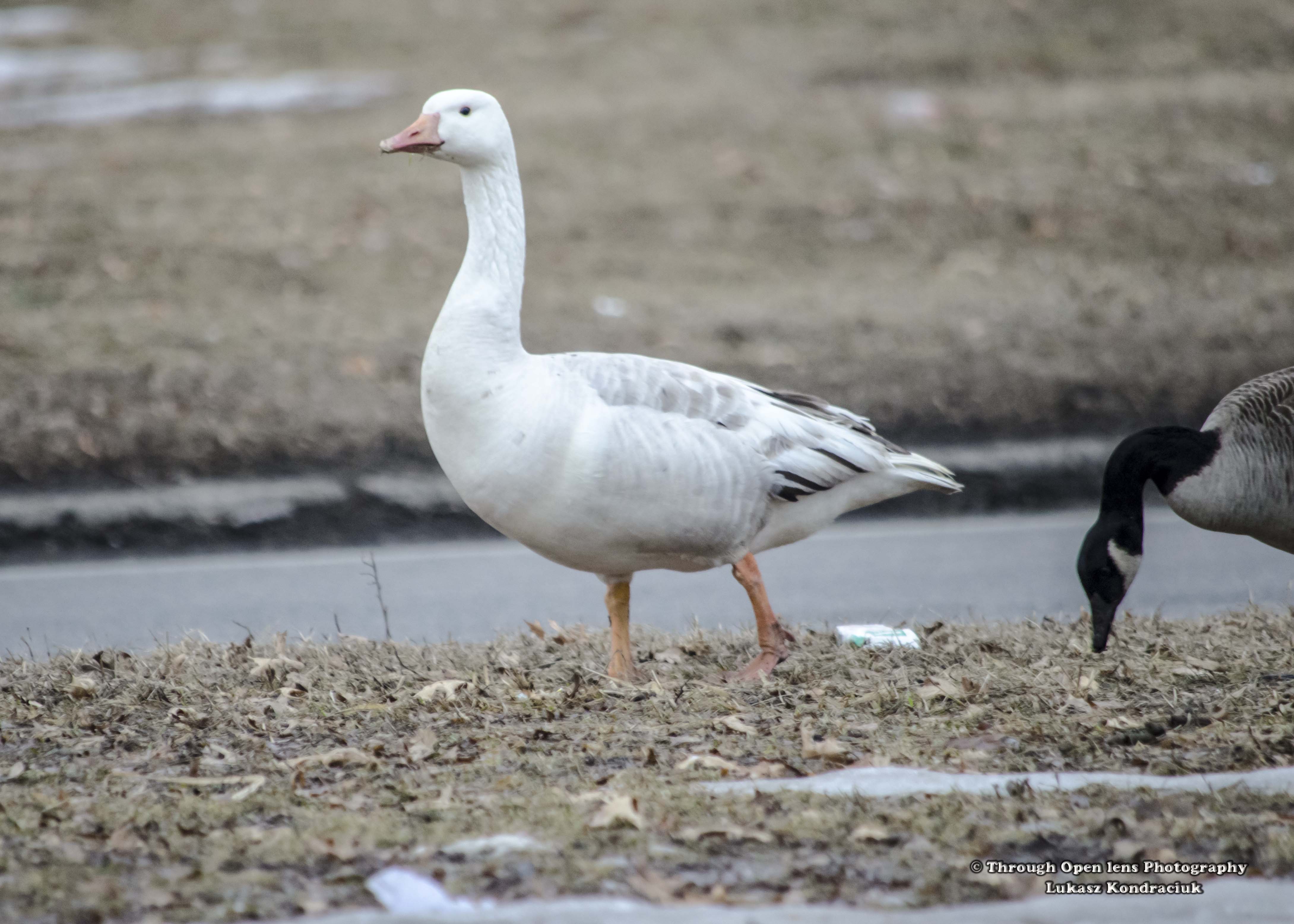
Snow Goose

F/ 5.6, 1/125, ISO 1600.

Snow Goose

What grows down, when it grows up?

A goose.

Interesting Fact:  Snow Goose hunting in the eastern United States was stopped in 1916 because of low population levels. Hunting was allowed again in 1975 after populations had recovered. Since then, their populations have continued to grow, to the point that some areas of tundra nesting habitat are starting to suffer. ( https://www.allaboutbirds.org/guide/Snow_Goose/lifehistory )