Always Be Yourself… Unless You Can Be A Duck… Then Always Be A Duck.

F/8.0, 1/250, ISO 200. 

Red-breasted Merganser 

Two men meet on opposite sides of a river.

One shouts to the other, “I need you to help me get to the other side!”

The other guy replies, “You’re on the other side!”

Interesting Fact: Red-breasted Mergansers are among the fastest flying ducks, clocking speeds of up to 81 miles per hour.  ( https://www.allaboutbirds.org/guide/Red-breasted_Merganser/lifehistory )


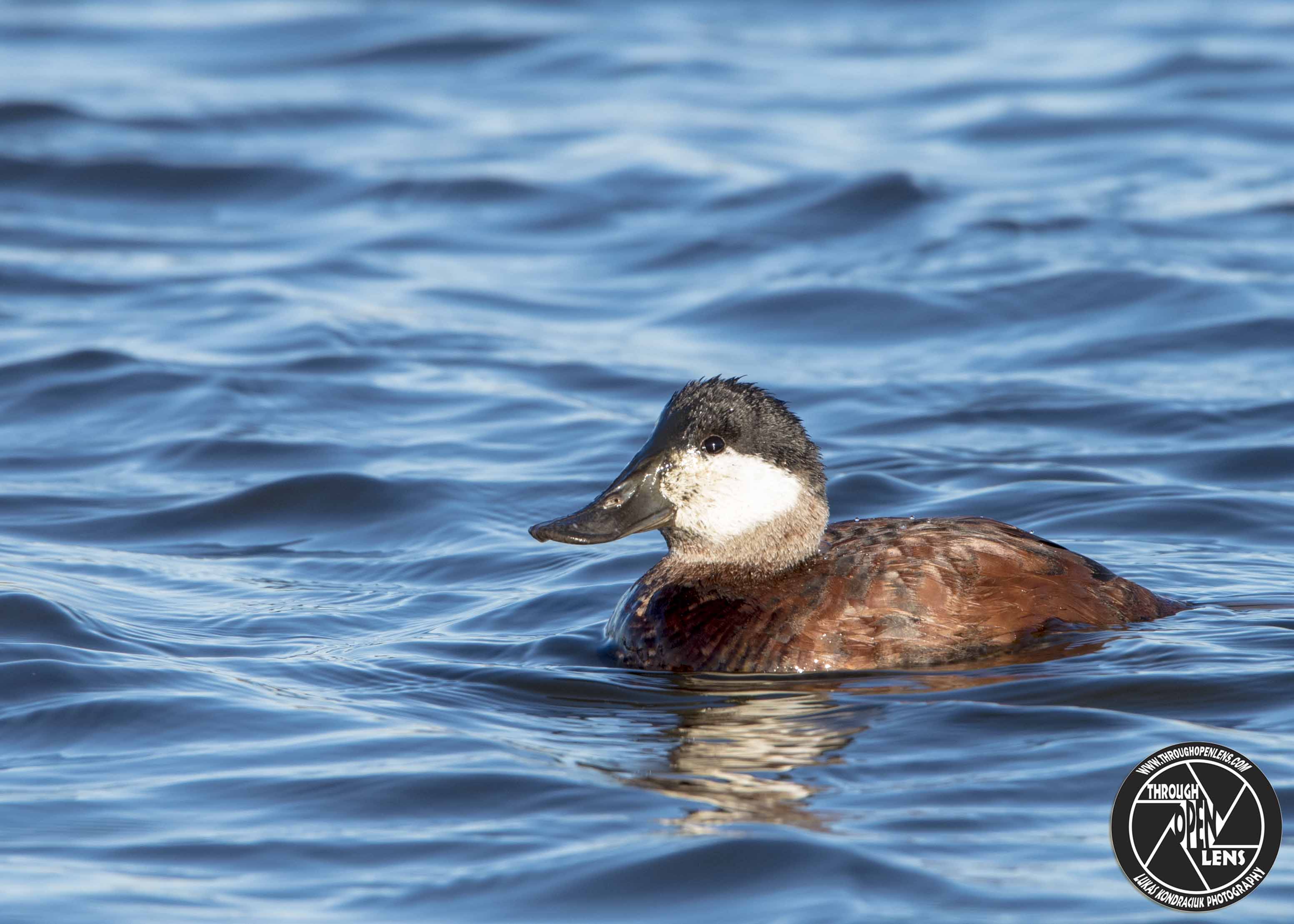
Welcome To The Duck Side. We Have Quackers.

F/9.0, 1/320, ISO 320.

Ruddy Duck 

Why didn’t my girlfriend believe I was a ghost?

She could see right through me.

Interesting Fact:  The nest is usually made of dead, dry plant materials, though some are built entirely with green vegetation. It starts as a platform and becomes more bowl-like throughout the construction process, with an inner cup measuring 4–12 inches across and 0.5–5 inches deep. Ruddy Ducks usually weave a canopy of vegetation over their nests. ( https://www.allaboutbirds.org/guide/Ruddy_Duck/lifehistory )

Bad Hair Day: Ain’t Nobody Got Time For That!

F/9.0, 1/320, ISO 200.

Red-breasted Mergansers 

Can February March?

No, but April May.

Interesting Fact:Red-breasted Mergansers nest along forested riverbanks, marsh edges, lakeshores, coastal islands, and sandy shores with vegetation. They are never far from water. Female Red-breasted Mergansers select a spot on the ground under dense cover from low tree branches, fallen logs, or boulders. They nest alone or in colonies often with gulls and terns. ( https://www.allaboutbirds.org/guide/Red-breasted_Merganser/lifehistory )


A Wise Duck Once Told Me “QUACK” And He Meant It!

F/7.1, 1/200, ISO 125.

White-cheeked pintail

Why did the student wear eye-glasses in math class?

It improved DiVision!

Interesting Fact: White-cheeked Pintail: Large, heavily spotted dark and light brown duck with striking white cheek patches, blue bill with bright red base, buff pointed tail. Legs and feet are blue-gray. Feeds on aquatic plants, small invertebrates. Swift direct flight with strong rapid wing beats. AKA Bahama Duck. ( https://identify.whatbird.com/obj/1029/overview/White-cheeked_Pintail.aspx )

Drink Water Suprise Your Liver!!

F/8.0, 1/250, ISO 200.

Wood Duck

Want to hear a pizza joke…. nah, it’s too cheesy.

What about a construction joke? Oh never mind, I’m still working on that one.

Interesting Fact:  Courting males swim before a female with wings and tail elevated, sometimes tilting the head backwards for a few seconds. Males may also perform ritualized drinking, preening, and shaking movements. Both members of a pair may preen each other. (  https://www.allaboutbirds.org/guide/Wood_Duck/lifehistory  )

Be Your Self Everyone Else Is Already Taken!

F/6.3, 1/400, ISO 1600.

Hooded Merganser ( Male )

Did you hear that all the toilets at the police station were stolen?

Yeah… the cops got nothing to go on.

Interesting Fact: Hooded Merganser ducklings leave their nest cavity within 24 hours of hatching. First, their mother checks the area around the nest and calls to the nestlings from ground level. From inside the nest, the little fluffballs scramble up to the entrance hole and then flutter to the ground, which may be 50 feet or more below them. In some cases they have to walk half a mile or more with their mother to the nearest body of water. ( https://www.allaboutbirds.org/guide/Hooded_Merganser )

I Am Coming For You!

F/11.0, 1/500, ISO 400.

Ruddy Duck ( Juvenile ) 

Why are elephants such poor dancers?

Because they have two left feet.

Interesting Fact: Ruddy Ducks get harassed by Horned Grebes, Pied-billed Grebes, and American Coots during the breeding season. The grebes sometimes attack Ruddy Ducks from below the water, a behavior known as “submarining.” ( https://www.allaboutbirds.org/guide/Ruddy_Duck )

Go Ahead… Make My Day!

F/6.3, 1/500, ISO 250.

Hooded Merganser ( Female )

What insect runs away from everything?

A flea!

Interesting Fact: Once a female begins incubating eggs her mate abandons her, and it’s not known if they reunite the following season. Incubating females may use a broken-wing display to protect eggs or nestlings from raccoons, mink, black rat snakes, black bears, pine martens, European Starlings, Northern Flickers, Red-headed Woodpeckers, and Red-bellied Woodpeckers. ( https://www.allaboutbirds.org/guide/Hooded_Merganser/lifehistory )


In Three Words I Can Sum Up Everything I’ve Learned About Life. IT GOES ON.

F/6.3, 1/640, ISO 200.

Canvesback

What do you call it when you have your Grandma on speed dial?

Instagram

Interesting Fact: Canvasbacks are social outside of the breeding season; they gather in large rafts by the thousands to tens of thousands. Only when winter food is scarce or clumped do they defend foraging areas against other Canvasbacks. ( https://www.allaboutbirds.org/guide/Canvasback/lifehistory )


People Say Nothing Is Impossible, But I Do Nothing Every Day.

F/10.0, 1/400, ISO 250.

Ruddy Duck 

Why are mountains so funny?

Because they are hill areas.

Interesting Fact: Most males pair up with one female each for the duration of the breeding season, but some take multiple mates. Their eggs are proportionally the largest of all waterfowl. The ducklings hatch well-developed and active, receiving minimal care from the mother and none from the father. Ducklings are preyed upon by Black-crowned Night-Herons, Ring-billed Gulls, California Gulls, mink, and raccoons. ( https://www.allaboutbirds.org/guide/Ruddy_Duck/lifehistory )