I Like To Be Alone But I Hate Being Lonely

F/8.0, 1/250, ISO 160.

Common Goldeneye

What did the salad say when the cabbage interrupted their meal?

Lettuce alone!

Interesting Fact: The eyes of a Common Goldeneye are gray-brown at hatching. They turn purple-blue, then blue, then green-blue as they age. By five months of age they have become clear pale green-yellow. The eyes will be bright yellow in adult males and pale yellow to white in females. ( https://www.allaboutbirds.org/guide/Common_Goldeneye )


I Don’t Have To Take This… I’m Going Home.

F/7.1, 1/200, ISO 200.

Black Scoter

Why did the tiny ghost join the football team?

He heard they needed a little team spirit.

Interesting Fact: A coastal duck that breeds in the subarctic, the Black Scoter is not well studied in North America. Only a few nests have ever been found. ( https://www.allaboutbirds.org/guide/Black_Scoter )


Keep Your Beak Clean

F/9.0, 1/320, ISO 640.

Ruddy Duck

Can your mother predict the future with cards?

Yes! She takes one look at my report card and tells me what will happen when my father gets home.

Interesting Fact: The nest is usually made of dead, dry plant materials, though some are built entirely with green vegetation. It starts as a platform and becomes more bowl-like throughout the construction process, with an inner cup measuring 4–12 inches across and 0.5–5 inches deep. Ruddy Ducks usually weave a canopy of vegetation over their nests. ( https://www.allaboutbirds.org/guide/Ruddy_Duck/lifehistory )


I Chill Harder Than You Party!

F/ 6.3, 1/60, ISO 320.

Wood Duck

What are those things you blow on and make wishes?

Breathalyzers

Interesting Fact: They are strong fliers and can reach speeds of 30 mph. Wood Ducks are not territorial, with the exception that a male may fight off other males that approach his mate too closely.  ( https://www.allaboutbirds.org/guide/Wood_Duck/lifehistory )

Quack Like You Mean It!

F/14.0, 1/500, ISO 800.

Black Scoter

This guy went to school and he asked
“May I use the bathroom?”
The teacher replied, ” no not unless you say your abc’s.”
The guy said “a b c d e f g h i j k l m n o q r s t u v w x y z.”
The teacher asked “Where’s the p?
He replied, ” running down my leg!”

Interesting Fact:  The Black Scoter occasionally does a “Wing-flap” display while swimming, flapping its wings with its body held up out of the water. Unlike other scoters, it almost always punctuates a Wing-flap with a characteristic downward thrust of head, as if its neck were momentarily broken. Surf and White-winged scoters keep their heads and bills pointing more or less above the horizontal throughout a Wing-flap.  ( https://www.allaboutbirds.org/guide/Black_Scoter/lifehistory )

Once You Stop Chasing The Wrong Things, The Right Ones Catch You.

F/9.0, 1/320, ISO 160.

Wood Duck

How does a man show he’s planning for the future?

He buys two cases of Beer instead of one.

Interesting Fact: Wood ducks cavities are typically places where a branch has broken off and the tree’s heartwood has subsequently rotted. Woodpecker cavities are used less frequently. Wood Ducks cannot make their own cavities. The nest tree is normally situated near to or over water, though Wood Ducks will use cavities up to 1.2 miles from water. ( https://www.allaboutbirds.org/guide/Wood_Duck/lifehistory )


Little Duckies Need Some Snackies

F/5.6, 1/160, ISO 100.

Mallard Female with Ducklings

Who earns a living driving their customers away?

A taxi driver.

Interesting Fact:  The female forms a shallow depression or bowl on the ground in moist earth. She does not carry material to the nest but rather pulls vegetation she can reach toward her while sitting on nest. During egg-laying phase, she lines the nest with grasses, leaves, and twigs from nearby. She also pulls tall vegetation over to conceal herself and her nest. After incubation begins, she plucks down feathers from her breast to line the nest and cover her eggs. The finished nest is about a foot across, with a bowl for the eggs that is 1–6 inches deep and 6–9 inches across. ( https://www.allaboutbirds.org/guide/Mallard/lifehistory )


You Really Quack Me Up!

F/10.0, 1/400, ISO 320.

Ruddy Duck

Did you hear about the duck who thought he was a squirrel?

It was one tough nut to quack.

Interesting Fact: Migrating Ruddy Ducks stop in a variety of habitats, most often on large, permanent wetlands, lakes, and reservoirs. They spend the winter throughout the southern half of the breeding range, also moving into wintering habitat that spans most of the United States and extends through Mexico to Central America. Their wintering habitat includes freshwater wetlands, lakes, and reservoirs as well as brackish bays, coastal marshes, and tidal estuaries. ( https://www.allaboutbirds.org/guide/Ruddy_Duck/lifehistory )

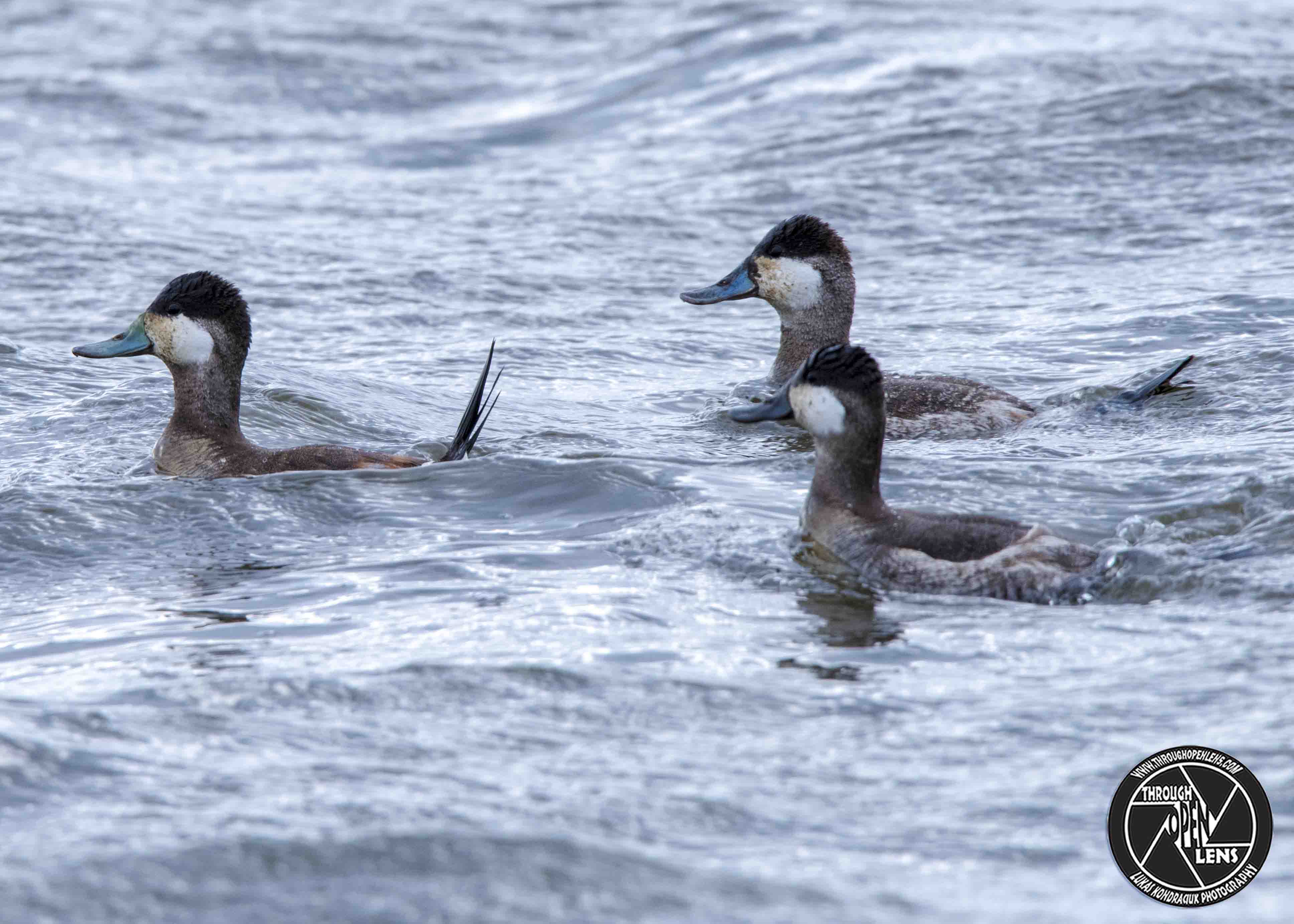
You Know What Guys I Am Getting Sick Of The V Formation!

F/10.0, 1/400, ISO 640.

Ruddy Duck

What do you get when you put four ducks in a box?

A box of quackers!

Interesting Fact: The Ruddy Duck has spiky tail feathers that are used in courtship displays. ( http://identify.whatbird.com/obj/116/overview/Ruddy_Duck.aspx )

Let’s Swim Away Together!

F/9.0, 1/320, ISO 200.

Wood Ducks

A man and a woman have just had their 50th wedding anniversary.

The husband turns to his wife and asks, “What do you want to do to celebrate our anniversary dear?”

She replies, “Let’s run upstairs and make love.”

He turns to her and says, “Well make up your mind, we can’t do both!”

Interesting Fact: Egg-dumping, or “intraspecific brood parasitism” is common in Wood Ducks—females visit other Wood Duck cavities, lay eggs in them, and leave them to be raised by the other female. This may have been made more common by the abundance and conspicuousness of artificial nest boxes; in some areas it happens in more than half of all nests. Individual females typically lay 10-11 eggs per clutch, but some very full nests have been found containing 29 eggs, the result of egg-dumping. ( https://www.allaboutbirds.org/guide/Wood_Duck/lifehistory#behavior )