Do Ants Carry Ten Times Their Own Weight In Emotional Baggage?

F/8.0, 1/200, ISO 320.

Ant

Why was the baby ant confused?

Because all his uncles were ants.

Interesting Fact: Ants communicate with each other using pheromones, sounds, and touch.[71] The use of pheromones as chemical signals is more developed in ants, such as the red harvester ant, than in other hymenopteran groups. Like other insects, ants perceive smells with their long, thin, and mobile antennae. The paired antennae provide information about the direction and intensity of scents. Since most ants live on the ground, they use the soil surface to leave pheromone trails that may be followed by other ants. In species that forage in groups, a forager that finds food marks a trail on the way back to the colony; this trail is followed by other ants, these ants then reinforce the trail when they head back with food to the colony. When the food source is exhausted, no new trails are marked by returning ants and the scent slowly dissipates. This behaviour helps ants deal with changes in their environment. For instance, when an established path to a food source is blocked by an obstacle, the foragers leave the path to explore new routes. If an ant is successful, it leaves a new trail marking the shortest route on its return. Successful trails are followed by more ants, reinforcing better routes and gradually identifying the best path. ( https://en.wikipedia.org/wiki/Ant#Behaviour_and_ecology )


It’s My Honey, And I Want It Now!

F/5.6, 1/125, ISO 500.

Bumble Bee

What do you call a bee born in May?

A maybe!

Interesting Fact: Unlike the honeybee, bumblebees will not die after stinging. They can sting as much as they want. Luckily, they are not aggressive and they will sting only in self defense. ( http://www.softschools.com/facts/animals/bumblebee_facts/582/ )

Something Is Flickering!

F/6.3, 1/160, ISO 640.

Northern Flicker

What did the math book say to its therapist?

I’ve got a lot of problems.

Interesting Fact: Northern Flickers usually excavate nest holes in dead or diseased tree trunks or large branches. In northern North America look for nests in trembling aspens, which are susceptible to a heartrot that makes for easy excavation. Unlike many woodpeckers, flickers often reuse cavities that they or another species excavated in a previous year. Nests are generally placed 6-15 feet off the ground, but on rare occasions can be over 100 feet high. Northern Flickers have been known to nest in old burrows of Belted Kingfishers or Bank Swallows. ( https://www.allaboutbirds.org/guide/Northern_Flicker/lifehistory )

You Had Me AT Meow!

F/6.3, 1/60, ISO 640.

Gray Catbird

Why can’t a bicycle stand up on its own? 

Because it’s two tired.

Interesting Fact: Catbirds usually build nests on horizontal branches hidden at the center of dense shrubs, small trees, or in vines, including dogwood, hawthorn, cherry, rose, elderberry, grape, honeysuckle, and blackberry. Nests are typically around 4 feet off the ground, but may be on the ground or as high as 60 feet. ( https://www.allaboutbirds.org/guide/Gray_Catbird/lifehistory )

I Claim This Branch!

F/7.1, 1/200, ISO 200.

Eastern Phoebe 

Why can’t you take a nap during a race?

Because if you snooze, you loose!

Interesting Fact: The Eastern Phoebe is a loner, rarely coming in contact with other phoebes. Even members of a mated pair do not spend much time together. They may roost together early in pair formation, but even during egg laying the female frequently chases the male away from her. ( https://www.allaboutbirds.org/guide/Eastern_Phoebe/lifehistory )

For That Reason, I’M OUT!

F/8.0, 1/250, ISO 160.

Common Gallinule

Wanna hear a joke about construction?

Never mind, I’m still working on it.

Interesting Fact: Common Gallinules nest in marshes, lakes, and ponds with emergent vegetation. They tend to build nests on top of thick mats of aquatic plants near the water’s edge, but sometimes nest in trees or shrubs. ( https://www.allaboutbirds.org/guide/Common_Gallinule/lifehistory )

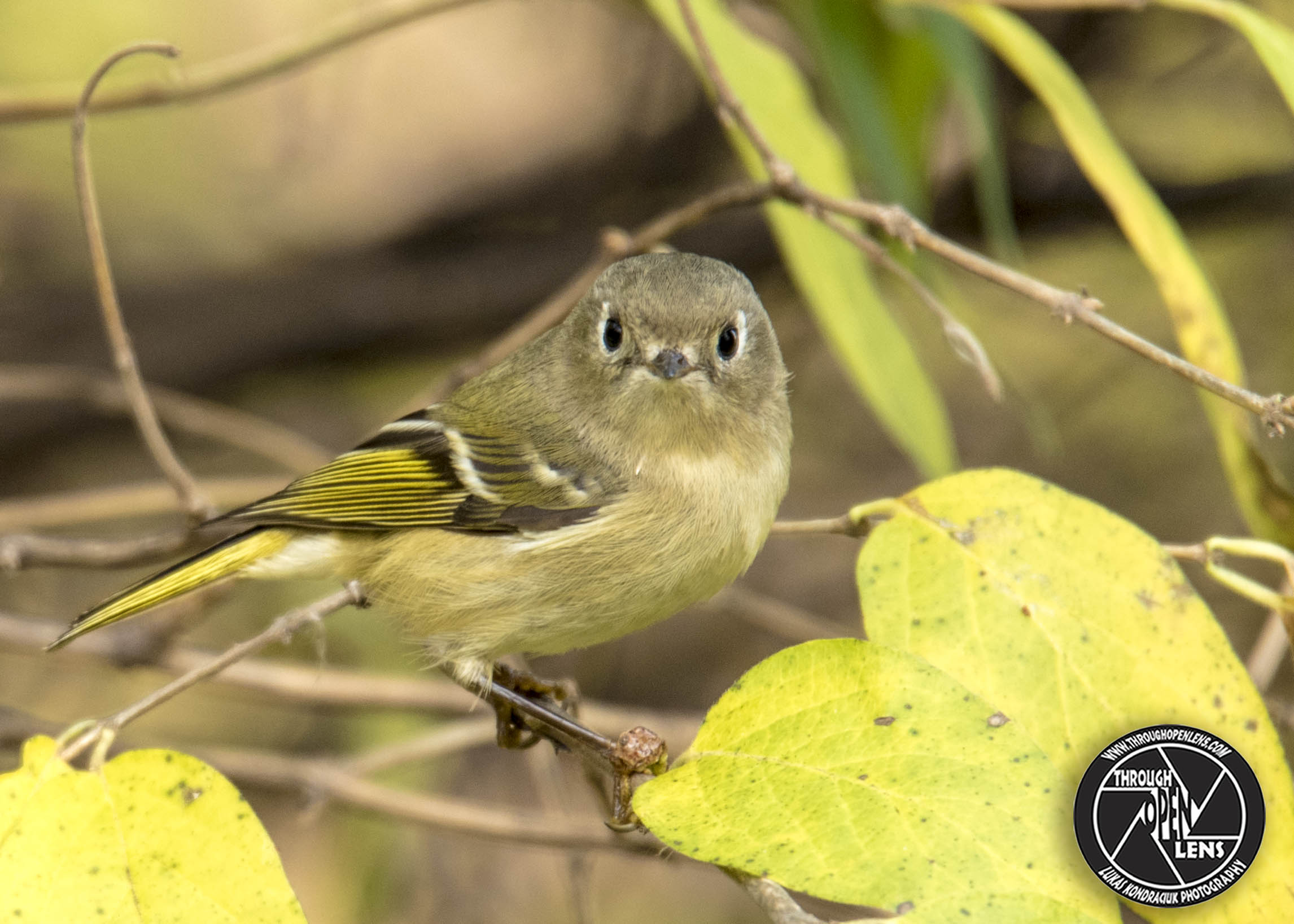
Staring Contest, GO!

F/6.3, 1/125, ISO 320.

Ruby-crowned Kinglet

What did the candle say to the other candle?

I’m going out tonight.

Interesting Fact: Metabolic studies on Ruby-crowned Kinglets suggest that these tiny birds use only about 10 calories (technically, kilocalories) per day. ( https://www.allaboutbirds.org/guide/Ruby-crowned_Kinglet/lifehistory )

Oh Stop, You Making Me Blush!

F/6.3, 1/160, ISO 500.

House Finch

What did one hat say to another? 

You stay here, I’ll go on a head.

Interesting Fact: House Finches nest in a variety of deciduous and coniferous trees as well as on cactus and rock ledges. They also nest in or on buildings, using sites like vents, ledges, street lamps, ivy, and hanging planters. Occasionally House Finches use the abandoned nests of other birds. ( https://www.allaboutbirds.org/guide/House_Finch/lifehistory )

Holy Smokes Batman Your Zipper Is Down!

F/9.0, 1/320, ISO 250.

American Robin

What happens when Batman and Robin fight a steamroller?

They become Flatman and Ribbon.

Interesting Fact: Although robins are considered harbingers of spring, many American Robins spend the whole winter in their breeding range. But because they spend more time roosting in trees and less time in your yard, you’re much less likely to see them. The number of robins present in the northern parts of the range varies each year with the local conditions. ( https://www.allaboutbirds.org/guide/American_Robin/lifehistory )

I’m Super Fly!

F/13.0, 1/640, ISO 320.

Northern Harrier

What did one toilet roll say to the other toilet roll? 

“People keep on ripping me off!”

Interesting Fact: Male Northern Harriers can have as many as five mates at once, though most have only one or two. The male provides most of the food for his mates and their offspring, while the females incubate the eggs and brood the chicks. ( https://www.allaboutbirds.org/guide/Northern_Harrier/overview )